
The 2026 Rust Anti-Cheat Stack — Four Layers Deep
Rust's anti-cheat in May 2026 isn't one system. It's four overlapping defenses, and only one of them is the kernel-level scanner most players think about. The other three are server-side or infrastructure-level, and they're where serious cheats die.
Layer 1 — Easy Anti-Cheat (EAC) kernel driver. This is the kernel signature scanner. It sits in ring 0, scans process memory, loaded drivers, and image regions. EAC for Rust is the same product Epic ships across Fortnite, Apex, and dozens of other titles — that gives Facepunch the benefit of Epic's continuous updates without having to staff a kernel-AC team themselves.
Layer 2 — Server-side player culling (since May 2025). This is the change that broke most Rust cheats. Before May 2025, the Rust server transmitted every player's position to every other player in a 200m radius — and "undetected wallhack" was just reading those packets and rendering boxes. After May 2025, the server runs occlusion checks and only transmits position data for players the receiving client can actually see (or could reasonably see in the next ~1 second of movement). Cheat ESP that relied on packet sniffing now sees empty space where enemies used to be. Memory-residue ESP (which reads enemies from the local game state, not packets) still works partially because Rust caches recently-seen players client-side for animation smoothing — but the cache is short. The May 2025 change is publicly documented in the Facepunch Surviving 12 Years devblog.
Layer 3 — Server-side spray-pattern recoil analyzer (since November 2025). This is the change that broke most no-recoil scripts. Rust weapon recoil patterns are deterministic — every gun has a fixed bullet-spread curve that the game applies to your aim. AHK and Logitech scripts compensated by feeding pre-recorded inverse-curves through the mouse driver. Facepunch added a server-side analyzer that watches the player's input stream for statistical regularities — if the inverse-curve is too perfect across enough engagements, the player flags. Their January 2026 devblog confirmed: "EAC has begun additional efforts targeting recoil cheats." Modern cheats use dynamic randomization on the recoil compensation curve so the pattern doesn't read as machine-perfect. The deeper Rust aimbot settings guide covers the math.
Layer 4 — Premium Servers + $15 inventory gate (since March 2025). This isn't an anti-cheat in the kernel sense; it's an economic filter. Premium Servers require a $15 minimum Steam inventory value to join — that means a disposable cheat account needs $15 of Rust skins (or other Steam Workshop items) before it can even log in. Facepunch claims this filters 98% of cheap-account-cycling cheaters because the cost-per-banned-account stops being trivial. The cheap free-cheat-on-fresh-Steam-account economy that powered the wipe-day toxicity for years is now structurally less viable.
Plus the bug bounty. Facepunch's HackerOne program has paid $300K+ to researchers through end of 2025. That's not anti-cheat technology — it's anti-cheat operations. Every public exploit, every cheat bypass methodology that becomes findable, gets reported and patched faster than the cheat-vendor side can iterate. Combine that with the explicit "new third-party anti-cheat layer in 2026" hint in Surviving 12 Years and the practical implication is that the Rust cheat-buying market will keep narrowing through 2026.
296,000 permanent bans · 42,000 temporary bans · 338,000 total · 16,000,000 cheat reports received · 90.8% automated detection · detection-time-to-ban dropped from 10 hours of playtime to under 7 hours during 2025. Source: Facepunch's own devblog.
What May 2025's Server-Side Culling Killed — And What Survived
If you're choosing between Rust cheat providers in 2026, the most important diagnostic question is: does the provider acknowledge the May 2025 culling change, and what specifically still works under it? Vendors who pretend the change didn't happen are shipping you 2024-era ESP that doesn't work.
What culling killed. Naive packet-stream ESP. The 2024 model of "intercept the position-update packets coming from the Rust server, parse them, render boxes" no longer works because the server stopped sending packets for players outside your visible / near-visible cone. ESP cheats that were exclusively packet-based stopped showing enemies entirely after May 2025. Wallhack copy that talks about "see all players within 200m through walls" is misrepresenting the post-May-2025 product.
What survived. Three specific ESP modalities still function under culling:
1. Memory-residue ESP. Rust caches recently-seen players client-side for animation continuity (so a player who runs behind a wall doesn't snap-disappear from your screen). The cache is short — usually 1-3 seconds depending on movement — but it's enough for an ESP to render players who just went behind cover. This is materially less powerful than 2024 ESP, but it's the most reliable post-culling option.
2. Radar (top-down minimap overlay). Radar typically combines memory-residue + audio-cue-derived directional data + dead-body locations + recently-seen extracts to build a top-down map. Because radar fuses multiple signals over time, it survives culling better than naive ESP — it shows you where enemies were and where they probably are now, which is often more actionable than instantaneous through-wall vision.
3. World ESP (loot, monuments, buildings). Loot positions, monument extract points, locked-crate timers, sleeping-bag spawn locations, and base structure positions are all server-side persistent state, not player position state, so they're unaffected by player culling. World ESP on Rust is actually MORE valuable than player ESP in 2026 because it gives you the routing information that decides whether a raid is worth attempting.
The marketing tell. A Rust cheat that markets "player ESP through walls" in 2026 as its flagship feature either (a) is using memory-residue ESP and being misleading about its range, (b) is using radar and labeling it ESP, or (c) is selling you a 2024 product that doesn't work. Look for vendors who specifically address the May 2025 change — that's the signal of current-generation engineering.
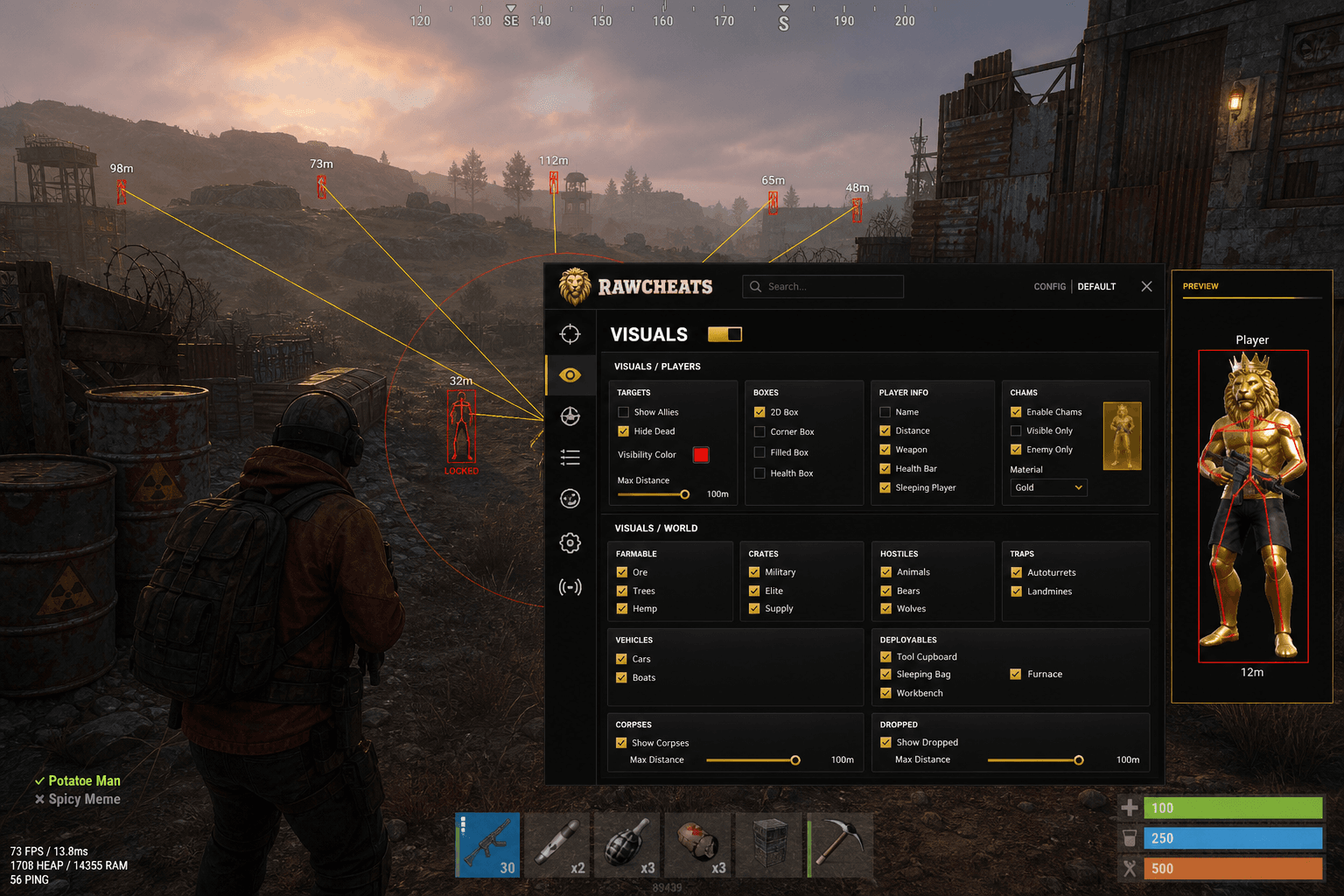
What Raw Rust ships. Memory-residue ESP with configurable cache window, radar with size/position/zoom sliders + FOV cone overlay, plus the full World ESP suite (Farmable, Crates, Hostiles, Traps, Vehicles, Deployables — six entity categories with per-class toggles). The product page has the current feature list; the Rust ESP / loot ESP cluster goes deeper on each.
The November 2025 Spray Analyzer — Why No-Recoil Scripts Stopped Working
If you bought a Rust cheat with no-recoil in 2024 and it worked, but the same product stopped working in late 2025 or early 2026, this is why. Facepunch quietly shipped a behavioral analyzer that targets a specific class of macro scripts, and it kills them deterministically.
The technical setup. Rust weapon recoil is a known curve — every gun has a fixed pattern that the game applies as a sequence of camera-rotation deltas during a sustained burst. Players who learned the spray patterns by hand could compensate manually but the skill ceiling on perfect compensation is high. AHK and Logitech G-Hub scripts let players record the inverse curve once (or download community-shared inverse curves) and replay them through the mouse driver during a spray, producing pixel-perfect recoil compensation that's far better than human.
What Facepunch shipped. A server-side analyzer that watches the input stream coming from each player's client. The analyzer compares the player's actual mouse-movement curve during a sustained spray against the expected human-error distribution for that weapon's pattern. If the player's curve is too statistically perfect across multiple engagements, the analyzer flags. Facepunch's January 2026 devblog noted that "EAC has begun additional efforts targeting recoil cheats" — that's the public confirmation of the analyzer.
What survives, what doesn't. Static no-recoil scripts (pre-recorded inverse curve replayed identically every spray) die first. Slightly-randomized scripts last longer but the analyzer's threshold is tuned tight enough that even ±5% randomization isn't sufficient — the underlying curve is still too obviously machine-generated. What survives is dynamic recoil compensation: the cheat reads the weapon's actual fired-shots state, computes the inverse compensation in real time with per-shot jitter drawn from a believable human-error distribution, and feeds that through the input pipeline. The Rust aimbot settings cluster covers the tuning specifics.
The marketing tell. A vendor that still markets "undetectable no-recoil scripts" or "Logitech G-Hub compatibility" in 2026 is selling you a product that was last competitive in 2024. Modern Rust cheats integrate recoil compensation into the aim assist subsystem with dynamic randomization, not as a standalone script.
What Raw Rust ships. Recoil control with dynamic compensation curves, no-spread, no-sway toggles, plus the rest of the misc panel (Instant Eoka, Instant Compound, Thick Bullet, Rapid Fire). The recoil compensation specifically is built around per-shot dynamic randomization to survive the November 2025 analyzer — this is the kind of engineering that requires writing your own code rather than reselling someone else's.
Feature by Feature — What Still Works in 2026 Rust
The cheats that survive 2026 Rust are software-based, external (not injected), and built around the post-culling / post-spray-analyzer reality. Here's the feature surface that's actually viable.
Aim assist with the controls that matter. Bone priority (Head / Chest / Arms / Legs as a draggable priority order), FOV cone (0-100% — Rust's first-person camera benefits from tighter cones than third-person games), smoothness (0-500 slider), visible-only filter for ranged engagements, auto bullet-drop prediction (Rust has meaningful drop at 150m+), aim key with hold / toggle / always modes, controller input support. Tournament-tier tuning is unusual in Rust because there's no tournament scene, but tight cones + high smoothness produce stream-safe aim curves.
Memory-residue player ESP. Configurable cache window, box style options, head dots, skeletons, name + distance + weapon labels, snaplines, health bars where readable, sleeping-player flag (a Rust-specific UX — knowing whether the player you're seeing through the cache is currently asleep changes the engagement decision). All per-toggle, all color-configurable.
Six-category World ESP. FARMABLE (ore nodes, trees, hemp), CRATES (military crate, elite crate, supply drop, locked crate with timer), HOSTILES (NPCs, bears, wolves, scientists), TRAPS (autoturrets, shotgun traps, landmines, bear traps), VEHICLES (cars, boats, helicopters, horses), DEPLOYABLES (Tool Cupboard, Sleeping Bag, Workbench, Furnace, Camera, Repair Bench, Mixing Table). The Tool Cupboard ESP specifically is the highest-value world-ESP feature for raid scouting — knowing exact TC location decides whether a base is raidable.
Configurable radar. Size, position X/Y, zoom, max distance — fully draggable mini-map overlay. Renders memory-residue players + loot caches + extract points + recently-seen positions. In Rust ranked / raid scouting this is frequently the most-used overlay.
Misc panel (the Rust-flavored utilities). Instant Eoka (eliminates the 50% misfire chance on the Eoka pistol), Instant Compound (eliminates the bow-pull delay), Thick Bullet (server-side bullet-hitbox amplification — projectiles register hits within a wider radius), Rapid Fire (semi-auto rate-of-fire ceiling removal), recoil control with dynamic compensation. Some of these are firmly in exploit territory and should be used cautiously; the Misc panel surfaces them with the understanding that they're high-attention features.
HWID spoofer is mandatory. Same logic as every modern AC: EAC's hardware fingerprint runs at session start before the cheat loads, so a previously-flagged HWID is recognized immediately. Always pair Rust cheats with Raw Spoofer; the cross-EAC ban risk is real (an EAC ban on Rust can affect other EAC games on the same hardware fingerprint).
What doesn't survive 2026. Naive packet-stream ESP (May 2025 culling killed it). Static no-recoil scripts via AHK/G-Hub (November 2025 analyzer kills them). Free cheats from GitHub (Lumma/Vidar 2.0 payloads). DMA hardware is still viable for Rust specifically (no IOMMU mandate like Fortnite) but the cost-of-ownership math is poor when software cheats handle every Rust-specific need at $4.99-$15/month.
Rust Ban Wave History 2024-2026
Facepunch's transparency makes Rust's ban-wave catalog the most accurate in the cheat-niche industry. Dates are Thursday-anchored (Facepunch's pre-wipe sweep cadence) where applicable.
June 12, 2024 — DMA usage formally permabannable. Coincides with Facepunch's Rules of Conduct update that explicitly listed DMA hardware as a bannable category.
April 2025 — 19,876 permanent bans (single month). Source: Alistair McFarlane (Facepunch dev) on X.
May 2025 — 19,876 perm bans coinciding with server-side culling rollout. The culling deployment caught a cohort of packet-stream ESP users whose cheat continued to send detection-triggering reads after the server changed what it transmitted.
June 2025 — 15,440 permanent bans (single month).
Mid-2025 — Detection-time-to-ban dropped from 10 hours of playtime to ~7 hours.
November 2025 — Server-side spray-pattern recoil analyzer goes live. Specific account count not disclosed but Facepunch's January 2026 devblog confirms the wave specifically targeted recoil-script users.
February 5, 2026 — Naval Update wipe + coinciding large ban wave. First-Thursday-of-month pre-wipe sweep is the Facepunch cadence.
March 6, 2026 — Shipshape Update wipe + coinciding ban wave.
April 3, 2026 — Spring Clean Update wipe + ban wave with tightened recoil heuristics.
May 1, 2026 — Pre-wipe sweep ahead of the May 7 Upgrade Hard / Raid Harder update.
2025 full-year totals: 296,000+ permanent bans, 42,000+ temporary, 338,000+ total enforcement actions. 16M+ cheat reports received. Cumulative all-time: 1M+ permanent bans since 2013. Source: Surviving 12 Years devblog.
The dedicated Rust ban wave history cluster expands each entry above into a full incident report with screenshot evidence from community-tracked sources.
Free Rust Cheats — The Same Infostealer Trap
Same warning as every other game pillar — but with Rust specifically, the free-cheat economy is heavily concentrated on Telegram and Russian-language forums, and the malware payloads are different from the GitHub honeypots that target Fortnite buyers.
The free Rust cheat distribution channels. GitHub repos are common but not the dominant vector for Rust specifically. The bigger channels are Telegram groups ("Free Rust Cheats 2026") and Russian-language forums (LolzTeam, etc.). The free-cheat operators target Rust because Rust's player base skews younger and the wipe-day toxicity cycle creates a constant demand for "just one more wipe" disposable cheats. The malware payload is often Lumma (the same family Microsoft DCU seized 2,300 domains of in May 2025) or RedLine, both of which harvest the same Steam tokens, Discord tokens, browser-saved passwords, and crypto wallet keys we cover in the free cheats warning cluster.
Why Rust-specific is worse. Rust players accumulate Steam Workshop skins over years. The average serious Rust player has $200-$500 in skin inventory on their main Steam account. A successful Lumma exfiltration on a Rust player isn't just "lost cheat money" — it's a Steam inventory that gets liquidated within hours.
The detection-time math. Free cheats hit Facepunch's detection within hours of launch. Public oneclick.ac / cobaltlab.tech style cheats average sub-12-hour detection. The shortest path from "I'll try the free one" to "I lost my main Steam account and my secondary banking" is about 4-8 hours.
Paid Rust cheats start at $4.99/day or ~$20/month depending on tier. The expected-loss math against Lumma infection (which averages $1,000+ in liquidated value per victim per Acronis research) favors paid by orders of magnitude.
Don't join them, don't download from them. The bigger groups are pure malware distribution pipelines. The smaller groups are honeypots for harvesting your Telegram handle to spam-DM other Rust groups. There is no "undetected free Rust cheat" in 2026.
Choosing a Rust Cheat Provider in 2026 — The 7-Test Rubric
Same rubric philosophy as the other pillars but Rust-specific. Run any vendor — including us — through these seven tests.
Test 1 — Do they acknowledge the May 2025 culling change? If a Rust cheat's marketing copy still talks about "player ESP within 200m through walls" without addressing post-culling reality, they're shipping you a 2024 product. Look for explicit references to memory-residue ESP, radar fusion, or world-ESP-first positioning.
Test 2 — Do they acknowledge the November 2025 spray analyzer? A vendor that markets "AHK-compatible no-recoil scripts" or "static recoil compensation" is shipping a product the analyzer will catch. Look for dynamic recoil compensation language.
Test 3 — Reseller or in-house? Battlelog.co specifically is a Rust-cheat reseller marketplace — their loaders source from upstream providers (often Russian) marked up 10-50x. When the upstream eats a wave, every Battlelog customer eats it. We're not in that network. Gulfcheats' Battlelog exposé covers the reseller markup math.
Test 4 — HWID spoofer bundling or sold as separate. Honest model: bundled or low-margin add-on. Predatory model: spoofer sold at premium upsell pricing because the vendor wants you to play un-spoofed and eat a ban, then upsell you the spoofer for recovery. Our spoofer is $4.99 add-on (same as everyone else's cheat-only tier).
Test 5 — Public Discord activity. Real customer conversations, real ban-wave response timing visible to non-customers. Hidden Discords behind paywalls are a red flag for any cheat brand but especially Rust where the wipe-Thursday cadence requires visible status communication.
Test 6 — Refund / warranty in writing. Specific terms for spoofer downtime, AC patching downtime, and license activation. Vague "satisfaction guarantee" isn't a policy.
Test 7 — Public ban-wave transparency. Does the vendor post when they detect their cheat got popped? Honest vendors do — it builds trust through visible response time. Vendors who quietly disable the loader and ship a new build without acknowledgment are betting on customers not noticing.
Cluster: Raw Rust vs PHCheats vs Battlelog runs these tests on the major 2026 Rust vendors with screenshots.
Why Raw Rust Is Built Differently
The directly-product-pitch section. Same template as every pillar; every claim grounded in what the product actually ships, not marketing language.
Everything is in-house. Raw Rust is built by the same team that ships Raw Fortnite, Raw Rivals, Raw Arc Raiders, Raw Overwatch, and Raw PUBG. Same shared SDK, same menu framework, same offset pipeline, same Discord support staff. Most competitor Rust cheat brands are reseller storefronts (Battlelog being the most prominent) — their loaders source from upstream Russian or Eastern European developers and the markup is 10-50x. When the upstream gets popped, every reseller eats it together. We're not in that network.
External cheat (not internal/injected). Raw Rust runs as its own process — doesn't inject code into Rust's runtime. External design is meaningfully harder for EAC's kernel scanner to detect because it can't sweep memory regions it doesn't own. This is one of the reasons our detection windows survive across the monthly Facepunch wipe sweeps when other vendors miss patches.
No DMA required. Pure software. Single machine. The Rust DMA market is still alive (no IOMMU mandate like Fortnite), but the cost-of-ownership at $500-$1,500 in hardware plus monthly firmware doesn't beat software cheats for Rust-specific features. Raw Rust delivers the full feature surface at $4.99/day to $20-something/month.
Shared SDK across six products. When we improve memory-residue ESP techniques, dynamic recoil compensation, or HWID-friendly driver hooks in shared code, all six game cheats benefit on the next build. Single team, single design language, single offset pipeline. The recent menu and infrastructure overhaul that landed across the lineup is one example — Raw Rust got the same upgrade on the same release.
Cross-version, cross-vendor compatibility. Windows 10 + Windows 11. Intel + AMD CPUs. Intel, AMD, NVIDIA GPUs. We test against the broad matrix and fix what breaks rather than restricting to a narrow supported list.
Wipe-day reliability cadence. Facepunch's first-Thursday wipe cadence is the most predictable patch schedule in the cheat-niche industry. We have an internal SLA on shipping a patched build before the post-wipe gameplay session — typically within 6-12 hours of the wipe-day patch landing. Status updates post on the forum and Discord with the build version. The continuously-evolving anti-detection infrastructure is what lets us hit this consistently.
Six-category World ESP with the right defaults. Tool Cupboard ESP is the highest-value world feature for raid scouting and we lead with it. Crate timers, sleeping bag spawn locations, deployable identification — all the Rust-specific UX that lets the cheat actually save you time rather than just enabling kills.
HWID spoofer companion. Raw Spoofer ships separately at $4.99 and we explicitly tell every customer to run it first. The cross-EAC ban risk (a Rust ban affecting Fortnite, Apex, etc.) makes spoofer use non-optional for serious cheat users.
The Wipe-Day Pre-Flight Checklist
Rust's first-Thursday wipe cadence is the most predictable schedule in the cheat-niche industry. The pre-wipe ban sweep + post-wipe rush mean the first 48 hours after a wipe are the highest-risk session for cheaters. Here's the pre-flight.
T-24 hours (Wednesday). Check the forum status board for Raw Rust. If a Facepunch patch is anticipated alongside the wipe (most wipes ship a content patch), confirm the cheat update is queued. Don't pre-play a session that's going to span the wipe — the patch can land mid-session and break detection.
T-0 (Thursday, force wipe). Wait for Raw Rust's status to flip to UNDETECTED for the new game build. Average wait time from wipe to ready-build is 6-12 hours. Don't run the previous build on the post-wipe game — that's the single most-common cause of post-wipe bans because the cheat's offsets are stale and the AC reads inconsistent state.
T+0 to T+12 hours (Thursday afternoon). Once status is UNDETECTED, cold-boot your PC. Run Raw Spoofer FIRST (before opening Steam). Launch Steam. Launch Rust. Inject Raw Rust. Verify the menu opens. Configure your aim, ESP, and radar settings — or load a saved config slot.
T+12 to T+72 hours (Friday-Sunday). The post-wipe rush is high-risk because cheat operators are pushing updates faster than usual and Facepunch is running aggressive monitoring on the new build. Stick to known-stable settings. Don't push edge-case features (Misc panel exploits — Thick Bullet, Instant Eoka, etc.) in the first 72 hours; they're more likely to trigger statistical anomaly flags than core aim+ESP features.
T+1 week. Stable operating window. Most ban-wave correlation evidence shows the post-wipe waves catch users in the first 7 days; surviving past the 7-day mark significantly raises the per-day survival probability for the rest of the wipe cycle.
T+wipe-month-end (last Thursday). Pre-wipe sweep. Facepunch consistently bunches its monthly bans into the first Thursday of the new month, so the last Thursday of the current month is the highest-risk single day. Some operators recommend not playing the 24 hours before the new force wipe; that's overly cautious but not unreasonable.
The dedicated Setting up Rust cheats safely cluster expands the above into a full 10-step pre-flight including DMA + IOMMU compatibility check, OBS streamproof verification, and separate Steam account hygiene.
Getting Started — Setup in Under 5 Minutes
The minimal happy-path setup. Full pre-flight in the safety cluster; this is the short version.
Step 1. Buy Raw Rust subscription + Raw Spoofer add-on. License keys delivered to your purchase email instantly.
Step 2. Cold-boot. Don't open Steam yet.
Step 3. Run Raw Spoofer as administrator. Enter spoofer license. Hardware identifiers randomize for the session.
Step 4. Launch Raw Rust loader. Enter cheat license. Select Rust from the game dropdown.
Step 5. Launch Rust via Steam. Click "Inject" in the loader when you reach the main menu. The cheat menu overlays within 2-3 seconds. Default keybind to toggle the menu is INSERT.
Step 6. Open the menu. Configure aim (bone priority, FOV, smoothness, visible-only), Visuals (Players: cache window, box style, info toggles), Visuals (World: per-entity toggles for the 6 categories), Visuals (Radar: size, position, zoom), Misc (recoil compensation, no-spread, no-sway). Save to a config slot.
Discord support 24/7 at discord.gg/rawcheats. Average reply under 10 minutes during waking hours.
Frequently Asked Questions
Did the May 2025 server-side culling kill Rust ESP?
It killed naive packet-stream ESP that worked by reading enemy positions out of the Rust server's network packets. The 2024 "player ESP within 200m through walls" feature class died overnight. What survives is memory-residue ESP (short cache of recently-seen players, typically 1-3 second window), radar (fuses memory-residue + audio cues + dead-body markers + extract points into a top-down view), and the full World ESP suite (loot, crates, deployables, vehicles — all server-side state unaffected by culling). Raw Rust ships all three. The bigger 2026 ESP win in Rust is World ESP — Tool Cupboard location, locked-crate timers, deployable identification — because those decide whether a raid is worth attempting.
Are no-recoil scripts still safe in 2026 Rust?
Not the static AHK / Logitech G-Hub kind. Facepunch shipped a server-side spray-pattern analyzer in November 2025 that flags pixel-perfect inverse-curve scripts within a single mag. The January 2026 devblog confirmed it directly. What survives is dynamic recoil compensation with per-shot jitter drawn from a human-error distribution — that requires the cheat to integrate recoil math into the aim subsystem with proper randomization, which is engineering most cheap-script vendors don't do. Raw Rust's recoil control is built around dynamic compensation for this reason.
How long until a Rust cheat gets detected after I start using it?
Facepunch's 2025 stats say detection-time-to-ban dropped to under 7 hours of playtime over the year. For free public cheats that's effectively the upper bound — most get caught in the first session. Paid private cheats with smaller user pools and active maintenance survive much longer; Raw Rust's detection-free windows have spanned multiple monthly wipe cycles in 2025-2026. The honest answer is that every cheat has a finite detection window and the question is how short. Free = hours. Mid-tier paid = weeks. Top-tier private with active engineering = months between detection events.
Does the Premium Servers $15 inventory gate apply to my main Steam account?
Only when joining Premium Servers (Facepunch's tier of officially-tagged servers that require $15+ Steam inventory value to join). Community servers and non-Premium official servers don't enforce the gate. Most serious wipe Rust happens on official servers, which means Premium Servers usage is meaningful but not exclusive. Your main Steam account with normal skin inventory clears the gate trivially. A throwaway Steam account does not, which is the entire point — Facepunch claims 98% of disposable cheat accounts get filtered.
Can I bypass an HWID ban with just a motherboard swap?
Sometimes for the first attempt, almost never for the second. EAC composites 16+ hardware identifiers into a single fingerprint hash (SMBIOS, motherboard serial, disk serials, MAC addresses, GPU UUID, RAM SPD serials, CPU ID, BIOS UUID, etc.). Swapping just the motherboard shifts the hash for SMBIOS Type 0/2 entries and the motherboard serial — but the other 14 identifiers are unchanged. Modern Facepunch + EAC detection cross-references the new fingerprint against the old; partial overlap = probable match = re-ban. Honest minimum hardware swap is motherboard + storage + NICs + RAM, which clears $800. Raw Spoofer at $4.99/month dominates the cost-benefit math.
Why does Rust have monthly ban waves instead of continuous detection?
It does both. Continuous detection (90.8% per the Facepunch 2025 stats) runs in real-time via EAC. Monthly ban waves are batched releases of pending detections that Facepunch holds for the pre-wipe sweep so cheat developers can't trace which specific signature fired. The pattern is: a cheat's detection signature triggers during a session, the player keeps playing, and on the next first-Thursday-of-month, the ban lands alongside the wipe + content patch. This makes it harder for the cheat operator to attribute the detection to a specific build version.
Is Raw Rust safe to use with Steam family sharing?
No, and this is a category of risk most users don't think about. Steam family sharing creates a hardware-and-account link between the cheating user and the legitimate user. If your account eats a Facepunch ban, the family-linked accounts on the same hardware can be flagged for review. Use Raw Rust on a Steam account with no family sharing relationships. Run Raw Spoofer to break the hardware link from any existing family-shared identity.
Does Raw Rust work on community servers / modded servers?
Yes. EAC runs on community servers too (it's a server-side opt-in for the server operator). Raw Rust targets EAC, so it works equivalently on community and official servers. Modded servers with custom anti-cheat plugins (Oxide / uMod) have additional admin-side detection that's harder to reason about — recommend sticking to vanilla / lightly-modded servers for cheat use.
How does Raw Rust handle Facepunch's new third-party anti-cheat (planned 2026)?
Facepunch's Surviving 12 Years devblog mentioned a new third-party anti-cheat layer in active testing for 2026 rollout. They've been deliberately vague about which vendor and what scope. We're tracking the announcement closely and our continuously evolving bypass infrastructure is designed to absorb new AC layers without breaking the product — multi-layered design means we don't lean on any single hook that a new AC can sign and kill. When the new AC lands, we ship a tuned build; status updates will post on the forum + Discord.
What's the difference between Raw Rust and Battlelog's Rust cheat?
Honestly compared in the comparison cluster. Battlelog is a reseller marketplace — their Rust cheat is upstream-sourced (often Russian developers) marked up significantly. Their detection windows track the underlying source's update cadence, not their own QA. Raw Rust is direct (we write the code), with the spoofer integration, dynamic recoil compensation that survives the November 2025 analyzer, and the in-house Discord support. We're not the cheapest but the math at $4.99/day to ~$20/month works.
Are free Rust cheats on Telegram or LolzTeam safe to test?
No, and this is critical. Telegram "Free Rust Cheats 2026" groups and Russian forum free-cheat threads are heavily concentrated with Lumma / RedLine / Vidar 2.0 infostealer payloads. Microsoft seized 2,300 Lumma distribution domains in May 2025 specifically because of this pattern. Running a free cheat on your main Steam account means your $200-500 Rust skin inventory gets liquidated within hours of infection, plus your saved browser passwords, Discord tokens, and crypto wallet keys all get exfiltrated. The expected loss exceeds the lifetime cost of a paid cheat by 10-100x. Free Rust cheats cluster has the full breakdown.
Can I get unbanned from Rust after a Facepunch ban?
Facepunch's Ban Second Chances policy allows first-time-banned users to request review after 8 months. Approval rates are not publicly disclosed; community consensus on r/playrust is that approvals exist but aren't generous. For HWID bans, the second-chances policy doesn't reset the hardware composite — you still need Raw Spoofer or hardware swap to get back into the game on the same machine. The cluster on recovering from a Rust hardware ban covers the appeal + spoofer workflow together.
Go Deeper
10 companion deep-dives covering specific aspects of rust cheats.
How Rust's Anti-Cheat Actually Works in 2026
Four-layer stack: EAC kernel + server-side player culling (May 2025) + server-side spray-pattern analyzer (Nov 2025) + Premium Servers $15 gate. Why Rust's anti-cheat is the most layered in survival gaming.
Rust Aimbot Settings Guide — Recoil Compensation, Bone Priority, FOV
Step-by-step tuning. Why silent aim is the only stream-safe option in Rust's spectate culture. Dynamic recoil compensation math for the post-Nov-2025 analyzer.
Rust ESP & Loot ESP — What Survived May 2025 Culling
Memory-residue player ESP. Six-category world ESP. Tool Cupboard ESP as the highest-value raid-scouting feature. Why World ESP > Player ESP in 2026 Rust.
Rust HWID Spoofer Guide — What EAC Reads
Same EAC fingerprint as Fortnite + Apex + DayZ — banned in Rust = banned in all EAC games on the same hardware fingerprint. Cross-EAC implications and the spoofer workflow.
Rust Ban Wave History 2020-2026 (Full Timeline)
Every documented ban wave sourced from Facepunch's own devblogs. Year-over-year ban totals, detection-time-to-ban trends, monthly cadence anchored on first-Thursday wipes.
Rust Cheat Pricing Comparison 2026
Live price snapshots across the major 2026 Rust cheat vendors. Battlelog reseller markup exposé. Per-tier pricing comparison.
Free Rust Cheats — Why They Get Detected (And Why You Get Robbed)
Telegram and LolzTeam free-cheat distribution channels. Lumma / Vidar 2.0 / RedLine payloads. Steam skin inventory liquidation. Why "just one wipe" never costs just one wipe.
Setting Up Rust Cheats Safely — Wipe-Day Pre-Flight
10-step pre-flight checklist tuned for the Thursday wipe cadence. Spoofer-first workflow, DMA + IOMMU compatibility check, OBS streamproof verification.
Raw Rust vs PHCheats vs Battlelog — Honest Comparison
Side-by-side feature matrix, detection track record, May 2025 culling response, November 2025 spray analyzer survival. Battlelog reseller markup math.
Rust Cheats FAQ 2026 — 50 Questions Answered
The 50 most-asked Rust cheat questions from Reddit, Discord, and our own support inbox. Premium Servers, ban appeals, wipe-day timing, family sharing, modded servers.
Sources
- [1]Surviving 12 Years (Facepunch 2025 transparency report) — Facepunch Studios official devblog
- [2]Rust Premium Servers launch announcement — Facepunch Studios
- [3]Rust devs surveil cheaters like an RTS game — PC Gamer Nov 2025 feature
- [4]Facepunch dev tweet on monthly ban statistics — Alistair McFarlane (Facepunch dev)
- [5]Rust Ban Second Chances policy — Facepunch Studios official support
- [6]Rust HackerOne bug bounty program — HackerOne (Facepunch managed program)
- [7]Naval Update wipe announcement (Feb 5, 2026) — Facepunch Studios
- [8]Spring Clean Update (April 3, 2026) — Facepunch Studios
- [9]Upgrade Hard / Raid Harder (May 7, 2026) — Facepunch Studios
- [10]Vidar Stealer 2.0 distributed via fake game cheats — Acronis Threat Research Unit
- [11]BattlEye Support FAQ — BattlEye Innovations official
- [12]If It Looks Like a Rootkit (kernel AC peer review) — ACM peer-reviewed kernel anti-cheat analysis
Get Raw Rust
All features documented in this guide are available right now in Raw Rust. Starting from $4.99.
View Plans & Purchase