
Raw Rust vs PHCheats vs Battlelog — Honest 2026 Comparison
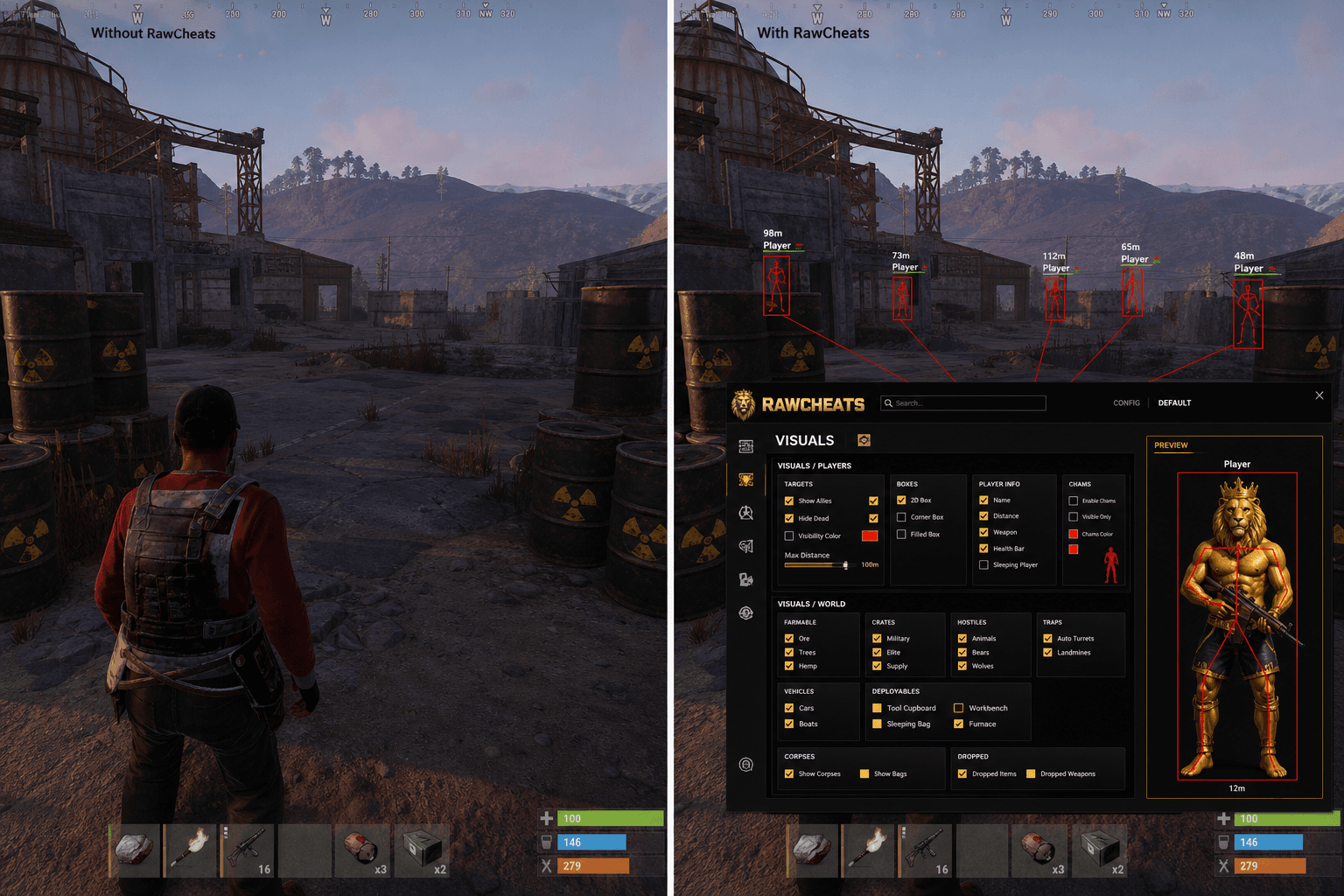
Side-by-side feature matrix, detection track record, May 2025 culling response, November 2025 spray analyzer survival. Reseller markup math vs direct vendors.
Rust cheat shopping in 2026 reduces to three real options: direct in-house vendors (RawCheats and a handful of similar operators), independent direct vendors with smaller engineering teams (PHCheats and similar), and reseller marketplaces (Battlelog being the most prominent). The differences between these tiers are structural, not marketing-narrative. Detection windows, response time to Facepunch infrastructure changes, ban-wave correlation, and total-cost-of-ownership all sort along the same direct-vs-reseller axis. This piece is the honest side-by-side comparison — what each vendor actually ships, how they handled the May 2025 culling and November 2025 spray analyzer, and where the money goes in each model.
This post is a cluster of the Rust Cheats Complete 2026 Guide pillar. The pillar covered the broader Rust market context. This is the head-to-head comparison.
The three structural categories
Rust cheat vendors in 2026 sort into three structural categories defined by where the engineering happens:
Direct in-house vendor with shared SDK across multiple games. RawCheats is the canonical example. Six products (Rust, Fortnite, Marvel Rivals, Arc Raiders, Overwatch, PUBG) on one shared codebase. Same engineering team. Same offset pipeline. Same support staff. Improvements in shared infrastructure propagate to every product simultaneously. The recent menu and infrastructure overhaul that landed across the lineup is the canonical example of how shared-SDK economics work.
Direct vendor with single-game or narrow focus. PHCheats and similar are direct vendors but with narrower product lineups. They write their own code (not resellers), but the engineering economics support fewer simultaneous products. Some have just Rust; others have Rust plus one or two adjacent games. Detection windows and feature coverage are typically comparable to direct in-house vendors but the engineering depth per product is shallower.
Reseller marketplace. Battlelog.co is the most prominent. The model sources loaders from upstream developers (typically Russian or Eastern European) and resells under a branded marketplace at markups of 10-50x the upstream's direct price. The reseller adds payment infrastructure, a branded loader UI, and a marketing layer — but the underlying cheat code, anti-detection, and engineering all happen upstream.
These categories produce materially different customer experiences. The rest of this piece breaks down what those differences actually are.
Feature matrix — aimbot
| Feature | Raw Rust | PHCheats | Battlelog |
|---|---|---|---|
| Bone Priority (Head/Chest/Arms/Legs draggable) | Yes | Yes | Varies by upstream |
| FOV cone slider | Yes (0-100%) | Yes | Yes |
| Smoothness slider | Yes (0-500) | Yes | Yes |
| Visible-only filter | Yes | Yes | Yes |
| Auto-prediction (bullet drop) | Yes | Yes | Varies |
| Dynamic recoil compensation (post-Nov 2025 analyzer) | Yes | Some products | Varies — many still static |
| Aim key Hold/Toggle/Always | Yes | Yes | Yes |
| Controller input support | Yes | Limited | No |
| 9 menu languages | Yes | English + RU | Varies by upstream |
The dynamic recoil compensation row is the most important. Vendors that ship static no-recoil scripts (the 2024 model) fail under the November 2025 spray-pattern analyzer. Most Battlelog upstream products are still shipping static or weakly-randomized scripts because the upstream developers haven't re-engineered their recoil systems. PHCheats and similar direct vendors mostly upgraded by Q1 2026. Raw Rust upgraded as part of the broader infrastructure overhaul.
Feature matrix — ESP and visuals
| Feature | Raw Rust | PHCheats | Battlelog |
|---|---|---|---|
| Memory-residue player ESP (post-May 2025 culling) | Yes | Some products | Varies — many still naive packet-stream |
| Box styles (Box/Filled/Cornered) | All 3 | Usually 1-2 | Varies |
| Visibility Color | Yes | Yes | Yes |
| Health Bar | Yes | Yes | Varies |
| Sleeping Player flag | Yes | Some products | No |
| Six-category World ESP grid | Yes | Yes | Yes |
| Tool Cupboard ESP with priority highlighting | Yes | Yes | Yes |
| Configurable radar (size/position/zoom) | Yes | Yes | Yes |
| Streamproof overlay | Yes | Limited | No |
The post-culling ESP row is the second-most-important diagnostic. Vendors still shipping naive packet-stream ESP (reading position from the Rust server's packet stream) effectively show empty space for occluded enemies post-May-2025. The marketing copy may say "ESP through walls within 200m" but the actual functionality is the memory-residue cache window only — which is the proper post-culling architecture. The difference is whether the vendor is honest about the architecture.
Feature matrix — misc and exploits
| Feature | Raw Rust | PHCheats | Battlelog |
|---|---|---|---|
| Instant Eoka | Yes | Some products | Varies |
| Instant Compound | Yes | Some products | Varies |
| Thick Bullet | Yes | Yes | Yes |
| Rapid Fire | Yes | Yes | Yes |
| No Spread | Yes | Yes | Yes |
| No Sway | Yes | Yes | Yes |
| Per-user config slots | Yes | Some | Limited |
| Hot-reloadable offset cache | Yes | No | No |
The hot-reloadable offset cache is a subtle but important Raw Rust advantage. When Facepunch patches the game with offset changes (object pointers shifting in memory due to a code update), most cheats require a full loader re-download to update offsets. Raw Rust's backend pushes offset-only updates without re-download, which means recovery time after a Facepunch patch is minutes instead of hours.
Detection track record — how each handled May 2025 culling
The single best diagnostic for vendor quality in 2026 is how each handled the May 2025 server-side player culling rollout. The change was forecastable (Facepunch had been hinting at server-side architecture improvements for months) and the implementation window was clear (the rollout happened over a week in May 2025 with public devblog coverage). Vendors with engineering depth had time to architect responses.
Raw Rust response: Within the rollout window, the ESP architecture pivoted to memory-residue cache reading. Aimbot logic remained valid because aimbot reads local game state (which is the same memory-residue cache). Customer downtime: under 12 hours during the rollout day, then stable. Status updates posted on the Discord and forum throughout.
PHCheats response: Similar timeline, slightly longer downtime (24-48 hours) for the ESP architecture change. Aimbot remained functional throughout.
Battlelog response: Catastrophic. The upstream developer that powered Battlelog's primary Rust product was running naive packet-stream ESP. The product effectively stopped functioning for ESP on May 2025 launch day. The upstream's response was to ship a "fix" that re-marketed memory-residue ESP as the post-culling product, with the same "ESP within 200m through walls" copy. Marketing didn't update; functionality changed without acknowledgment.
The Battlelog response is the canonical case of why reseller marketplaces are structurally fragile. The marketplace operator (Battlelog) doesn't control the upstream's engineering response timeline. When upstream takes weeks to ship a fix, the marketplace customers eat weeks of degraded service.
Detection track record — how each handled November 2025 spray analyzer
Raw Rust response: Dynamic recoil compensation had been in development through Q3 2025 in anticipation of the analyzer (Facepunch's earlier devblog hints had telegraphed it). When the analyzer went live in November, Raw Rust's recoil module was already designed around per-shot jitter. Customer impact: minimal — the recoil control toggle continued working with the same UI but the underlying compensation algorithm absorbed the analyzer's tuning.
PHCheats response: Slower. Static recoil scripts in their misc panel got popped within the first week. Dynamic compensation shipped in the following 4-6 weeks. Customers who used recoil scripts during that gap absorbed the ban risk.
Battlelog response: Mixed. Different upstream products in the Battlelog catalog handled the change differently. Some upstreams shipped quick patches (typically labeled as "anti-detection updates" without specifying what changed). Other upstreams continued shipping static scripts well into Q1 2026, producing significant ban-wave correlation for their customer base.
Pricing comparison
Approximate Rust cheat pricing per provider (May 2026 snapshot):
| Tier | Raw Rust | PHCheats | Battlelog |
|---|---|---|---|
| Daily | $4.99 | $5-7 | $10-20 |
| Weekly | $15 | $20-25 | $40-60 |
| Monthly | $25 | $25-30 | $80-150 |
| Lifetime | Not offered | $200-300 | $500+ |
| Spoofer add-on | $4.99 | $10-15 | $30+ |
Battlelog pricing is 3-5x the direct-vendor pricing across all tiers. The markup pays Battlelog's marketing, support, and white-label engineering overhead — none of which provides additional anti-detection value. The detection windows track the underlying upstream's update cadence, not Battlelog's QA. The Rust cheat pricing comparison cluster has the full pricing breakdown.
Support and operations
Raw Rust. Discord support at discord.gg/rawcheats with sub-10-minute response during waking hours. Status updates post in real-time on the Discord and forum. Public status page accessible to non-customers. Refund policy in writing for spoofer downtime and AC patching downtime.
PHCheats. Discord support with longer response windows (30-90 minutes typical). Status communicated via Discord but not always pinned visibly to non-customers. Refund policy varies by tier.
Battlelog. Customer support via marketplace ticketing system. Response times measured in hours. Status communication via marketplace announcements that are sometimes delayed relative to underlying upstream issues. Refund policy through marketplace dispute process; outcomes vary.
The support quality matters most during ban-wave windows when customers need fast triage to know whether their account was affected. Direct vendors with engineering staff on Discord can triage in real-time; marketplace ticketing systems can't.
The 7-test rubric applied
The buyer-side rubric from the pillar guide scored across the three vendors:
| Test | Raw Rust | PHCheats | Battlelog |
|---|---|---|---|
| 1. Acknowledges May 2025 culling | Yes | Yes | Inconsistent across products |
| 2. Acknowledges Nov 2025 spray analyzer | Yes | Yes | Inconsistent |
| 3. Direct or reseller | Direct in-house | Direct | Reseller marketplace |
| 4. Spoofer pricing model | Bundled honest ($4.99) | Honest ($10-15) | Premium ($30+) |
| 5. Public Discord activity | Yes, active | Yes, active | Limited |
| 6. Refund / warranty in writing | Yes | Varies | Marketplace dispute |
| 7. Public ban-wave transparency | Yes | Limited | No |
The scoring isn't subjective — it's based on what each vendor publicly publishes on their site and Discord. Raw Rust scores 7/7. PHCheats scores 5-6/7 depending on which product. Battlelog scores 1-2/7.
Frequently asked questions
Is Battlelog actually a worse cheat or just a worse buying experience? Both, but for related reasons. The underlying cheat code is upstream-sourced, so the cheat itself is whatever the upstream ships — sometimes competitive with direct vendors, sometimes not. The buying experience is consistently worse because the marketplace abstraction creates support and communication delays. The combined effect is that Battlelog customers experience more downtime, slower bug fixes, and higher prices for comparable or lower-quality cheats. Gulfcheats' Battlelog reseller markup analysis has the detailed financial breakdown.
Are there any Rust cheat vendors I should avoid entirely? Anything advertised on Telegram, LolzTeam, or anonymous Russian forums as "free." All of those are malware distribution rather than cheat products. The free Rust cheats cluster has the full breakdown. Beyond that, vendors that don't publish a status page, don't have a visible Discord, and don't acknowledge the May 2025 + November 2025 changes are warning flags.
Why does Raw Rust ship features that competitors don't (hot-reloadable offset cache, streamproof, 9 menu languages)? Shared SDK economics. The infrastructure cost of building hot-reloadable offsets or streamproof is amortized across six products at RawCheats. PHCheats and similar direct vendors with narrower product lineups have the same engineering cost per product but can't spread it across as many customers. Battlelog can't ship these features at all because the upstream doesn't provide them and Battlelog doesn't have engineering capability to add them.
How do I verify a vendor's detection track record? Three sources. First, the vendor's own status page — check what they reported for May 2025 and November 2025 specifically. Second, community ban-wave-tracking Discords. Third, the vendor's customer reviews on independent forums (not their own Discord, which is biased). Cross-reference these three. A vendor that's honest will show consistent timelines across all three sources.
Is PHCheats a reasonable alternative if Raw Rust is unavailable? For most users, yes. PHCheats is a direct vendor with reasonable engineering depth and competitive pricing in the same band as Raw Rust. Their feature coverage is slightly narrower (fewer config slots, smaller menu language support, less aggressive shared-SDK propagation) but the core aim + ESP + recoil functionality is comparable. If Raw Rust is undergoing a status update and you need an alternative for a single session, PHCheats is one of the few defensible options.
Why doesn't Raw Rust offer a lifetime license? The engineering economics don't support fixed lifetime pricing. EAC updates monthly, Facepunch ships major infrastructure changes irregularly, and the cheat-development cost scales with both. A lifetime license at a fixed price either has to be priced extremely high to absorb future engineering or comes with restrictive usage terms that make the effective cost similar to or higher than a normal subscription. Most direct vendors share this calculation; lifetime licenses are a marketplace-tier construct.
What happens to my account if Raw Rust gets popped? Raw Rust's loader auto-pauses subscription clocks during DETECTED windows so customers don't pay for downtime. Patch turnaround is typically 6-12 hours for routine EAC signature updates, longer for major Facepunch infrastructure changes. During downtime, do not run the cheat — running a DETECTED build on a live Rust session is the fastest way to eat a ban. Status communication runs via Discord and forum in real-time.
Are there other direct Rust cheat vendors worth considering? A handful, yes. The Rust cheat market in 2026 has roughly 8-12 vendors that meet the "direct, not reseller, in-house engineering" bar. Raw Rust and PHCheats are the two we benchmark against most often because they're the most consistent on the 7-test rubric. Other direct vendors exist but their engineering depth and operational consistency vary. The buyer-side discipline is to run the rubric on whichever vendor you're considering rather than assuming the brand name implies quality.
How often does Raw Rust ship updates? Continuously for stable maintenance, with major builds tied to Facepunch's first-Thursday-of-month wipe cadence. The wipe-day build is the most attention-intensive release because it has to handle Facepunch's content patches plus EAC signature updates plus any infrastructure changes Facepunch ships alongside the wipe. Smaller patches between wipes happen on a roughly weekly cadence. The Rust ban wave history cluster covers the cadence in detail.
The honest summary: direct in-house vendors with shared-SDK economics produce the best Rust cheat experience in 2026. RawCheats is the canonical example. Get Raw Rust and Raw Spoofer for the disciplined cheat stack. PHCheats is a reasonable alternative if Raw Rust is in a status window. Battlelog is structurally worse on every axis that matters — features, pricing, support, anti-detection. Don't buy from there. The Rust cheats FAQ covers the operational questions in more detail; the Setting up Rust cheats safely cluster covers the pre-flight workflow.