
Rust Wallhack — See Foundations & Base Interiors (2026)
Last updated · October 18, 2026
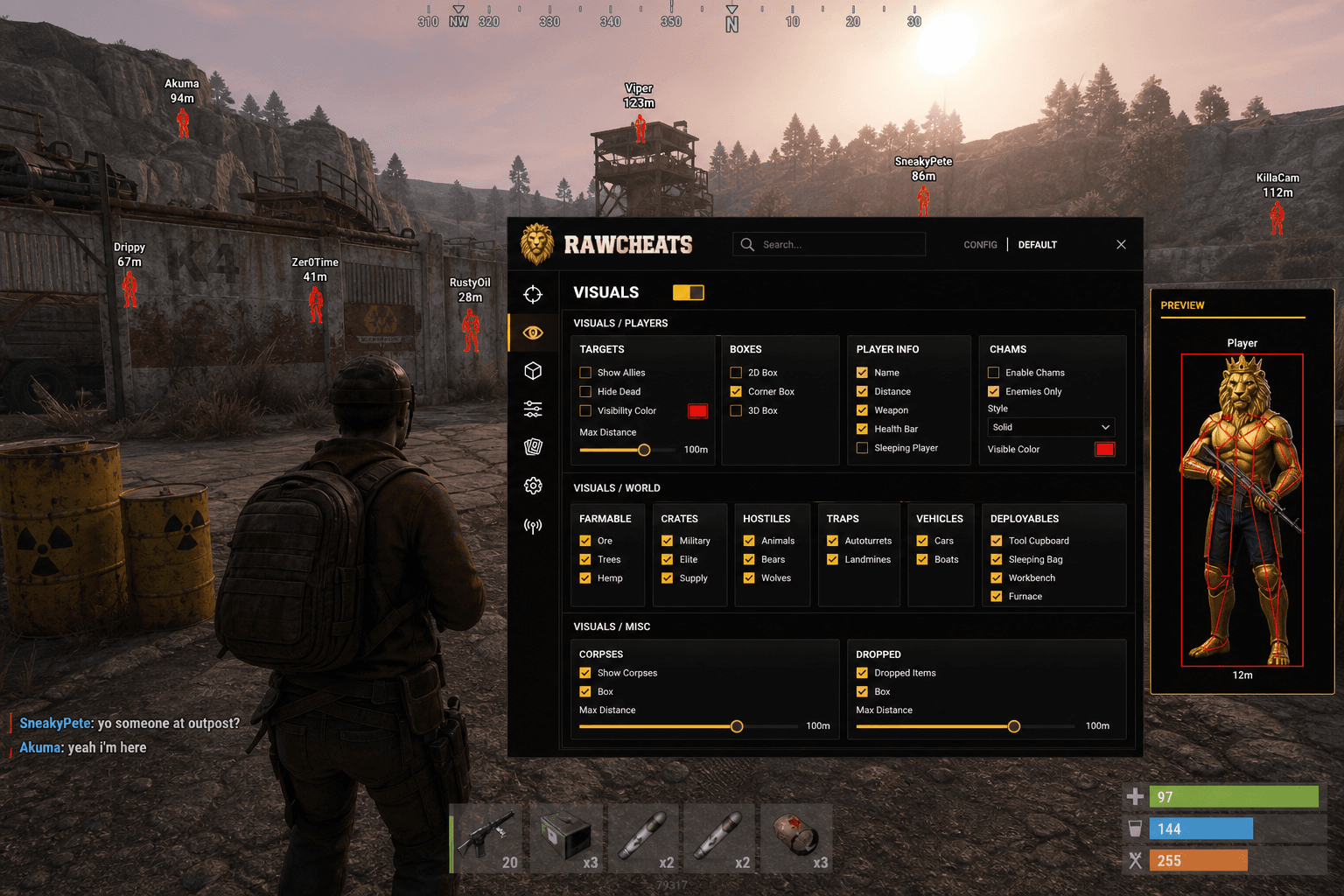
Why Rust Wallhacks Are Different from Every Other Game
Rust wallhack is fundamentally different from Fortnite or PUBG wallhacks because the base structures matter as much as the players. You're not just looking for enemies through walls — you're scoping foundations, honeycomb layers, TC placements, bedroom locations, and loot room layouts. The raid economy depends on knowing what's inside a base before you commit rockets, which means the wallhack has to render the building geometry just as clearly as the players inside it.
Every Rust wallhack feature in this list exists because real raiders kept asking for it. Scope a base from 200m, see the honeycomb thickness, see the TC position, see the loot rooms, see the online defenders inside, plan your raid path through the optimal walls, and execute. The wallhack collapses what used to be a multi-day scouting operation into a 30-second base flyover before the raid even starts.
Every Type of Cover Rust Has, Solved
See foundations and TC placement through stone and metal walls. When you're scouting a target base, you know exactly where the load-bearing foundations sit, which walls are honeycomb (one wall thick) vs structural (multiple layers), and where the TC is positioned to upkeep the base. This intel is what separates a successful raid from a wasted afternoon — knowing the difference between a 4-rocket honeycomb breach and a 16-rocket structural raid.
Scope loot through closed doors before breaching. You'll know if the airlock you're about to blow has a chest behind it or just a corridor. Combined with the raid base interior preview from the ESP, you can route your raid path optimally — blow the door that leads directly to the loot room rather than the airlock that leads to a hallway full of decoys.
See online players inside bases through honeycomb walls. Track where defenders are positioned before you commit a peek. Knowing whether the defender is sitting in the bedroom waiting for you to push or whether they're already at the rocket window changes your engagement entirely. Pre-aim the angle they're holding and they walk into your shot.
Track enemy roamers through forest cover at distance. Rust's open-world night roams are the most dangerous time of day because visibility is bad and ambushes are common — the wallhack solves both. See enemy positions through trees and rocks regardless of time of day, eliminating the ambush surprise that makes night roams so risky for solos and small groups.
See helicopter and chinook attack patterns through map terrain. The patrol heli and chinook events are two of the highest-loot moments in Rust, but both involve navigating around the heli's attack pattern. The wallhack shows you the heli's trajectory and the bullet patterns through map terrain so you can pre-position for the loot drop or avoid the engagement entirely if you're outclassed.
Why It Stays Undetected by EAC
The wallhack uses modern overlay technology rather than the old transparent-wall pattern that got Rust cheats banned in waves around 2021. Instead of modifying how the game renders walls, we draw visual indicators on top of your normal game view through a separate overlay window. From Easy Anti-Cheat's perspective, the Rust client is rendering the game completely normally — there are no signature hits because no game memory has been touched.
We test the wallhack overlay against every Easy Anti-Cheat signature push and every Facepunch patch. Updates ship within 6-12 hours of an EAC update. Facepunch's wave bans target behavioral anomalies (impossible kill rates, perfect first-shot accuracy, and aim deltas that exceed human limits) — the humanizer system caps your visible behavior under those thresholds so you don't trip the manual review flags either. Combined with the HWID Spoofer for hardware-level protection, the long-term survival rate is among the best in the niche.
What You Get with the Raw Rust Wallhack
The wallhack pairs with the aimbot's tracking system — the moment a player or sleeper becomes visible through a wall, the aim is already locked onto them. When they peek your honeycomb or push your tunnel, your shot is already on target. This integration is what separates Raw Rust from cheats that ship the wallhack and aimbot as separate plugins glued together with a config wizard.
Player health and shield bars render through walls so you know who's already cracked during raids — prioritize confirms accordingly. The chinook drop predictor renders the predicted landing zone the moment the chinook event spawns, which combined with the radar's heli route tracking lets you camp the optimal landing spot before anyone else gets there.
Pricing & Access
The wallhack is part of the full Raw Rust suite — included in every subscription tier alongside the aimbot, ESP, no-recoil, triggerbot, exploits, and radar. Plans run $4.99 for a 1-day pass through $34.99 for a 1-month subscription. License delivers instantly via email after payment, the loader installs in under 2 minutes on Windows 10 or 11, and the wallhack is active from your first match. Combine with the HWID Spoofer for maximum account survival insurance during Facepunch's monthly wave bans.
// Features Included
// Frequently Asked Questions
Does the Rust wallhack show base foundations?
Yes. Foundation, wall, and ceiling structures render through any other wall material so you can scope a base's layout before you raid it. You see honeycomb thickness (single layer vs structural), TC placement, and bedroom locations through stone and metal walls.
Will the Rust wallhack show online defenders inside bases?
Yes. Online players inside a base structure render through honeycomb and structural walls with team color coding. You can see where defenders are positioned before you commit a peek, which lets you pre-aim the angle they're holding.
Can I scout loot rooms through closed doors?
Yes. The wallhack reveals what's behind every door before you breach — chests, sleeping bags, furnaces, and players. Saves you from blowing airlocks for empty corridors. Combined with the raid base interior preview, you can route your raid path optimally before placing the first rocket.
Does the Rust wallhack work in night-time roams?
Yes. Night vision is one of the highest-value use cases because Rust's natural visibility is terrible after dark. The wallhack overlay renders enemies through forest cover and rocks regardless of time of day, eliminating the ambush surprise that makes night roams so risky.
Will EAC detect the Rust wallhack overlay?
We test against EAC after every signature push and ship rebuilds within 6-12 hours. The wallhack uses overlay technology that doesn't modify the game renderer or memory in ways EAC scans for, so signature detection misses it. Behavioral protection caps your kill rates at configurable percentages to avoid manual review flags.
How does the chinook drop predictor work in Rust?
The wallhack renders the predicted chinook landing zone the moment the event spawns, based on the chinook's flight trajectory and the standard drop point algorithm Facepunch uses. Combined with the radar's heli route tracking, you can camp the optimal landing spot before the rest of the lobby even realizes the event triggered.
Does the Rust wallhack work for solo raid scouts?
Especially well for solos. The whole point of the wallhack for solo raiders is replacing the multi-person scouting operation that clans run. You scope the target base, see the foundation layout, count the online sleepers, plan the raid path, and execute — all without needing a raid group to do recon.
Can the wallhack distinguish between honeycomb and structural walls?
Yes. The wallhack rendering shows the wall type with color coding so you can immediately see whether a wall is single-layer honeycomb or structural multi-layer. This is the key intel for raid planning because honeycomb walls take 4 rockets to breach versus 16+ for structural walls — knowing the difference saves you from raids that aren't worth committing to.