
Rust Cheat Pricing Comparison 2026 — Where the Money Actually Goes
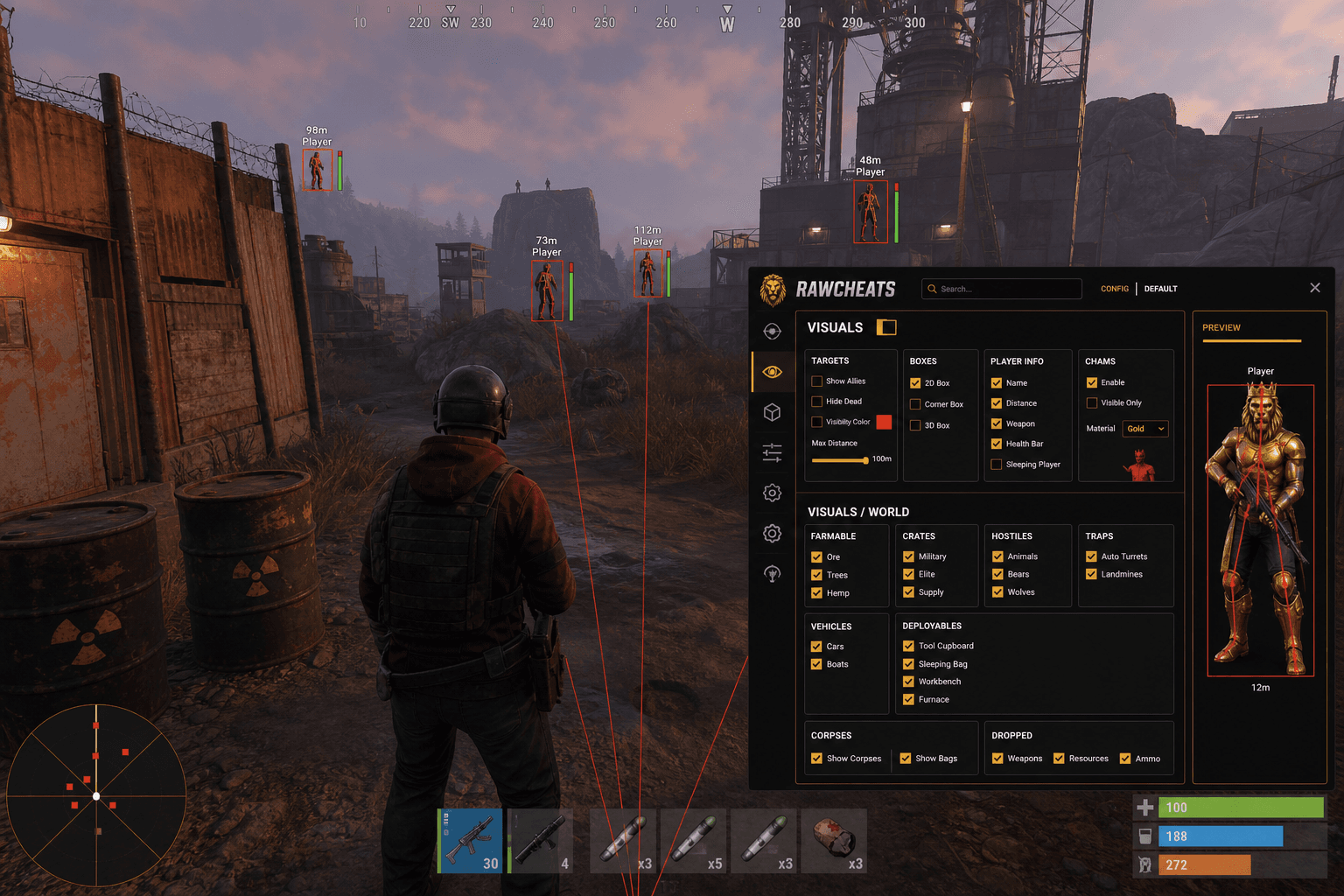
Live 2026 Rust cheat pricing across major vendors. Battlelog reseller markup math, daily-vs-monthly tier breakdown, the $15 Premium Servers add-on.
The Rust cheat market in May 2026 has two distinct pricing tiers and a chasm between them. The cheap tier ($4.99/day, $20-25/month) is software-only, single-machine, run-it-and-hope. The expensive tier ($60-200/month for DMA-backed setups, plus $300-1500 in hardware) is the leftover DMA market that Facepunch hasn't IOMMU-mandated out of existence yet. Most buyers are in the cheap tier and the differentiation among vendors there comes down to three things: whether the operator is direct or a reseller, whether the spoofer is bundled or sold as a separate margin grab, and whether the cheat actually survives the November 2025 spray analyzer or just claims to. This piece breaks down where the money actually goes when you buy a Rust cheat in 2026.
This post is a cluster of the Rust Cheats Complete 2026 Guide pillar. The pillar covered the broader 2026 Rust cheat landscape. This is the dollars-and-cents breakdown.
The cheap tier — software cheats
Software-only Rust cheats in 2026 cluster in a tight pricing band because the value proposition is similar across vendors: external software cheat, single PC, runs alongside EAC, requires spoofer for HWID protection.
Daily licensing is the cheapest entry point: $4-7 per 24-hour access window. Most vendors offer this as the minimum unit. Useful for one-off wipe sessions where you don't want to commit to a month subscription. The daily-rate-equivalent monthly cost (if you bought 30 daily licenses) would be $120-210, which is why nobody buys 30 dailies in sequence — they roll up to monthly subscriptions.
Weekly licensing is the middle option: $15-25 per 7-day window. Daily-rate-equivalent of roughly $2.50-$3.50/day. Most Rust wipes are weekly cycles, so weekly licensing pairs naturally with single-wipe play.
Monthly licensing is the most common: $20-30 per 30-day window. Daily-rate-equivalent of roughly $0.65-$1/day. The economics dominate the other tiers if you play more than one or two wipes per month.
Lifetime licensing is rare on Rust specifically because the engineering churn (responding to EAC updates, Facepunch infrastructure changes) makes the operator's economics painful at a fixed lifetime price. A few vendors offer it at $200-500 with significant restrictions in the fine print.
Raw Rust sits in the standard band — daily license available, monthly subscription as the dominant tier, plus the Raw Spoofer add-on at $4.99/month.
The expensive tier — DMA setups
Direct Memory Access cheating is technically still viable on Rust in 2026 because Facepunch hasn't issued an IOMMU mandate the way Epic did for Fortnite in February 2026. The DMA market for Rust is smaller than it was 2022-2024 but still exists. Pricing breaks down into:
- DMA hardware — $300-1500 depending on tier. Cheap end is a PCIe card with no firmware optimization; expensive end is a multi-board setup with FPGA-tier custom firmware. Plus $50-100 for the secondary capture screen.
- DMA cheat subscription — $60-200/month for the software side that pairs with the hardware. Higher monthly cost than software cheats because the DMA-side operator has to maintain custom drivers for the secondary system that captures the game memory off PCIe.
- Secondary PC (or microcontroller) — required to host the cheat overlay because DMA setups display on a second screen. $200-500 if you don't already have one.
Total DMA setup cost: $560-2,100 first-month, then $60-200/month ongoing. Versus $4.99-30/month for a software cheat with the same effective feature surface in 2026 (memory-residue ESP, dynamic recoil compensation, full World ESP). The DMA cost-of-ownership math is poor unless you're specifically buying DMA for cross-game capability (DMA hardware that works on Fortnite + Apex + Rust simultaneously absorbs the cost across multiple game licenses).
The May 2025 culling change specifically eroded DMA's value proposition because the previous DMA advantage was reading 200m of player position from system RAM. The post-culling reality means DMA reads the same memory-residue cache that software cheats read, with the same staleness. DMA's relative advantage shrunk significantly.
The reseller markup problem
The single most-misunderstood pricing dynamic in the Rust cheat market is the reseller economy. Specifically:
Battlelog.co is the most prominent Rust cheat reseller marketplace. Their model is to source loaders from upstream developers (often Russian or Eastern European), white-label them, and resell at markup. Markup varies but typically 10-50x the upstream price. A cheat that the upstream developer sells direct for $5/day might appear on Battlelog at $50/day with a "premium" branding badge.
The reseller markup problem isn't just price. The structural issue is detection-window correlation. When the upstream developer's cheat gets popped, every reseller's customer eats the ban simultaneously because they're all running the same underlying code. The reseller's QA, support, and bypass infrastructure are all the upstream's — the reseller adds only a branded loader and a payment system. When upstream goes down, the entire reseller cohort goes down together.
The buyer-side diagnostic: if a Rust cheat vendor's loader has multiple visible game options (Rust + Apex + Tarkov + others), they're likely a reseller marketplace. Direct vendors typically focus on a single game or a tight family (like RawCheats' six-product lineup) with shared engineering across the family rather than disparate sourced products.
Gulfcheats published a reseller markup exposé in 2024 that documented several specific upstream-to-reseller price mappings. The math hasn't changed materially in 2026.
Spoofer bundling — the honest vs predatory split
How a vendor prices the HWID spoofer is a signal of how the vendor thinks about its customer base.
Honest model: Spoofer is bundled with the cheat subscription or sold as a low-margin add-on ($4.99/month, same range as the cheat itself). Examples include RawCheats ($4.99 spoofer add-on bundled with Raw Rust subscriptions) and a handful of direct vendors.
Predatory model: Spoofer is sold at premium pricing ($15-30/month for spoofer alone, sometimes higher than the cheat subscription itself). The economic incentive for this model is that vendors want customers to play without a spoofer initially, eat a ban, and then come back to buy the spoofer for recovery — turning the spoofer into a recovery-tax product rather than a session-safety product.
The buyer-side diagnostic: ask the vendor what the spoofer costs separately and what it costs bundled. If the standalone price is more than 2x the cheat subscription, the model is predatory.
Raw Spoofer pricing: $4.99/month standalone, bundled discount with Raw Rust. The Raw Spoofer pricing is documented on the HWID Spoofer Complete 2026 Guide pillar.
The Premium Servers $15 add-on cost
The Premium Servers launch in March 2025 added a new line item to the cheat-buyer's total cost. Premium Servers require $15 of Steam inventory value on the account, which means:
- For your main Steam account: Usually trivial. Most established Rust accounts already have $15+ in skin inventory. No incremental cost.
- For a fresh Steam account (post-ban recovery, alt account): Mandatory $15 inventory purchase before the account can join Premium Servers. Trading cards, low-value Steam Workshop items, or single Rust skins all count toward the threshold.
The $15 inventory threshold is a one-time cost per Steam account. If you're cycling accounts after bans, the per-account total-cost-of-entry is:
- $40-100 for the Rust game license
- $15 for Premium Servers inventory threshold
- $5-30 for the first month of cheat subscription
- $5 for the first month of spoofer
Total: $65-150 per fresh account. The disposable-account economy that powered the 2020-2024 market at $5-10 per cycle is materially harder to sustain at this cost profile.
Total cost of ownership — the honest math
Realistic monthly cost to operate a Rust cheat in 2026:
Conservative scenario (one main Steam account, infrequent bans):
- Raw Rust monthly: $25
- Raw Spoofer monthly: $5
- Total monthly: $30
- Annual total: $360
Moderate scenario (one ban per year requiring account swap):
- Raw Rust monthly: $25 × 12 = $300
- Raw Spoofer monthly: $5 × 12 = $60
- One fresh Steam account: $40
- One $15 Premium inventory top-up: $15
- Annual total: $415
High scenario (aggressive cheating, 3-4 bans per year):
- Raw Rust monthly: $25 × 12 = $300
- Raw Spoofer monthly: $5 × 12 = $60
- 4 fresh Steam accounts: $160
- 4 × $15 Premium inventory: $60
- Annual total: $580
DMA-tier (if you're determined to run DMA for Rust):
- First-year hardware: $800 (mid-tier setup)
- DMA cheat subscription: $100 × 12 = $1,200
- Spoofer: $5 × 12 = $60
- Annual total: $2,060+
The cost differential between disciplined software cheating and DMA cheating is roughly 6x for the same effective feature surface in 2026 Rust. DMA's value proposition collapsed when culling removed the through-walls-from-RAM advantage.
The free-cheat false economy
The cheapest tier of Rust cheats is "free" — $0 cash cost. The trap is that free cheats are uniformly malware-distribution vectors. The Free Rust cheats cluster goes into the specific payloads (Lumma, Vidar 2.0, RedLine) but the economic math is straightforward:
- Free cheat: $0 cash
- Expected loss from infostealer infection: $1,000+ in liquidated Steam inventory + browser-saved credentials + crypto wallet contents (per Acronis Threat Research Unit's Vidar 2.0 distribution analysis).
The expected-loss-adjusted cost of free cheats is 30-50x the cost of paid cheats. The "free" tier doesn't actually exist as a viable option for anyone with meaningful Steam inventory or crypto holdings.
Frequently asked questions
Why are software Rust cheats so much cheaper than DMA? Two reasons. First, software cheat operating costs are mostly engineering time (no hardware inventory, no shipping, no firmware development), which has better unit economics than physical product. Second, DMA's value proposition collapsed in May 2025 when culling reduced DMA's through-walls advantage — the surviving DMA market is smaller, less competitive, and priced higher because the vendor pool consolidated.
Is monthly or daily Rust cheat licensing better economically? Depends on play frequency. If you play 2+ wipes per month (most serious Rust players), monthly licensing dominates daily by 5-10x. If you play one wipe occasionally, daily licensing makes sense. Weekly licensing is the middle option for one-wipe-per-week players.
Are lifetime Rust cheat licenses worth it? Generally no. The operator's economics break down at fixed lifetime pricing because they have to absorb future engineering costs (EAC updates, Facepunch infrastructure changes, new anti-cheat layers in 2026-2027). Lifetime licenses typically come with restrictions — usage caps, feature exclusions, or transfer-blocking — that make the effective monthly cost similar to or higher than a normal subscription.
Why is Battlelog so expensive vs direct vendors? Reseller markup. Battlelog sources loaders from upstream developers and resells at 10-50x the upstream's direct price. The markup pays Battlelog's marketing, support, and white-label engineering — none of which provide additional anti-detection value. The detection windows track the underlying source's update cadence, not Battlelog's QA. Direct vendors like RawCheats price closer to actual engineering costs.
Does Raw Rust pricing change for ban-wave windows or wipe days? No. Pricing is stable across the month. What varies is the Raw Rust loader's UNDETECTED status — during EAC updates or Facepunch infrastructure rollouts, the loader pauses subscription clocks so customers don't pay for downtime. The $25/month effective price assumes the cheat is operational; when it's not, the subscription clock pauses.
How does Raw Rust's pricing compare to direct competitors? Comparable to other direct vendors (PHCheats and similar are in the same band). Materially cheaper than Battlelog and reseller marketplaces. Comparable in feature coverage but with the in-house engineering advantage (shared SDK across six products) and the bundled-spoofer pricing. The detailed comparison is in the Raw Rust vs PHCheats vs Battlelog cluster.
The honest math: $30/month for software-tier cheating plus spoofer. Disciplined operators clear $360-$580/year all-in. DMA is 6x more expensive for the same effective surface. Free cheats are 30-50x more expensive on an expected-loss basis. Get Raw Rust for the software tier; Raw Spoofer for cross-EAC fingerprint protection. The Setting up Rust cheats safely cluster covers the pre-flight to maximize per-account survival time.