
Rust Ban Wave History 2020-2026 — Every Documented Facepunch Sweep
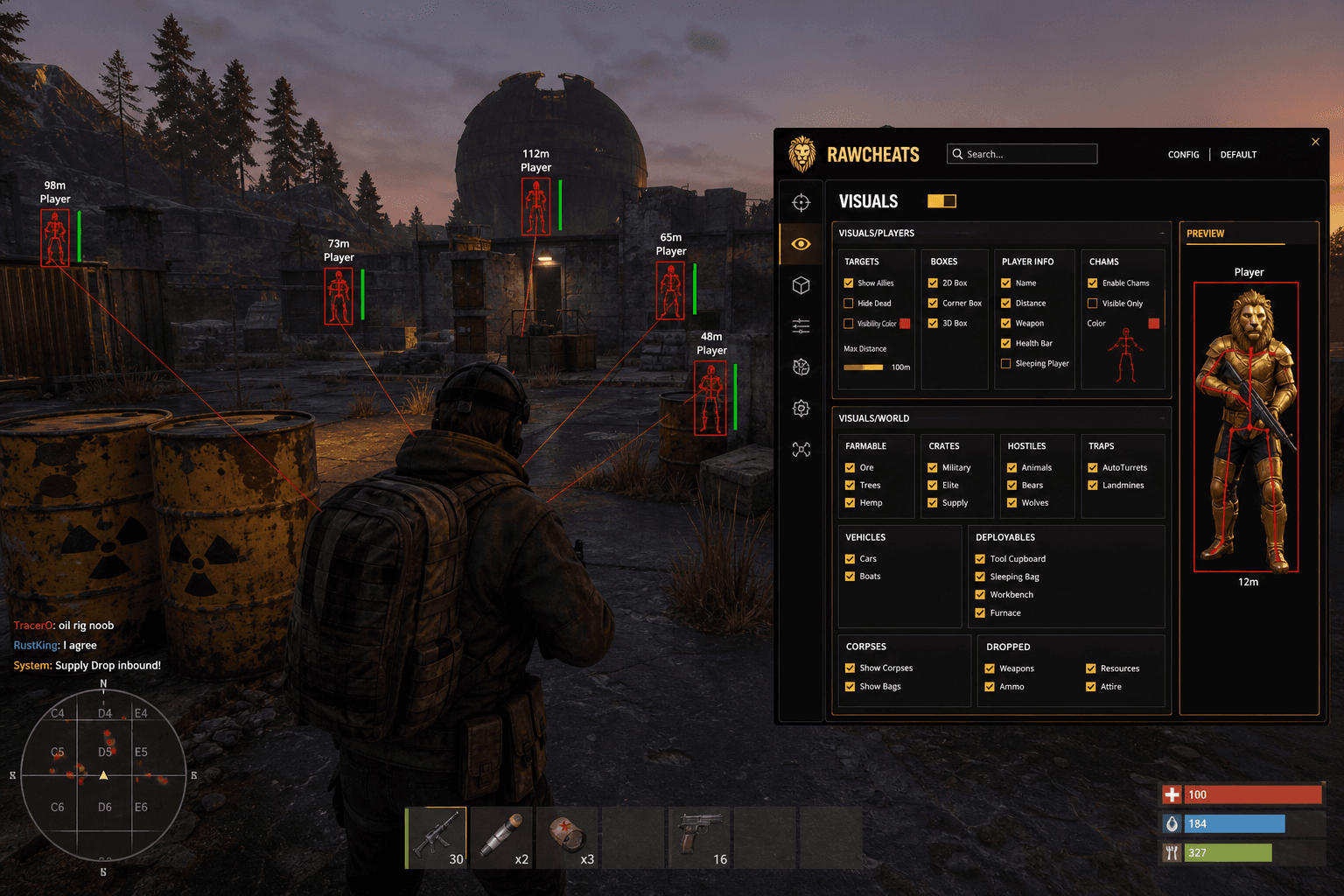
Complete timeline of Rust ban waves 2020-2026 with primary-source citations. 296K perm bans in 2025, detection-time-to-ban trends, monthly wipe cadence.
Facepunch publishes more ban-wave data than any other AAA publisher in gaming. The annual "Surviving X Years" devblog series has been running since 2019 and openly discloses ban counts, detection-time trends, automated-vs-manual detection ratios, and the specific anti-cheat infrastructure changes that drove each year's numbers. The 2025 edition (Surviving 12 Years) put the headline number at 296,000 permanent bans for the year, with detection-time-to-ban dropping from 10 hours of playtime to under 7. For anyone trying to understand the Rust cheat economy in 2026, the ban-wave catalog is the foundation document — it's where you can actually read the numbers instead of guessing.
This post is a cluster of the Rust Cheats Complete 2026 Guide pillar. The pillar covered the broader Rust market in 2026. This piece is the documented timeline of every notable Rust ban wave from 2020 through May 2026, sourced from Facepunch's own devblogs, dev tweets, and the HackerOne bug bounty program reports.
How Facepunch's ban cadence actually works
Before the timeline, the cadence model matters. Facepunch operates on a hybrid schedule combining continuous detection (real-time bans for unambiguous signature matches) with batched ban waves (held detections released on a fixed monthly cadence).
Continuous detection runs in real-time via EAC. Approximately 90.8% of Facepunch's 2025 enforcement actions came from automated detection — the player ran a flagged cheat, EAC's signature scanner caught it, the ban landed within hours.
Batched waves are held detections released on a fixed monthly cadence — specifically the first Thursday of every month, which aligns with Facepunch's monthly force-wipe schedule. The wave includes detections that triggered during the prior month but weren't released to avoid revealing which specific signature fired (revealing this would help cheat developers reverse-engineer the detection).
Pre-wipe sweep is the technical name for the first-Thursday wave. The reason for the timing: a player banned right before a wipe loses access to their pre-wipe base, accumulated resources, and team progress. The psychological weight is significantly higher than a ban during mid-wipe stagnation. Facepunch leverages this for behavior modification — surviving cheaters lose more on a Thursday ban than on a Wednesday ban.
The monthly cadence creates predictable risk windows. The 24-48 hours before the first Thursday of each month is the highest-detection window because that's when Facepunch is releasing held detections. Cheaters who push aggressive settings in that window absorb disproportionate ban risk.
The 2020-2024 baseline
2020-2021 — Documented annual bans roughly 100,000-150,000 per year per Facepunch's own annual disclosures. Detection-time-to-ban averaged 50+ hours of playtime (a cheater would survive multiple weeks before getting caught). EAC's kernel scanner was less aggressive than the 2024+ version. The cheat-vendor ecosystem was less professionalized — most operators were single-developer projects with monthly update cycles.
2022 — Approximately 175,000 permanent bans. Detection-time dropping into the 30-hour range. EAC ships a kernel-pool expansion that catches a cohort of internal-injection cheats that had survived prior signature pushes.
2023 — 195,000+ permanent bans. The DMA market starts to gain attention in Rust specifically because external memory readers are technically harder for EAC to catch than software cheats. Several DMA-focused vendors enter the market.
June 12, 2024 — Facepunch updates the Rules of Conduct to explicitly list DMA hardware as a bannable category. This is the first publisher in survival/sandbox gaming to formally permaban DMA usage. The change is documented in Facepunch's news index under the 2024 updates. The DMA ban category creates a research market for "DMA detection" — how Rust's EAC fingerprints a system as having DMA cards installed even when the cards aren't loading software into the OS.
Late 2024 — Approximately 220,000 permanent bans for the year. Detection-time-to-ban dropping into the 15-20 hour range. EAC's scanner is increasingly catching memory-residue ESP cheats that had been safe for years.
2025 — The transformational year
This is the year that materially changed Rust's anti-cheat landscape. Three major infrastructure changes plus continued kernel-scanner evolution.
March 13, 2025 — Premium Servers launch. The Premium Servers announcement launches the $15 Steam inventory gate. Disposable-account cheating on official servers immediately becomes more expensive per banned account. Facepunch claims 98% disposable-account filtering. Community estimates of the actual filtering rate vary but the consensus is "materially reduces cheap-account cycling."
April 2025 — 19,876 permanent bans (single month). Documented by Alistair McFarlane, Facepunch developer, on X. The April wave coincides with the rollout of Premium Servers and catches a cohort of cheaters who'd been operating on disposable Steam accounts that suddenly couldn't access the prime server pool.
May 2025 — Server-side player culling deployment. The most consequential single anti-cheat change of the entire 2025 cycle. The Rust server stops transmitting position data for occluded players. Naive packet-stream ESP breaks overnight. The accompanying wave includes 19,876+ permanent bans during the culling rollout window — Facepunch held the wave to coincide with the deployment so that cheats running detection-triggering packet reads against the new server protocol got flagged simultaneously.
June 2025 — 15,440 permanent bans. Per Facepunch dev disclosures. The June wave catches the second wave of culling-affected cheats — operators who shipped "post-culling" updates without properly handling the new server protocol got caught when their updated reads still produced detection-triggering telemetry.
Mid-2025 — Detection-time-to-ban drops to ~7 hours. Per Surviving 12 Years. The year-over-year improvement comes from a combination of expanded EAC kernel scanning, the culling-driven cheat-architecture changes (forcing cheats to read game memory more aggressively, which produces more detection surface), and the spray-pattern analyzer entering testing.
November 2025 — Server-side spray-pattern recoil analyzer goes live. The analyzer that targets macro-script no-recoil. Specific account count not disclosed but Facepunch's January 2026 devblog confirms the wave specifically targeted recoil-script users. PC Gamer's November 2025 feature on Facepunch's surveillance approach covers the change.
December 2025 — Year-end wave. Standard pre-wipe sweep. The year-end totals get reported in Surviving 12 Years in early 2026: 296,000 permanent bans for the year, 42,000 temporary bans, 338,000 total enforcement actions, 16 million cheat reports received, 90.8% automated detection rate.
The 2025 cumulative: roughly 1,000,000+ Rust permanent bans since the game launched in 2013. Per-account survival times shorter than they've ever been.
2026 — Monthly cadence (year-to-date)
The 2026 ban waves follow the first-Thursday-of-month cadence locked in by the 2024-2025 operational baseline.
February 5, 2026 — Naval Update wipe + ban wave. Facepunch ships the Naval Update (new boat content + map changes) alongside the standard pre-wipe sweep. The wave includes the first batch of November-2025-spray-analyzer detections that had been held for the post-November release window. Specific count not disclosed but community-tracked sources estimate 15,000-20,000 permanent bans.
March 6, 2026 — Shipshape Update wipe + ban wave. Standard cadence. Tightened recoil heuristics push more macro-script users into the detection pool.
April 3, 2026 — Spring Clean Update wipe + ban wave. The Spring Clean Update adds quality-of-life improvements + further refines the spray analyzer. Wave includes a cohort of recoil-script users whose ±5%-randomization scripts were finally caught by the post-March-analyzer tuning.
May 1, 2026 — Pre-wipe sweep ahead of the May 7 Upgrade Hard / Raid Harder update. Standard first-Thursday cadence. The Upgrade Hard / Raid Harder update on May 7 includes structural raid-mechanics changes that prompt a wave of cheat-architecture re-evaluations from vendors.
What the ban-wave data tells you about cheat selection
The catalog above isn't just history. It's a buyer's diagnostic. Several patterns emerge across the 2020-2026 timeline:
The detection-time-to-ban trend is monotonically decreasing. Cheating in 2020 gave you 50+ hours of playtime before detection. In 2026 it's under 7. Vendors who don't acknowledge this trend (and don't ship infrastructure that responds to it — multi-layered bypass, dynamic anti-detection, active engineering against the EAC update cadence) are shipping products with shorter and shorter survival windows.
The infrastructure changes are step-function, not gradual. May 2025 culling and November 2025 spray analyzer didn't ramp up — they went live and caught entire cohorts of cheats within days. A cheat that survives the next step-function change is a cheat with engineering depth, not a cheat with a clever single-trick bypass.
The monthly cadence creates predictable risk windows. First Thursday of every month is the highest-detection window. Push aggressive features earlier in the cycle (week 1-2 after wipe) and dial back to conservative settings as you approach the next first Thursday.
The Premium Servers gate has restructured the cheap-account market. The disposable-account economy that powered the 2020-2024 cheat market is materially diminished on Premium official servers. Cheap-account cycling still works on community servers but the prime server pool has consolidated cheating into a smaller but more expensive market.
Pre-wipe pre-flight checklist for ban-wave windows
The wipe-day risk-mitigation playbook based on the cadence above:
- T-72 hours (Monday before wipe Thursday): Reduce session aggression. Don't run new exploit toggles. Stay on stable settings.
- T-48 hours (Tuesday): Check the Raw Rust forum status. If a cheat update is anticipated alongside the Facepunch wipe content patch, don't pre-play a session that will span the patch.
- T-24 hours (Wednesday): Reduce session time. The Wednesday-into-Thursday window is when the wave is being released. Avoid maximum-detection-attention features (Misc panel exploit stacks).
- T-0 (Thursday force wipe): Don't run the previous Raw Rust build on the post-wipe game. Wait for status to flip to UNDETECTED for the new build. Typical wait is 6-12 hours.
- T+0 to T+48 (Thursday afternoon through Saturday): Cold-boot. Run Raw Spoofer FIRST. Launch Steam, Rust, Raw Rust loader. Stick to known-stable settings; the post-wipe rush is high-monitoring.
- T+72 to T+1 week: Stable window. Higher tolerance for experimental settings.
- T+1 week through T-72: Normal operating window.
The Setting up Rust cheats safely cluster expands this into a full 10-step pre-flight.
Frequently asked questions
Why does Facepunch publish ban numbers when other publishers don't? Strategic transparency. Facepunch's stated reason in Surviving 12 Years is that public ban data deters casual cheaters (visible enforcement signals discourage marginal cheaters from trying) and builds trust with the legitimate player base. The downside (giving cheat developers data to model detection rates) is offset by the upside (deterrence + community trust). Most publishers calculate the tradeoff the other way; Facepunch goes the other direction.
Are the ban numbers inflated? The community-track of ban-wave evidence (Discord-tracked ban dates, individual-account ban screenshots, cheat-forum reports) corroborates Facepunch's published numbers within reasonable variance. The aggregate scale (~300K permanent bans annually) is consistent with Steam Charts player-base data and the publicly-known cheat-vendor user-pool sizes.
Why are some waves bigger than others? Infrastructure changes drive wave size. The May 2025 culling rollout produced a larger wave because the architecture change caught entire cheat product lines simultaneously. The November 2025 analyzer was similarly outsized. Routine monthly waves are smaller because they represent incremental detection of cheats that were already being caught individually throughout the prior month.
Does the HackerOne bug bounty actually affect ban counts? Indirectly, yes. The HackerOne program has paid $300K+ to researchers through end of 2025. Most reported exploits aren't cheat bypasses per se — they're game vulnerabilities. But several have been anti-cheat methodology disclosures that Facepunch then patched, which shortened the half-life of the affected cheat techniques. The bounty doesn't directly produce bans; it produces faster patches that produce future detections.
Is the 296K number permanent bans or total enforcement? 296,000 was specifically permanent bans. Total enforcement actions for 2025 was 338,000 (including 42,000 temporary bans). Temporary bans are typically lower-confidence detections that Facepunch released as warnings rather than permabans, often resolved by appeal or by repeat-offense escalation to permaban.
What's the bigger threat to cheaters — kernel detection or behavioral analysis? Both in different timeframes. EAC's kernel signature scanner catches the obvious cheats fast (hours-to-days). Server-side behavioral analysis (the culling-driven anomaly detection, the spray analyzer, the statistical-distribution flagging) catches the more sophisticated cheats slower (days-to-weeks). The discipline-tuned cheat survives the kernel scanner but eventually trips a behavioral flag. The careless cheat trips both.
The Rust ban-wave catalog is the most transparent in the cheat-niche industry. Use the cadence above to time your sessions around the high-detection windows. Get Raw Rust for engineering that's built around the wave cadence, and Raw Spoofer for the cross-EAC fingerprint protection. The How Rust anti-cheat works cluster covers the four-layer detection stack that produces these numbers; the Rust cheats FAQ covers the operational questions in detail.