
How Rust Anti-Cheat Actually Works in 2026 — EAC, Server-Side Culling, Spray Analyzer & Premium Servers
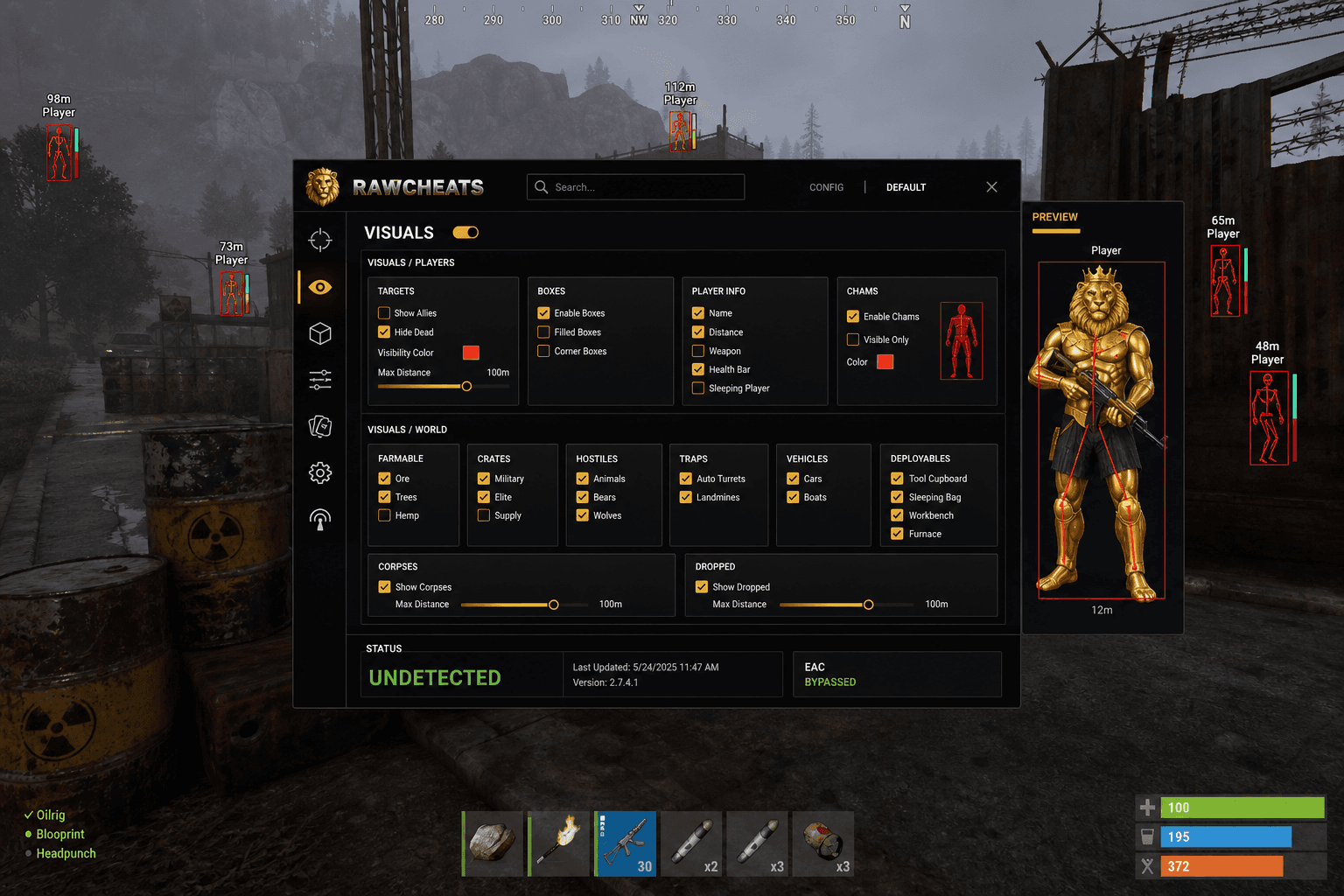
Four-layer Rust anti-cheat: EAC kernel, May 2025 server-side culling, Nov 2025 spray analyzer, and the $15 Premium Servers gate. What survives and what doesn't.
Facepunch's Surviving 12 Years devblog put numbers on the table that most publishers in this industry refuse to publish: 296,000 permanent bans in 2025, 42,000 temporary bans, 338,000 total enforcement actions, 16 million cheat reports processed, 90.8% automated detection rate, and detection-time-to-ban dropped from 10 hours of playtime to under 7 hours over the course of the year. That is not normal industry transparency — Epic doesn't publish those numbers, Krafton doesn't, Activision doesn't. Facepunch does. And the reason it matters for anyone shopping for a Rust cheat in May 2026 is that the cheat market is still mostly describing Rust as if the May 2025 server-side culling and the November 2025 spray-pattern analyzer never happened. Here is what's actually running between you and a ban when you launch Rust today.
This post is a cluster of the Rust Cheats Complete 2026 Guide pillar. The pillar covered the broader 2026 Rust market context. This piece goes deep on the four-layer anti-cheat architecture itself.
The four-layer stack at a glance
Rust's anti-cheat in 2026 is not one product. It's four overlapping defenses, only one of which is the kernel-level scanner most players think about. The other three are server-side or infrastructure-level, and they're where serious cheats die.
- Layer 1 — EAC kernel driver. The signature scanner at ring 0.
- Layer 2 — Server-side player culling (since May 2025). Server stops sending position data the client can't see.
- Layer 3 — Server-side spray-pattern recoil analyzer (since November 2025). Server flags machine-perfect inverse-curve scripts.
- Layer 4 — Premium Servers $15 Steam inventory gate (since March 13, 2025). Economic filter that kills the disposable-account market.
Each layer is independent. A cheat that defeats one still has to survive the other three. That layered architecture is why Facepunch's per-account survival numbers are dropping while the cheat market keeps inflating its claims.
Layer 1 — EAC kernel driver
Easy Anti-Cheat is the kernel signature scanner — the part most cheat content focuses on because it's the most visible. EAC for Rust is the same Epic-owned product running on Fortnite, Apex, the Finals, and dozens of other titles. That cross-title scale gives Facepunch the benefit of Epic's continuous signature pipeline without staffing a kernel-AC team themselves.
At runtime EAC's driver loads before Rust fully initializes — it sits in ring 0, the highest-privilege CPU mode on Windows. From there its hot loop covers:
- Periodic memory scans against signature databases streamed from EAC's servers. Signatures are hashes of cheat-code patterns Epic has flagged across the EAC customer base. A cheat that gets popped in Fortnite can get popped in Rust on the same signature push if the underlying code is shared.
- Process and thread callbacks. Every time a new process or thread starts system-wide, EAC gets notified by the Windows kernel. Same for DLL and driver image loads.
- Handle operation monitoring. When user-mode code opens a handle to the Rust process — a precursor to reading its memory — EAC sees it.
- Anti-debug and anti-tamper. EAC validates that its own driver hasn't been tampered with by an attacker who got kernel access.
- Statistical telemetry export. Per-frame data goes to Facepunch's server-side analytics for the behavioral layer to model.
What EAC historically does not do well: catch external DMA cards reading Rust's memory off the PCIe bus without ever loading into the OS. Rust still has no IOMMU mandate equivalent to Fortnite's February 2026 policy — DMA is technically still viable on Rust, but the cost-of-ownership math is poor when software cheats deliver the full Rust feature surface for $4.99/day.
Layer 2 — Server-side player culling (May 2025)
This is the change that broke most Rust cheats overnight and the change vendors are still ignoring in their marketing copy.
Before May 2025: The Rust server transmitted every player's position to every other player in roughly a 200m radius. "Undetected wallhack" was literally just reading those packets from the network stack and rendering boxes — no game memory access required, no kernel hooks, no EAC interaction at all. The cheat was a passive packet sniffer.
After May 2025: Facepunch deployed a server-side occlusion check. The server runs a visibility test for every player-pair every tick and only transmits position data for players the receiving client can actually see (plus a short prediction window for players who could reasonably come into view in the next ~1 second of movement). The packet sniffer suddenly sees empty space where enemies used to be. Naive ESP that didn't touch game memory at all stopped working.
The change is publicly documented in the Surviving 12 Years devblog and PC Gamer covered the surveillance-cheaters story in November 2025 from a different angle. The architecture is unambiguous.
What survives. Three ESP modalities still function under culling. Memory-residue ESP reads the local game state's client-side cache of recently-seen players (the cache exists for animation continuity, typically 1-3 seconds depending on movement). Radar fuses memory-residue + audio cue directional data + dead-body markers + recently-seen extracts into a top-down view. World ESP (loot crates, monuments, sleeping bags, Tool Cupboards) is unaffected because it reads server-side persistent state that culling doesn't touch.
A vendor that markets "player ESP within 200m through walls" in 2026 is either misrepresenting memory-residue ESP, labeling radar as ESP, or shipping a 2024 product that doesn't work. The Rust ESP and loot ESP cluster goes into the math.
Layer 3 — Server-side spray-pattern analyzer (November 2025)
The change that broke most no-recoil scripts. Rust weapon recoil is a known curve — every gun has a deterministic spread pattern that the game applies as a sequence of camera-rotation deltas during a sustained burst. Players who learned the patterns by hand could compensate manually but the skill ceiling on perfect compensation is high. AHK and Logitech G-Hub scripts let players record (or download) the inverse curve once and replay it through the mouse driver, producing pixel-perfect compensation far cleaner than human input.
What Facepunch shipped in November 2025. A server-side analyzer that watches each player's input stream during sustained sprays. The analyzer compares the actual mouse-movement curve against the expected human-error distribution for that weapon's pattern. If the player's curve is too statistically perfect across enough engagements, the analyzer flags. Facepunch's January 2026 devblog confirmed it directly: "EAC has begun additional efforts targeting recoil cheats."
What survives, what doesn't. Static pre-recorded scripts (the bulk of the 2024 macro market) die first — the inverse curve is identical every spray, which reads as machine-generated within one or two engagements. Slightly-randomized scripts (±5% jitter) last longer but the analyzer's threshold is tuned tight enough to catch them too. What survives is dynamic recoil compensation: the cheat reads the weapon's actual fired-shots state, computes inverse compensation in real time, and applies per-shot jitter drawn from a believable human-error distribution. That requires integrating recoil math into the aim subsystem with proper randomization — engineering most cheap-script vendors don't do.
If a vendor still markets "AHK-compatible no-recoil" or "Logitech G-Hub no-recoil scripts" in 2026, they're selling a 2024 product. The Rust aimbot settings cluster covers the dynamic compensation tuning specifically.
Layer 4 — Premium Servers $15 Steam inventory gate (March 13, 2025)
This isn't an anti-cheat in the kernel-driver sense. It's an economic filter, and it's arguably the most consequential 2025 change for the Rust cheat market.
The mechanism. Premium Servers (Facepunch's tier of officially-tagged servers) require a minimum $15 Steam inventory value to join. Inventory value is computed from Rust skins, Steam Workshop items, trading cards, and other inventory artifacts the Steam economy assigns market value to. The check runs at server join — accounts below the threshold can't connect to Premium Servers regardless of cheat status.
Why it matters. The 2020-2024 Rust cheating economy ran on disposable Steam accounts. Buy a $4 Steam account from a marketplace, install a $5/wipe cheat, play one wipe, eat a ban on Thursday, repeat. The cost-per-banned-account was trivial. Premium Servers killed that model because the $15 inventory gate raises the cost-per-account into a range where the disposable-account math stops working for casual cheaters. Facepunch's stated estimate is that the gate filters 98% of disposable cheat accounts. The Premium Servers launch announcement has the official framing.
The market structure implication. Community servers and non-Premium official servers don't enforce the gate, so cheap-account cheating still works there. But the wipe culture for serious Rust play has consolidated on Premium official servers — that's where the prime population is, where the streamers play, where the wipe-day rushes happen. Pushing the disposable-account market into the second-tier server pool has fragmented the cheating community and made the economic environment significantly worse for cheap-end vendors.
Layer 5 (planned 2026) — Third-party anti-cheat in active testing
The Surviving 12 Years devblog included a deliberately vague reference to "a new third-party anti-cheat layer in active testing for 2026 rollout." Facepunch hasn't disclosed which vendor or what scope. The phrasing implies a parallel-to-EAC system rather than a replacement — likely a behavioral-detection or telemetry-analysis vendor sitting alongside EAC rather than a kernel-driver swap.
What this means structurally: by late 2026, Rust will run two kernel-or-server anti-cheat products simultaneously plus the spray analyzer plus the culling plus the Premium gate. The defense surface keeps expanding. Vendors who rely on a single bypass technique will keep losing ground.
The bug bounty as anti-cheat operations
Facepunch runs a public HackerOne bug bounty program that has paid over $300,000 to researchers through end of 2025. That's not anti-cheat technology — it's anti-cheat operations. Every public exploit, every cheat bypass methodology that becomes findable, gets reported and patched faster than the cheat-vendor side can iterate. It's the same economic asymmetry that makes large public bounties effective for browser security and OS vendors: paying researchers to bring exploits to you costs less than paying engineers to find them all internally, and it materially shortens the half-life of any cheat technique that touches a publicly discoverable surface.
Why kernel anti-cheats are described as rootkits — and why it doesn't matter
The ACM peer-reviewed paper If It Looks Like a Rootkit and Deceives Like a Rootkit analyzed kernel anti-cheats including EAC and concluded they operate as rootkits by every technical measure — kernel code execution, hiding from user-mode tools, persistent monitoring. That's literally what a rootkit is. The point isn't that EAC is malicious. The point is that cheats operate at ring 0, so the anti-cheat has to operate at ring 0 to detect them. The kernel-vs-kernel war is structural.
For Rust specifically in 2026: free public cheats get detected in hours (sub-12-hour detection windows are the norm for oneclick.ac / cobaltlab.tech-tier free releases). Mid-tier paid cheats survive weeks. Top-tier private cheats with active engineering, like Raw Rust, sustain detection-free windows that span multiple monthly Facepunch wipe sweeps. The vendors who survive long-term aren't the ones with the cleverest single bypass — they're the ones with multi-layered infrastructure that treats bypass as a moving target across all four (soon five) anti-cheat layers simultaneously.
What this means for cheat-buyer decisions
The four-layer architecture above translates into specific buyer-side diagnostic questions:
- Does the vendor acknowledge the May 2025 culling change? A pitch that still leads with "player ESP within 200m through walls" is shipping a 2024 product. Look for explicit references to memory-residue ESP, radar fusion, or World ESP positioning.
- Does the vendor acknowledge the November 2025 spray analyzer? A pitch with "AHK-compatible no-recoil" or "static recoil compensation" is shipping a product the analyzer catches. Look for dynamic recoil language.
- Is the cheat external or internal? External is harder for EAC's kernel scanner to detect because EAC can't sweep memory regions outside its own process. Raw Rust is external for this reason.
- Is HWID spoofing bundled or sold separately? Layer 3 in the kernel sense (the hardware fingerprint) is what turns a single ban into a long-term cross-EAC problem. Always run Raw Spoofer alongside Rust cheats. The cluster on Rust HWID spoofer setup covers exactly what EAC fingerprints.
- Does the vendor publish ban-wave response timing? Honest operators post when they detect their build got popped. Vendors who quietly disable the loader and ship without acknowledgment are betting on customers not noticing.
Frequently asked questions
How does Rust's anti-cheat compare to Fortnite's? Same kernel scanner (EAC) but a fundamentally different supporting stack. Fortnite has Epic's proprietary behavioral analysis layer and the February 2026 IOMMU mandate. Rust has server-side culling, the spray analyzer, the Premium Servers gate, and the HackerOne bug bounty. Fortnite's stack is heavier at the hardware boundary (IOMMU killed DMA). Rust's is heavier at the network protocol layer (culling killed packet-stream ESP) and the input-stream layer (spray analyzer killed macros). Both stacks converge on the same answer for cheat buyers: external software cheats with HWID spoofing and disciplined tuning are what survives.
Why doesn't Rust have an IOMMU mandate like Fortnite? Facepunch hasn't announced one. The structural reason is that DMA cheating in Rust is less dominant than in Fortnite — Rust's slow-fight survival genre puts less premium on the 1ms-reaction-time advantage DMA provides, and the May 2025 culling change blunted DMA's wallhack-from-RAM advantage by removing the position data DMA would otherwise read. The Rust DMA market exists but it's not the high end the way it was for Fortnite pre-IOMMU.
Did EAC's signature scanner change for Rust in 2025-2026? Yes, continuously. EAC signature databases push updates as cheats get reported, and the cross-title scale means a signature flagged on Fortnite or Apex propagates to Rust on the next update if the underlying code is shared. The Q1-Q2 2026 EAC rebuild that materially expanded the scanner's reach on Fortnite applies to Rust on the same kernel driver. Vendors who don't ship patched builds within hours of EAC pushes are caught in week one of every update cycle.
What's the role of the HackerOne bug bounty in anti-cheat? It shortens the half-life of every cheat technique that touches a publicly discoverable surface. A cheat operator who burns a novel bypass gets one wipe of value before a security researcher finds it, reports it for $500-$5,000 from Facepunch, and Facepunch patches it. The economic loop favors defenders because the bounty pool is large enough to attract serious researchers. Most publishers don't run aggressive bounties; Facepunch does.
Can a cheat survive all four layers simultaneously? Not by accident, and not by single-technique bypass. Vendors who survive all four operate multi-layered bypass stacks: external architecture (Layer 1), memory-residue ESP that operates inside the post-culling reality (Layer 2), dynamic recoil compensation with per-shot jitter (Layer 3), and customer guidance toward established Steam accounts to clear the Premium gate (Layer 4). That's what Raw Rust is structured around. The four-layer stack is the bar, not a wishlist.
How long until the planned third-party anti-cheat actually lands? Facepunch was vague. "Active testing for 2026 rollout" with no committed quarter. Conservative read: H2 2026. The vendor identity matters — if it's a behavioral-analytics provider sitting alongside EAC, the bypass cost is moderate; if it's a parallel kernel driver, the bypass cost is much higher. We'll update the Rust ban wave history cluster and Rust cheats FAQ when the announcement lands.
Is BattlEye involved in Rust at all? No. Rust ran a brief BattlEye integration years ago but has been EAC-exclusive since 2016. Any 2026 vendor that markets "bypasses BattlEye on Rust" is signaling they haven't done the research. The BattlEye support FAQ at battleye.com doesn't list Rust because Rust isn't a BattlEye-protected title anymore.
The 2026 Rust anti-cheat stack is the most layered defense in survival gaming. Four active layers (kernel, culling, spray analyzer, Premium gate), a fifth in testing, plus the bug bounty operations and the cross-EAC signature pipeline. Raw Rust is built to survive across all of them — external architecture, memory-residue ESP, dynamic recoil compensation, and integration with Raw Spoofer for the HWID side. Status updates post live; check Raw Rust for the current build state before every wipe.