
Rust Aimbot Settings Guide 2026 — Bone Priority, FOV, Smoothness & Dynamic Recoil
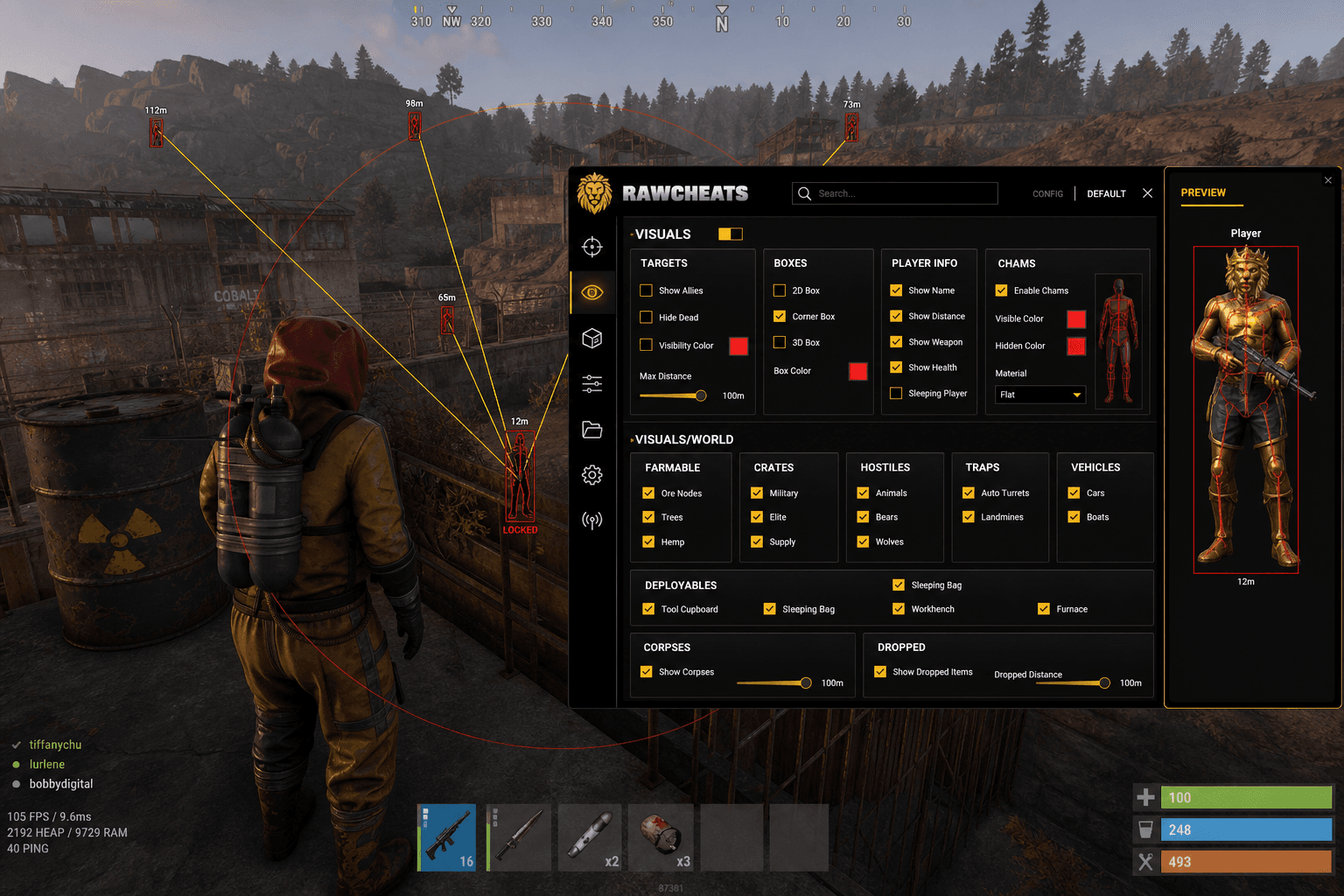
Step-by-step Rust aimbot tuning. Bone priority, FOV cones, smoothness curves, and dynamic recoil compensation for the post-November 2025 spray analyzer.
Facepunch's November 2025 server-side spray-pattern analyzer changed Rust aimbot tuning in a specific way: any cheat shipping static no-recoil scripts now fails within a single mag, and the aim settings that paired with those scripts have to be re-thought from scratch. The January 2026 Facepunch devblog confirmed it directly — "EAC has begun additional efforts targeting recoil cheats." If you tuned a Rust cheat in early 2025 and assumed the same settings would carry into 2026, the analyzer is the reason your account ate a wipe-day ban. Here's the working reference for Raw Rust's aimbot menu under the current anti-cheat reality.
This post is a cluster of the Rust Cheats Complete 2026 Guide pillar. The pillar covered the broader Rust feature landscape. This is the deep tuning reference for the aimbot panel specifically.
The four aimbot controls that actually matter
Raw Rust's aimbot panel has more than a dozen toggles, but four produce 90% of the gameplay difference. Tune these first, leave the rest at defaults.
Bone Priority. Raw Rust ships a draggable priority picker — Head / Chest / Arms / Legs. The bot tries the top slot first; if that bone isn't a valid target (occluded, outside the FOV cone, dead, friendly), it falls down the list. Standard stack for Rust raids and PvP is Head -> Chest -> Arms -> Legs. Rust differs from build-shooters here because there's no spectator-replay culture forcing you to mask headshot rate — every kill is final and the dead player respawns naked across the map, not in the same lobby. The headshot-rate masking that matters in Fortnite tournaments doesn't translate to Rust.
FOV (Field of View) Cone. Slider 0-100% of half-screen width. Lower values restrict the bot to targets near your crosshair; higher values let it lock onto enemies anywhere on screen. The math at 1920x1080: 30% FOV equals roughly 288px radius from center. Rust's first-person camera and the typical 90-degree engagement distance benefit from tighter cones than third-person games — recommend 30-50% for general PvP, 60-70% for raid scouting where situational awareness matters more than pure aim precision, 15-25% if you're streaming and worry about clip-review.
Smoothness. Slider 0-500. Speed of the aim transition from your current crosshair to the locked target. 0 equals instant snap (visibly bot-like). 500 equals slow human-flick speed. Recommended bands: 100-200 for casual / PvE / wipe-day farming, 200-350 for serious PvP, 300-500 for streamed gameplay or sweaty server play where someone might clip your kills. Going below 100 produces snaps that read as obvious mechanical input even in Rust's death-cam-free environment, because the killed player can spectate you in third-person mode briefly during the death animation.
Visible-Only filter. Toggle. When ON, the aimbot ignores enemies hidden behind terrain, rocks, walls, or world geometry. When OFF, the bot will track through-wall targets but won't fire (you'd need an Exploits-tier feature for that and we don't recommend stacking it). Default ON for everything. Visible-Only specifically matters more in Rust than in build-shooters because Rust has so much terrain occlusion — running with Visible-Only OFF in a forest produces a bot that's constantly hunting unrendered targets, which feels wrong in normal play and creates statistical anomalies during long sessions.
Those four settings dialed correctly produce the aim profile that survives 2026 detection windows. Everything else is tuning around the edges.
Auto-prediction handles bullet drop and weapon physics
Raw Rust's aimbot has an auto-prediction toggle that adjusts the aim point for projectile-weapon physics — bullet travel time, gravity drop, and target velocity lead. Rust has meaningful bullet drop starting around 150m and significant lead requirements at 200m+ with the slower-projectile weapons (Bolt Action, L96).
The cheat reads the equipped weapon's actual projectile parameters per shot (muzzle velocity, gravity multiplier, projectile mass) and computes inverse compensation in real time. There's no manual "Bolt Action drop curve" or "AK lead multiplier" slider because the cheat doesn't need one — auto-prediction handles per-weapon physics from the game's own ballistic data.
If a competitor vendor markets per-weapon profile slots ("Bolt Action profile, AK profile, MP5 profile"), they're shipping a 2023-era cheat where manual per-weapon babysitting was a thing. The 2026 auto-prediction model is materially better because it handles weapon swaps mid-fight without the user having to load a different config.
Aim Key + activation modes
Bind the aim key to any keyboard key, mouse button, or controller input. Three activation modes are available in the dropdown:
- Hold — aimbot active only while the key is pressed. Most common mode for Rust because right-click is your aim-down-sights input and pairs naturally with the cheat key. Press to ADS, cheat engages with the same action.
- Toggle — press once to enable, press again to disable. Useful for sustained close-range fights where you don't want a hand committed to holding a key.
- Always — always on. Don't use this on official servers. The lack of player-input gating shows up in statistical analysis as suspicious because there's no observable "decision to use cheat" moment in the input stream.
The Hold-with-right-click setup is the cleanest because it ties cheat activation to the same player input that legitimate ADS uses, which makes the input stream look like a player who simply has very good aim-down-sights tracking.
Dynamic recoil compensation — the November 2025 problem
This is where Rust aimbot tuning diverged from every other 2025-era cheat market. Most Rust cheat marketing through 2024 and early 2025 talked about "no-recoil scripts" as a separate feature from the aimbot — typically delivered as a Logitech G-Hub macro pack, an AHK script, or an external compensation driver. Facepunch's November 2025 server-side spray-pattern analyzer broke those models.
Why static no-recoil scripts fail. Rust weapon recoil is deterministic — every gun has a fixed inverse-curve that produces zero recoil if applied perfectly. The 2024 macro market just played that curve through the mouse driver. Facepunch's analyzer watches the player's input curve during sustained sprays and compares it against the expected human-error distribution. A pixel-perfect inverse-curve is identical every spray (or near-identical with poorly randomized scripts), which reads as machine-generated within one or two engagements. The detection-to-ban window for static scripts dropped to a single session through Q4 2025.
Why dynamic recoil compensation survives. Raw Rust integrates recoil math directly into the aim subsystem. The cheat reads the weapon's current fired-shot state (which shot in the burst, current camera rotation, current spray angle), computes the ideal inverse compensation for the next shot, then applies per-shot jitter drawn from a believable human-error distribution. The jitter parameters are calibrated against real-player spray data so the resulting curve sits inside the human-error band statistically.
Recoil Control tuning. The slider runs 0-100% strength. 0% = no compensation (your raw aim). 100% = mathematically perfect compensation (with dynamic jitter — not the static perfect that the analyzer catches). Recommended range: 70-90%. Going above 90% reduces the jitter-randomization headroom; going below 70% leaves enough recoil that the practical advantage disappears. For Bolt Action / single-shot weapons, recoil is mechanical and consistent; for full-auto weapons, 80% is the sweet spot.
Combine with No Spread and No Sway. Both are toggles, both work alongside dynamic recoil. No Spread eliminates Rust's weapon bloom (the inaccuracy cone applied to non-laser weapons). No Sway eliminates the camera drift when holding a weapon up to scope. Both are part of the Misc panel, both are tuned for compatibility with the post-November 2025 analyzer.
The Misc panel — Rust-specific utilities
The Misc panel surfaces the Rust-flavored exploit toggles that don't fit into the aimbot or ESP categories. Each has a specific use case:
- Instant Eoka. Eliminates the 50% misfire chance on the Eoka pistol. Eoka is Rust's improvised flintlock — useful for early-wipe raids when you don't have proper firearms yet. Instant Eoka makes every Eoka shot a guaranteed fire, which materially changes the early-wipe weapon balance.
- Instant Compound. Eliminates the bow-pull delay on the Compound Bow. Useful for the bow-meta wipes when arrows are competitive with low-tier firearms.
- Thick Bullet. Server-side hitbox amplification — projectiles register hits within a wider radius than the visible target geometry. Higher detection-attention than recoil control because it produces server-side statistical anomalies (impossible-angle hits). Use sparingly.
- Rapid Fire. Removes the rate-of-fire ceiling on semi-auto weapons. Turns semi-autos into effective full-autos. Detection-attention is moderate — the firing-rate anomaly is visible to server-side analysis but isn't always flagged.
The Misc panel toggles are exploit-tier features. Each individually is moderately detectable; stacking three or four of them simultaneously is what produces the "this is clearly cheating" telemetry profile that gets accounts caught fast. Discipline: pick one or two at a time, not the whole stack.
Tuning per play mode
Different defaults for different Rust contexts. Save each as a config slot (Settings -> Configs -> Save) so you can swap presets without re-tuning.
Solo wipe / casual config
- Bone priority: Head -> Chest -> Arms -> Legs
- FOV cone: 60%
- Smoothness: 150
- Visible-only: ON
- Aim key: Right Mouse Button, Hold mode
- Prediction: ON
- Recoil Control: 80%
- Misc: Instant Eoka ON, others OFF
Group wipe / raid scouting config
- Bone priority: Head -> Chest -> Arms -> Legs
- FOV cone: 50%
- Smoothness: 250
- Visible-only: ON
- Aim key: Right Mouse Button, Hold mode
- Prediction: ON
- Recoil Control: 80%
- Misc: All OFF except recoil control (raid scouting needs clean telemetry)
Sweaty server / streamer config
- Bone priority: Chest -> Head -> Arms -> Legs (reduces headshot rate in death-cam spectator view)
- FOV cone: 25%
- Smoothness: 380
- Visible-only: ON
- Aim key: Right Mouse Button, Hold mode
- Prediction: ON
- Recoil Control: 70%
- Misc: All OFF
Wipe-day rush config (first 24 hours after force wipe)
- Bone priority: Head -> Chest -> Arms -> Legs
- FOV cone: 40%
- Smoothness: 200
- Visible-only: ON
- Aim key: Right Mouse Button, Hold mode
- Prediction: ON
- Recoil Control: 75%
- Misc: All OFF (high-monitoring window — don't stack risk)
These are starting points. Fine-tune from there based on your mouse sensitivity, monitor size, and play style. The Setting up Rust cheats safely cluster covers the wipe-day pre-flight including how to verify status before pushing aggressive settings.
Controller support
Raw Rust supports binding the aim key to any controller button (trigger, bumper, or face button). One of the few cheats in the niche that handles non-keyboard-mouse input correctly. The aimbot otherwise operates the same way regardless of input device — bone priority, FOV, smoothness, visible-only all work identically.
The shared SDK that powers Raw Rust also powers Raw Fortnite, Raw Overwatch, and the rest of the lineup — so controller support is the same across all six products. If you've used Raw Fortnite with a controller, Raw Rust feels identical.
Common tuning mistakes that get accounts caught
- Max FOV (100%) plus low smoothness (0-50). Produces snap-aim across the entire screen, which is the canonical machine-input signature even outside the spray analyzer's scope. Caught within days.
- Static no-recoil at 100% strength. Even with dynamic compensation enabled, pushing recoil strength to 100% reduces the jitter headroom enough that the analyzer can catch the residual pattern. Cap at 85-90%.
- Always-mode aim key with no input gate. No observable cheat-activation event in the input stream is a behavioral-analysis flag. Caught in 14-30 days even with otherwise-clean settings.
- All Misc toggles on simultaneously. Instant Eoka + Instant Compound + Thick Bullet + Rapid Fire stacked on the same account produces a statistical profile that's unambiguously machine-generated. Pick one or two at most.
- Skipping the spoofer. The fastest way to convert a single ban into a permanent cross-EAC fingerprint problem. Always run Raw Spoofer before launching the game.
The disciplined approach is conservative defaults plus dynamic recoil at 75-85% plus aim-key gating, with Misc toggles used selectively. The How Rust anti-cheat works cluster covers why the four-layer detection model makes discipline matter more in Rust than in less-monitored games.
Frequently asked questions
What FOV cone should I run for streaming? 15-30%. Tighter than ranked, tight enough that the aim assist isn't visible in a clip-review of your stream. Rust's death-cam briefly shows the killing player in third-person during the kill animation, which is the closest analog to spectator replay — a wide FOV cone produces visible bot-tracking in those frames.
Does smoothness above 400 actually feel slow in fights? Slightly, yes. At smoothness 400-500 the aim transition takes long enough that a fast peek-and-shoot exchange may finish before your aim fully tracks. This is a feature — it forces engagements that look human-paced. If you want every fight won purely mechanically, you don't need a cheat; you need an aim trainer.
Is dynamic recoil compensation actually undetectable? No cheat is undetectable forever. Dynamic recoil compensation survives the November 2025 analyzer because the per-shot jitter sits inside the human-error distribution the analyzer expects. Detection windows for properly-tuned dynamic compensation have spanned multiple monthly Facepunch sweeps. Static scripts get caught in single sessions. The difference is engineering, not magic.
Should I bind a separate key for No Spread or Rapid Fire? For Rapid Fire, yes — many users bind it to a side-mouse button so they can engage it only for specific shots (e.g., when finishing a wounded target with a semi-auto). For No Spread, leave it as a session-level toggle rather than per-shot. The detection-attention math favors keeping individual exploits behind activation gates rather than always-on.
Can I run the aimbot alone without recoil control or Misc? Yes, and we recommend it for the first 10-20 hours on a new account. Aimbot alone (bone priority + FOV + smoothness + visible-only + prediction) is the cleanest setup and produces sustained survival. Add recoil control after the account has some legit-feeling playtime; add Misc toggles selectively after that.
Are silent aim or magic bullet features available on Rust? Silent aim is in the Exploits-tier feature class — different category from the core aimbot, exploit-attention level. Magic bullet (hits regardless of crosshair direction) is not in Raw Rust because the detection-attention is too high and the practical value over Silent Aim is marginal. The Rust ESP and loot ESP cluster goes deeper on what visibility-tier features the product surfaces.
How does Raw Rust compare to Battlelog's aim settings? Battlelog is a reseller marketplace — their Rust offering sources from upstream Russian-language developers and the recoil compensation is usually static scripts marketed as dynamic. Survival rates against the November 2025 analyzer are accordingly poor. The Raw Rust vs PHCheats vs Battlelog cluster runs the side-by-side comparison.
Tune Raw Rust for your wipe routine. Get Raw Rust from $4.99 and load the solo / group / streamer / wipe-day configs above as starting points. Pair with Raw Spoofer before every session — the cross-EAC fingerprint risk is real. Check the Rust ban wave history for the monthly cadence so you can time your push-aggressive sessions away from the first-Thursday sweep window.