
PUBG HWID Spoofer Guide — Why Volume Serial Coverage Matters
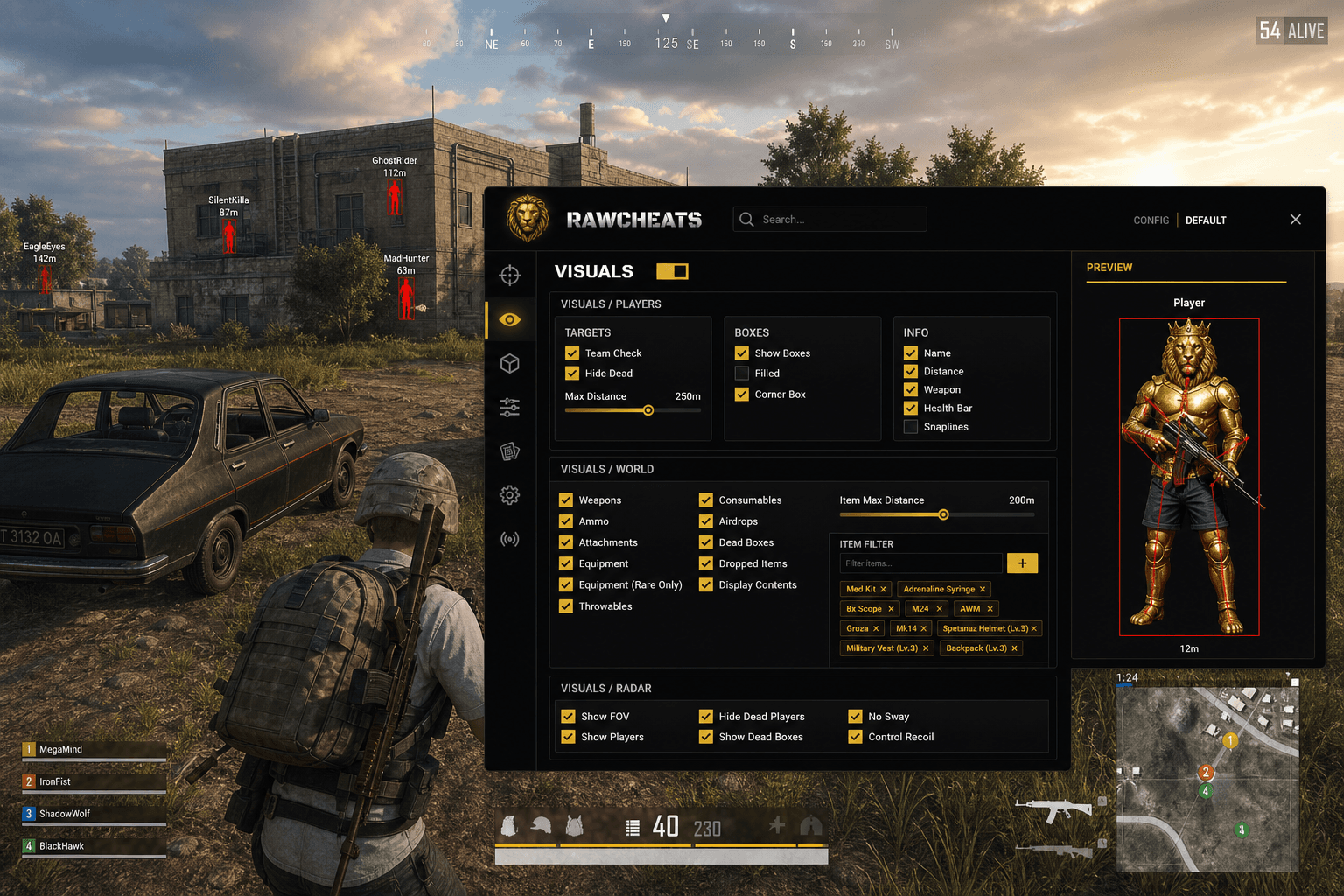
BattlEye reads Volume Serial. Most spoofers miss it. Full 16-identifier surface for PUBG HWID bans plus Krafton 2026 hardware re-entry blocks.
The PUBG ban that catches you isn't always the account ban — it's the hardware ban that follows it. BattlEye's fingerprinting catalogs 16+ hardware identifiers per session, Krafton's 2026 Anti-Cheat Roadmap explicitly reinforced hardware re-entry blocks in the March 25, 2026 post, and approximately 260,000 DMA-specific permabans across 2025 were paired with hardware-fingerprint records that follow your motherboard, storage, and GPU into any new account you create on the same machine. The detail most cheap spoofers miss: Volume Serial. It's a NTFS-level identifier BattlEye reads alongside the hardware-level identifiers, and a spoofer that handles motherboard serial / GPU UUID / MAC address without touching Volume Serial leaves a backdoor wide open for the ban to re-attach.
This post is a cluster of the PUBG Cheats Complete 2026 Guide pillar. The pillar covered HWID bans at a high level. This piece is the deep technical reference for what BattlEye reads, what Krafton's hardware re-entry blocks check, and what a spoofer needs to handle to keep your hardware un-flagged.
What BattlEye actually reads at session start
The ACM MATE Workshop 2025 peer-reviewed paper on BattlEye's reverse-engineered behavior catalogs the fingerprint surface. The secret.club analysis supplements with older but corroborated data. Combined, the public-knowledge surface is approximately 16 distinct identifier categories:
- Motherboard Serial Number — read via SMBIOS table queries.
- Motherboard UUID — separate from serial, a 16-byte GUID assigned at manufacture.
- CPU Serial Number — Intel and AMD CPUs expose serial via CPUID instruction (where supported).
- GPU Device ID + Serial — PCI configuration space reads.
- MAC Address (all NICs) — Ethernet + WiFi adapters enumerated.
- HDD/SSD Serial Numbers — IDENTIFY DEVICE command.
- Volume Serial Numbers — NTFS-level, per-volume identifier. The one most spoofers miss.
- RAM Module Serials — SPD data from each DIMM.
- Monitor EDID + Serial — DDC/CI queries to the display.
- USB Controller IDs — PCI configuration space.
- BIOS UUID — SMBIOS read.
- TPM Endorsement Key — TPM 2.0 module identifier.
- Computer Name — Windows registry / NetBIOS.
- Windows Installation ID — registry-stored Microsoft ID.
- Disk GUIDs — partition table-level identifiers.
- Audio Device IDs — speakers, headphones enumerated.
Plus contextual fingerprint dimensions Krafton may correlate server-side: IP address class, Steam account age, payment method history, time-zone alignment, hardware spec consistency. Those aren't "hardware identifiers" in the strict sense, but they're part of the multi-signal correlation that ties bans to identity.
A spoofer that handles 8 of these 16 identifiers leaves the other 8 as ban-attachment points. Volume Serial is the single most-missed of the lot.
Why Volume Serial specifically matters for PUBG
Volume Serial is the 32-bit identifier NTFS writes to the boot sector of each volume when the volume is created. It persists across normal Windows operations — formatting a partition rewrites it, but mounting, unmounting, even Windows reinstall on the same partition keeps it (until reformatting). It's distinct from the physical drive serial number; it's a software-level identifier that BattlEye queries via standard Windows API calls.
Why BattlEye queries it: because it's harder to forge at the OS level than the SMBIOS-reported hardware serials. The hardware serials can be queried but can be overridden by drivers; Volume Serial requires either a real format or a sector-level patch. A cheater who randomizes their SMBIOS reports but doesn't touch Volume Serial leaves an obvious mismatch — "this hardware claims to be different but the NTFS volume signature is identical to the banned account's volume."
Krafton's 2026 hardware re-entry blocks specifically check for this kind of cross-identifier consistency. Spoofing five hardware identifiers but leaving Volume Serial intact produces a signature that's more suspicious than not spoofing at all.
Raw Spoofer handles Volume Serial in the standard 16-identifier coverage. Most basic spoofers either don't, or do it incorrectly (rewriting only one volume when multiple volumes are present).
How HWID bans actually attach to your hardware
The mental model most users have is wrong. They think: account got banned → BattlEye stored my hardware ID → my hardware is on a banlist forever. The reality is more granular and more recoverable.
The actual flow when a PUBG account gets banned:
- BattlEye reads all 16+ identifiers at session start (and periodically during the session for re-validation).
- The fingerprint set gets paired with the Steam account ID and stored server-side.
- When the account is banned, Krafton's server flags the fingerprint set as "associated with banned account."
- When ANY future account boots PUBG with a fingerprint set that matches more than a threshold percentage of the banned fingerprint, the new account inherits ban status.
The threshold percentage is key. Krafton doesn't ban on a single-identifier match (too many false positives from shared corporate hardware, internet cafes, etc). They ban on cumulative match — if 8 of 16 identifiers match a banned set, you're flagged. If 4 of 16 match, you're probably fine.
The spoofer's job is to push that match count below threshold. The strategy isn't to spoof every single identifier (some don't change across legitimate hardware reboots and would look suspicious if randomized too aggressively); the strategy is to randomize enough that match count drops below detection threshold.
What a proper spoofer changes
Raw Spoofer's 16-identifier coverage:
- Motherboard Serial → randomized per session
- Motherboard UUID → randomized per session
- CPU Serial → spoofed at SMBIOS layer
- GPU Serial → PCI config space modification
- MAC Addresses → spoofed at NIC driver layer (all NICs)
- HDD/SSD Serials → IDENTIFY DEVICE response modified
- Volume Serial Numbers → randomized per volume (the one others miss)
- RAM Serials → SPD spoof at memory controller
- Monitor EDID → DDC query interception
- USB Controller IDs → PCI config layer
- BIOS UUID → SMBIOS layer
- TPM Endorsement → kernel-driver interception
- Computer Name → registry layer
- Windows Installation ID → registry layer
- Disk GUIDs → partition table layer
- Audio Device IDs → enumeration layer
Coverage at this depth requires kernel-driver-level access. Userland spoofers can hit the easy identifiers (registry-stored values, NIC MAC addresses) but can't reach SMBIOS, PCI config space, or TPM. That's why the spoofer needs to be a kernel-mode driver, not a userland EXE.
Cross-BattlEye ban risk — why PUBG spoofer choice matters beyond PUBG
A BattlEye ban from PUBG doesn't stay in PUBG. The same fingerprint set is shared with BattlEye's central infrastructure, which means the hardware ban can affect:
- Escape from Tarkov — BattlEye-protected, fingerprint shared.
- Rainbow Six Siege — BattlEye-protected, fingerprint shared.
- Arma 3 / Reforger — BattlEye-protected.
- DayZ — BattlEye-protected.
- PUBG: New State (mobile) — separate fingerprint pipeline.
If you cheat in PUBG without a spoofer and eat a BattlEye ban, your other BattlEye-protected games may inherit the ban. Tarkov bans propagating from PUBG cheating is documented behavior. The cross-game ban risk is unique to BattlEye titles — EAC bans on Fortnite don't propagate to Apex (different EAC instances), but BattlEye's centralized fingerprinting means PUBG bans do propagate to Tarkov and R6.
This is why the spoofer isn't optional for PUBG cheating — it's the difference between losing one account and losing your entire BattlEye-game library.
The Krafton 2026 hardware re-entry block reinforcement
Krafton's March 25, 2026 Anti-Cheat Roadmap specifically named "reinforced hardware re-entry blocks" as one of five priorities. The roadmap text didn't disclose technical specifics, but the implication based on what Krafton has shipped previously:
- Additional identifier categories. Expanding from the current ~16 fingerprint surface to include newer Windows-tracked identifiers (TPM 2.0 keys, Pluton processor IDs on supported hardware, secure-boot endorsement keys).
- Tighter threshold scoring. Reducing the cumulative match percentage required to inherit a ban — making it harder to escape with partial spoofing.
- Behavior-correlated re-entry detection. Combining hardware fingerprint with behavioral fingerprint (matchmaking patterns, payment timing, IP geolocation consistency) to ban accounts whose hardware looks new but behavior looks like a returning banned user.
The defense against all three: deeper spoofer coverage and behavioral hygiene (don't reuse the same Steam payment method, IP, time zone as your banned account).
The standard workflow for using Raw Spoofer with PUBG
Cold-boot order matters. The wrong sequence leaves identifiers exposed to BattlEye before they're randomized.
- Cold-boot Windows. Don't open Steam yet.
- Run Raw Spoofer as administrator. UAC prompt; accept.
- Enter spoofer license key. Single-pane window; license field is at the top.
- Click "Spoof". Kernel driver loads; identifiers randomize over the next 2-3 seconds. Spoofer logs each identifier change in the GUI.
- Wait for "Spoof complete" confirmation. Don't proceed until you see this.
- Run Raw PUBG loader. Standard load sequence.
- Launch PUBG via Steam. BattlEye initializes after PUBG launches; by that point the spoofed identifiers are already in place.
The wrong sequence — launching Steam before running the spoofer, or running PUBG before clicking Spoof — leaves a window where BattlEye can read the real identifiers. The Setting up PUBG cheats safely cluster covers the full workflow with screenshot-level detail.
What happens when you already have a hardware ban
If you ate a BattlEye / Krafton hardware ban before running the spoofer, the recovery path is:
- Spoof BEFORE creating the new Steam account. If you create the new account on the un-spoofed hardware, the new account is linked to the same fingerprint and gets flagged on first PUBG launch.
- Use a new Steam account. Old account can't be unbanned (Krafton's 2026 false-ban review system is H2 2026 and only for false positives).
- New payment method. Reusing the same credit card on the new Steam account creates a payment-correlation signal Krafton can use to re-link.
- New IP. VPN to a region you don't normally play, or wait for ISP to assign a new IP.
- Behavioral hygiene. Don't queue at the same times, don't play with the same friends list, don't use the same gear / settings that might fingerprint your play style.
Most of this is overkill for casual ranked play but matters for tournament-tier accounts or repeat-offender recovery. The economic reality: a $4.99 Raw Spoofer subscription is cheaper than buying a new motherboard.
FAQ
What is Volume Serial? A 32-bit identifier NTFS writes to the boot sector of each volume when the volume is created. It persists across normal Windows operations and is queried by BattlEye via standard Windows APIs. Distinct from the physical drive's hardware serial.
Why do most spoofers miss Volume Serial? Because randomizing it correctly requires writing to the volume's boot sector at the disk layer — most userland spoofers can't, and many kernel-driver spoofers don't bother because Volume Serial wasn't part of BattlEye's fingerprint surface in 2018. It's been included since the 2020 BEDaisy revision but the cheap-spoofer market hasn't caught up.
Does running a spoofer break my Windows install? No. Raw Spoofer changes identifiers in-memory and at driver-interception layers; nothing is written to your actual hardware or partition table. On reboot, identifiers return to defaults until you re-run the spoofer.
Can I run the spoofer once and then keep cheating across sessions? No. Identifiers reset on reboot. Run the spoofer at every cold-boot before launching Steam / PUBG.
Does the spoofer protect against DMA-specific detection? Partially. Hardware spoofing addresses BattlEye's PCI configuration-space scan to the extent the spoofer covers PCI identifiers. But DMA detection is multi-signal (behavioral analysis, firmware fingerprinting on the FPGA itself, network-level latency analysis); spoofing the OS-visible identifiers alone doesn't fully neutralize DMA detection. The DMA discussion in the pillar covers more.
Does the spoofer work with Windows 11? Yes — Windows 10 and Windows 11 both supported. TPM 2.0 endorsement key spoofing is the Windows 11-specific feature; older Windows 10 hardware without TPM 2.0 doesn't need it.
Is Raw Spoofer a separate product or bundled with Raw PUBG? Separate product — Raw Spoofer at $4.99/day standalone. Most cheaters buy both. Some discount tiers bundle them; check the Raw Spoofer product page for current pricing.
What about MAC address randomization built into Windows? Windows' built-in MAC randomization changes the MAC address for WiFi network privacy. It doesn't randomize SMBIOS, Volume Serial, or any of the other ~14 identifiers BattlEye reads. Useful for general privacy; not a substitute for a proper spoofer.
Pair with the rest of the stack
The spoofer is one piece of a full PUBG cheating stack. The aimbot side at PUBG aimbot settings — No-Sway, Control Recoil; the ESP side at PUBG ESP 12-toggle world filter; the broader anti-cheat technical context at How PUBG anti-cheat works; the setup workflow at Setting up PUBG cheats safely.
Raw Spoofer ships 16-identifier coverage including Volume Serial. Pair with Raw PUBG and the full PUBG Cheats Complete 2026 Guide pillar. Cross-context HWID spoofer coverage at the HWID Spoofer Complete 2026 Guide pillar.