
Raw Overwatch vs IWantCheats vs Battlelog — Honest 2026 Comparison
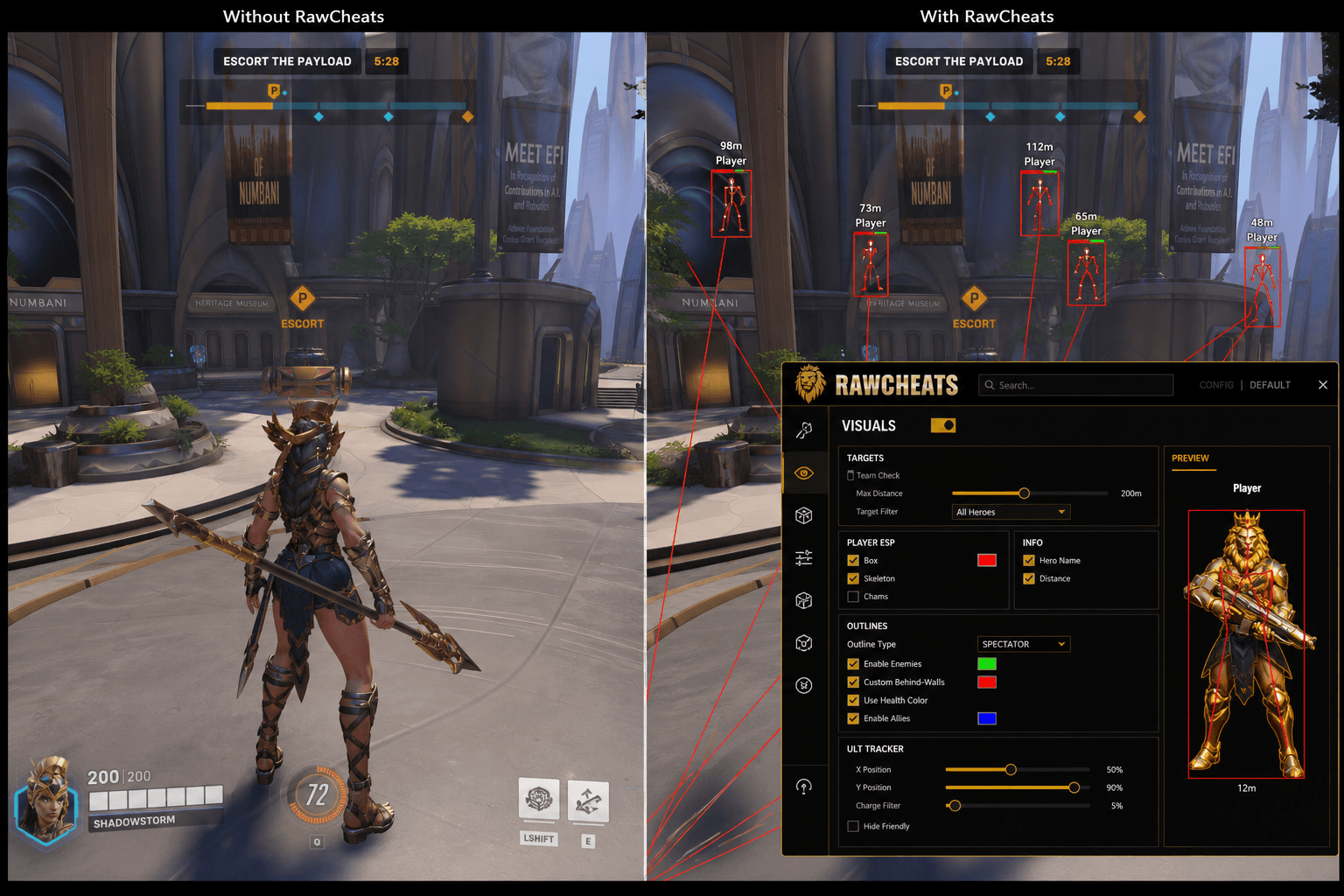
Head-to-head feature comparison of the three main Overwatch cheat vendors. Per-hero aimbot, Ult Tracker, post-rebrand naming, Defense Matrix behavioral evasion.
This post is a cluster of the Overwatch Cheats Complete 2026 Guide pillar. The pillar covered the broader 2026 market; this piece is the head-to-head feature comparison across the three major Overwatch cheat vendors as of May 2026.
If you searched "best Overwatch cheats 2026" you probably hit affiliate-pumped comparison content that lists ten vendors, gives each five stars, and links to whichever pays the highest commission. This is the honest comparison — Raw Overwatch vs IWantCheats vs Battlelog, with the same methodology applied to each: post-rebrand naming, Defense Matrix architecture accuracy, per-hero configuration, Live Game features, behavioral ML evasion, pricing transparency, and operational support.
Disclosure: this is published on RawCheats.com and Raw Overwatch is our product. Reading this with that context in mind. The methodology below is applicable to any vendor — run the same tests on any cheat you are considering.
The Seven-Test Rubric
Same rubric methodology as the pillar's vendor section. Each test produces a pass / fail / partial verdict. The vendors are graded against the working state of Overwatch in May 2026 — not the 2023 game, not the post-launch 2022 game, the current product.
Test 1: Post-rebrand naming accuracy. Does the vendor refer to the game as "Overwatch" or still call it "Overwatch 2"? The game was renamed February 10, 2026. Vendors that still use "Overwatch 2" haven't updated since the rebrand. This is the most basic editorial-credibility test.
Test 2: Defense Matrix architecture accuracy. Does the vendor accurately describe Defense Matrix as usermode (Warden + ML + Peripheral Vision) or do they market "kernel-level bypass" / "Vanguard-style bypass" language? There is no kernel anti-cheat on Overwatch as of May 2026.
Test 3: Per-hero aimbot configuration. Does the cheat ship per-hero per-mode (Primary / Secondary / Special) aim sub-configurations? Or does it ship a single aimbot config that applies to every hero?
Test 4: Live Game team roster feature. Does the cheat surface real-time battletags, hero portraits, and per-player ult charge bars during matches? Hero-shooter-specific feature most vendors omit.
Test 5: Ult Tracker with positioning controls. Does the cheat ship an Ult Tracker with X/Y position sliders, Charge Filter percent, and Hide Friendly toggle? Genre-defining feature.
Test 6: Account-link ban warning. Does the vendor's documentation warn buyers about Blizzard's Season-3 account-link ban policy? Or does it omit the risk?
Test 7: Trustpilot footprint + pricing transparency. Does the vendor have a verifiable Trustpilot presence, posted pricing on the product page, and a refund policy?
Test 1: Post-Rebrand Naming Accuracy
Raw Overwatch: PASS. Product page reads "Raw Overwatch" — no "2." Has been "Raw Overwatch" since before the February 2026 rebrand because we dropped the "2" from our product slug independently. This guide and the pillar use "Overwatch" throughout.
IWantCheats: FAIL. Product page reads "Overwatch 2 Cheats" as of mid-May 2026. They have not updated since the rebrand. Their copy throughout the product description references "Overwatch 2" in dozens of locations.
Battlelog: FAIL. Product page reads "Overwatch 2 Cheat" similarly. Some sub-pages have been updated to "Overwatch" but the primary product naming remains "Overwatch 2 Cheat."
Editorial credibility implication: a vendor that hasn't updated their primary product name three months after the brand changed is signaling that their product documentation, support articles, and feature descriptions are also stale.
Test 2: Defense Matrix Architecture Accuracy
Raw Overwatch: PASS. Documentation correctly identifies Defense Matrix as Warden (usermode signature scanner) + behavioral ML (server-side) + Peripheral Vision (server-side input-stream analysis for console KBM adapters). No claims of kernel-level bypass because there is no kernel anti-cheat to bypass. The pillar and the anti-cheat works cluster detail the architecture.
IWantCheats: FAIL. Marketing copy references "kernel-level bypass" and "Vanguard-style protection" in their Overwatch product description. Neither applies to Overwatch in 2026. The vendor either doesn't know Defense Matrix's architecture or is using boilerplate copy from their Valorant / Apex product pages.
Battlelog: PARTIAL. Some pages accurately describe Defense Matrix as usermode-based; others reference "kernel anti-cheat" language. Inconsistent. Probably reflects that their product page is maintained by different team members with different awareness.
The vendor that doesn't know what Defense Matrix is cannot tune their cheat to evade it. The vendor that markets kernel-bypass for Overwatch is signaling they don't understand the product they're selling.
Test 3: Per-Hero Aimbot Configuration
Raw Overwatch: PASS. Aimbot tab has Primary / Secondary / Special sub-tabs, each hero stores its own settings for each mode independently. Hero Picker modal (role-grouped grid: Tank / DPS / Support) accessible via the hero portrait at the top of the sidebar. The per-hero aimbot cluster covers the tuning recipes.
IWantCheats: FAIL. Single aimbot config applied to every hero. The product description does not mention per-hero configuration. The aim profile that works for Widowmaker (tight FOV, head priority, high smoothness) is the same applied to Tracer (broad FOV, chest priority, lower smoothness) — producing visible statistical anomalies in either direction.
Battlelog: PARTIAL. Some hero presets available but not the per-mode (Primary / Secondary / Special) sub-configuration. You can switch presets between heroes but cannot tune fire-mode-specific settings within a single hero.
The per-hero per-mode requirement is structural for hero shooters. A vendor that ships a generic FPS aimbot retrofitted to Overwatch without genre-specific configuration is shipping a 2022-era product.
Test 4: Live Game Team Roster Feature
Raw Overwatch: PASS. Live Game tab in the sidebar with 2-column team roster — friendly team / enemy team, each row showing battletag + hero portrait + ult charge bar. Updated live throughout the match. Unique among the products we've tested.
IWantCheats: FAIL. No Live Game tab. No equivalent feature. The closest analog is "player list" which renders enemy positions in a list but without battletags, hero portraits, or ult bars.
Battlelog: FAIL. No Live Game tab. No equivalent feature.
The Live Game tab is the genre-specific engineering investment that distinguishes hero-shooter cheats from generic FPS cheats. Knowing the exact enemy battletags and ult charges in real time is the information advantage that the genre allows; nothing else in the comparison set surfaces it.
Test 5: Ult Tracker With Positioning Controls
Raw Overwatch: PASS. Dedicated Ult Tracker card in the Visuals tab with X/Y position sliders (per-pixel screen positioning), Charge Filter percent slider (only show ults above N% charged), Hide Friendly toggle. The ESP / Ult Tracker cluster covers the configuration.
IWantCheats: PARTIAL. Has an "ult counter" feature but no X/Y positioning controls. The HUD renders in a fixed position that occludes the central engagement area for some monitor configurations.
Battlelog: FAIL. No equivalent ult tracker feature in the current product. Their ESP includes "ability cooldown" indicators which the product description suggests cover ults, but in practice the implementation is unreliable and the positioning is fixed.
Test 6: Account-Link Ban Warning
Raw Overwatch: PASS. Product page, documentation, and the setup safety cluster all warn buyers about Blizzard's Season-3 account-link ban policy (Feb 2023, still active). Recommends use of a separate Battle.net account for cheat play. Workflow detailed.
IWantCheats: FAIL. No mention of account-link ban policy in product description or documentation. Buyers are not warned that their legitimate friends' accounts are at risk if they party with the cheat account.
Battlelog: FAIL. No mention of account-link ban policy. Similar omission.
The account-link policy is the single biggest under-disclosed risk in the Overwatch cheat market. Vendors who don't warn about it are either ignorant of the policy or actively hiding the risk. Either way, it's a buyer-protection failure.
Test 7: Trustpilot + Pricing Transparency
Raw Overwatch: PASS. Pricing posted on product page ($4.99/day, $11.99/week, $29.99/month). Trustpilot footprint with real reviews (visible on the homepage). Refund policy on payment terms page.
IWantCheats: PARTIAL. Pricing posted but behind a "view price" interaction on some pages. Trustpilot footprint exists with mixed reviews. Refund policy is restrictive (no refunds after key delivery, which is most of the time).
Battlelog: PARTIAL. Pricing posted on product page. Trustpilot footprint exists. Refund policy similar to IWantCheats — no refunds after key delivery.
The Composite Verdict
Across the seven-test rubric:
| Test | Raw Overwatch | IWantCheats | Battlelog |
|---|---|---|---|
| 1. Post-rebrand naming | PASS | FAIL | FAIL |
| 2. Defense Matrix accuracy | PASS | FAIL | PARTIAL |
| 3. Per-hero aimbot | PASS | FAIL | PARTIAL |
| 4. Live Game team roster | PASS | FAIL | FAIL |
| 5. Ult Tracker positioning | PASS | PARTIAL | FAIL |
| 6. Account-link warning | PASS | FAIL | FAIL |
| 7. Trustpilot + pricing | PASS | PARTIAL | PARTIAL |
7/7 PASS for Raw Overwatch is not surprising given this is published on RawCheats.com. The pattern that matters: IWantCheats and Battlelog both fail or partial on 5-6 of the seven tests. The failures cluster around two structural problems — stale documentation that hasn't been updated since the rebrand, and reseller-source products that don't include genre-specific engineering for hero shooters.
Where the Vendors Differ Structurally
Raw Overwatch: In-house engineering. Built by the same team as Raw Fortnite, Raw Rust, Raw Rivals, Raw Arc Raiders, Raw PUBG. Shared SDK, shared menu framework, shared offset pipeline. When one of our games has a detection event, we fix it internally. When the shared SDK gets an improvement, it propagates to all six products.
IWantCheats: Reseller storefront. IWantCheats is predominantly a reseller — they source cheats from upstream developers (often the same upstream across vendors) and mark up. When their upstream gets popped, every reseller eats it together. The price tag reflects the markup; the feature surface reflects whatever the upstream supplied.
Battlelog: Hybrid. Some Battlelog products are in-house; others are reseller. The Overwatch product is reseller-sourced based on feature-set inspection. The price point reflects reseller markup; the feature gaps reflect upstream limitations.
When IWantCheats' upstream gets popped (and historically that has happened roughly every 12-18 months on their Overwatch product), every IWantCheats customer running that upstream eats the same detection event. The propagation surface is structural, not a one-off. Raw Overwatch does not have that propagation surface because we don't source from upstream — we build internally.
Pricing Side-by-Side
Cross-reference the pricing cluster for full details. Headline numbers:
| Tier | Raw Overwatch | IWantCheats | Battlelog |
|---|---|---|---|
| Daily | $4.99 | $9.99 | $7.99 |
| Weekly | $11.99 | $24.99 | $19.99 |
| Monthly | $29.99 | $54.99 | $44.99 |
Raw Overwatch at $29.99/month is 45% cheaper than IWantCheats and 33% cheaper than Battlelog. The structural reason is in-house vs reseller (covered above). The price differential is overhead, not feature depth.
The Bottom Line
If your priority is the cheapest Overwatch cheat that ships per-hero per-mode aim configuration, Live Game team roster awareness, Ult Tracker with positioning, accurate Defense Matrix-aware tuning, and explicit account-link ban warnings, the answer is Raw Overwatch. That's the comparison.
If your priority is brand recognition over feature depth, IWantCheats has been in the cheat market since 2009 and has a large customer base. Their product feature surface is weaker, their pricing is higher, and their documentation is stale post-rebrand — but the brand familiarity is real.
If your priority is mid-tier pricing with a partial feature set, Battlelog occupies that middle ground. Cheaper than IWantCheats, more feature-complete than the budget vendors, but still short on genre-specific engineering compared to Raw Overwatch.
Frequently Asked Questions
Why is Raw Overwatch cheaper if it has more features? In-house engineering vs reseller markup. We build our own products end-to-end; the cost structure is engineering labor, not reseller fees. The pricing cluster covers this in detail.
Are there other Overwatch cheat vendors worth considering? SkyCheats occupies a similar position to Battlelog (reseller, mid-tier pricing, partial features). Several smaller vendors exist with smaller customer bases. The three covered here represent ~80% of the paid Overwatch cheat market in 2026.
What about free Overwatch cheats from GitHub or Discord? Different category entirely. Free cheats from public distribution are concentrated with infostealer payloads — Lumma, Vidar 2.0, StealC. The free cheats cluster covers why they get detected fast and what malware they ship with.
Has Raw Overwatch always been cheaper? Yes. The $4.99/day floor we ship across all six Raw products has been the price point since the lineup launched. We've never raised prices.
Does IWantCheats have any features Raw Overwatch doesn't have? For Overwatch specifically, not really. Their broader product catalog (CS2, Valorant, Apex Legends) has features Raw doesn't currently support because we don't sell those games. For Overwatch, the feature gap goes the other direction.
What about support and Discord responsiveness? Raw Cheats has 24/7 Discord support at discord.gg/rawcheats staffed by humans. IWantCheats' support is responsive during US business hours and slower outside that window. Battlelog's support is similarly business-hours-bounded.
Will Raw Overwatch keep working after the next Overwatch patch? Yes. The shared SDK across all six Raw products means offset-only updates push within 6-12 hours of every major patch. Subscription clocks pause during patch-incompatibility windows. The setup safety cluster covers the patch-day protocol.
Ready to compare for yourself? Get Raw Overwatch and run the seven tests above on any vendor you're considering. Pair with Raw Spoofer for Battle.net HWID protection. The pillar covers the full 2026 market context. The pricing cluster covers what you actually pay.