
How Overwatch Defense Matrix Anti-Cheat Actually Works in 2026
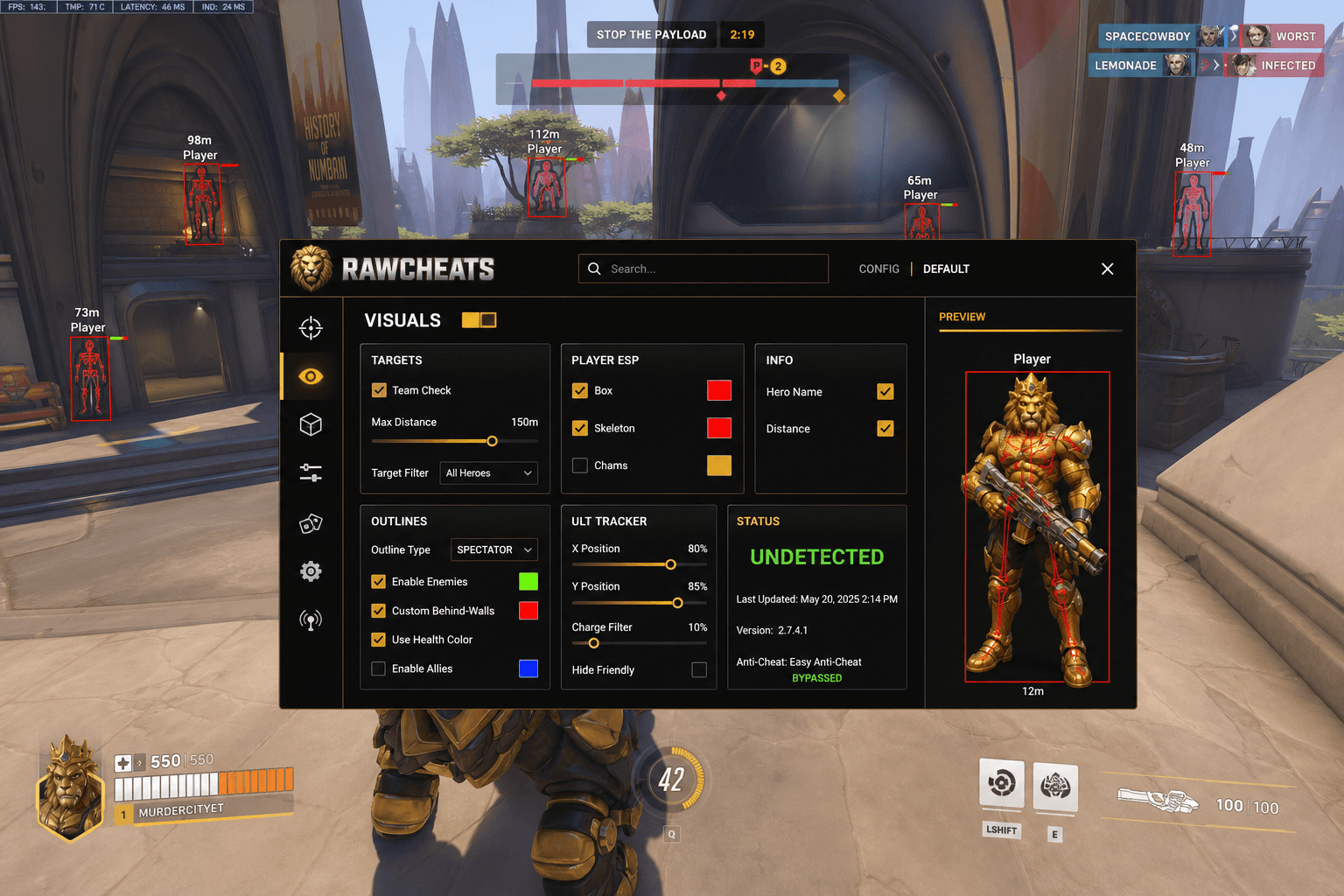
Defense Matrix runs entirely in usermode — Warden + behavioral ML + Peripheral Vision. No kernel driver as of May 2026. Here is the full architecture.
This post is a cluster of the Overwatch Cheats Complete 2026 Guide pillar. The pillar covers the broader 2026 market and the February rebrand context; this piece goes deep on the technical architecture of Defense Matrix itself.
If you are reading "Overwatch 2 anti-cheat" content elsewhere, two things are likely wrong with it. First, the game stopped being called "Overwatch 2" on February 10, 2026 — Blizzard rebranded back to just "Overwatch" after the Spotlight 2026 announcement on February 4. Second, almost every "how the anti-cheat works" article online describes either the 2023 Defense Matrix or assumes parity with Vanguard/EAC/BattlEye kernel anti-cheats. Neither is current. As of May 2026, Defense Matrix is still entirely usermode — there is no kernel driver, no ELAM boot driver, no TPM endorsement-key read. That is the load-bearing fact for the entire Overwatch cheat market in 2026.
The Three-Layer Architecture
Defense Matrix in 2026 is not a single product. It is a three-layer stack and only the first layer runs in your process at all.
Layer 1 — Warden (usermode signature scanner). Warden is the in-process signature scanner Blizzard has shipped across Battle.net titles since the World of Warcraft era. It loads inside the Overwatch process, scans game memory for known cheat signatures, and reports findings to Blizzard's anti-cheat backend. Warden has been reverse-engineered for over a decade — the architecture is well-understood and the source of detection windows is statistical sampling, not kernel sweeps. Warden cannot scan memory outside the Overwatch process. That is the structural reason external software cheats survive longer on Overwatch than on every other major FPS we cover.
Layer 2 — Behavioral ML on Blizzard's servers. This is the layer almost nobody talks about because it is server-side and you cannot reverse-engineer it. Blizzard has publicly confirmed machine-learning models for chat moderation (voice-to-text plus text classification). Anti-cheat ML is implied but Blizzard has not publicly confirmed aim-input or movement classification specifically — although Defense Matrix posts reference "anti-cheat technology in development" without specifics. The models flag statistical anomalies — headshot percentage distributions, angular-velocity profiles, reaction-time consistency, kill-streak vs MMR bracket mismatch — for either automated soft action or manual review.
Layer 3 — Peripheral Vision (server-side input-stream analysis). Launched August 29, 2025 via the Defense Matrix Peripheral Vision post on overwatch.blizzard.com. Peripheral Vision targets XIM / Cronus / ReaSnow console keyboard-and-mouse adapters by analyzing input-stream characteristics on accounts flagged as console. The first enforcement window produced 23,000+ actions. This layer is irrelevant to PC software cheats but worth knowing about — it represents Blizzard's most aggressive 2025-2026 anti-cheat investment, and the engineering attention went there rather than into a kernel driver.
What Is NOT in the Stack
Defense Matrix in May 2026 does not include any of the following: no kernel-mode driver, no ELAM (Early Launch Anti-Malware) boot driver like Riot Vanguard, no TPM 2.0 endorsement-key reads, no Microsoft Remote Attestation (which Activision deployed in Call of Duty Black Ops 7 — but that is Ricochet, a separate Activision-Blizzard project), no Pluton chip-to-cloud attestation, no IOMMU mandate (which Epic introduced for Fortnite tournaments in February 2026).
This is unusual in 2026. Every other major FPS we cover has at least kernel-mode AC: Riot Vanguard on Valorant, Easy Anti-Cheat on Fortnite plus Rust plus Marvel Rivals, BattlEye on PUBG plus Arc Raiders (companion to Anybrain), NetEase NeacSafe on Marvel Rivals as primary, Activision Ricochet on Call of Duty. Overwatch is the only major FPS where the anti-cheat does not touch ring 0.
Why Hasn't Blizzard Shipped a Kernel AC?
The honest answer is that Blizzard has not publicly explained the decision. What we can observe: kernel anti-cheats are expensive engineering investments with significant ongoing maintenance — Riot allocates dozens of engineers full-time to Vanguard, Epic has the same scale on EAC. Blizzard's Overwatch team has been reorganized multiple times since the Microsoft acquisition closed in late 2023, and Defense Matrix posts since 2024 cite priorities focused on accessibility (peripheral detection, smurf detection, ML chat moderation, account-link enforcement) rather than ring-0 engineering.
Microsoft has not publicly directed Blizzard to ship a Vanguard-equivalent. The April 23, 2026 We Are Xbox rebrand consolidated Microsoft Gaming under the Xbox brand but came with no anti-cheat-related statement. Activision's Ricochet (kernel AC for Call of Duty) and Blizzard's Defense Matrix (no kernel) remain operationally separate products within the same parent company. Whether this changes in late 2026 or 2027 is open — the cheat infrastructure most serious vendors run is built to absorb a future kernel-AC shift without customers needing to redownload binaries.
What Warden Actually Does at Runtime
Warden loads inside the Overwatch process at startup. It is a usermode DLL — it does not run with kernel privileges. It cannot see memory outside Overwatch, it cannot scan kernel drivers, it cannot read PCIe device tables, it does not register kernel callbacks on process creation. What it can do:
- In-process signature scans. Warden walks Overwatch's address space and compares memory regions against signature hashes streamed from Blizzard's anti-cheat backend. Signatures are hashes of known cheat code patterns the company has previously flagged. Internal-mode cheats that inject DLLs into Overwatch are highly visible to Warden because their code lives where Warden scans.
- Pattern matching on suspicious code modifications. Hooks placed in Overwatch's own code (function-prologue redirects, IAT patches, inline detours) are visible to Warden.
- Statistical telemetry export. Warden sends per-frame data to Blizzard's behavioral analytics pipeline, feeding Layer 2's ML models.
- Self-integrity checks. Warden validates that its own image has not been tampered with by a cheat that obtained the Overwatch process handle first.
What Warden does not do well, historically: catch external memory readers, kernel-resident cheats, DMA cards, or anything that operates from outside the Overwatch process address space. That gap is the structural reason Raw Overwatch is engineered as an external cheat rather than an injected one.
The Behavioral ML Layer — The Actual Long-Term Threat
Most Overwatch cheat content focuses on Warden because Warden is the visible layer. The cheats that get caught at scale in 2026, however, are caught by Layer 2 — Blizzard's server-side behavioral analytics. Warden catches signature-detectable cheats in hours to days. Layer 2 catches well-built private cheats in weeks based on statistical patterns.
The models look at things like:
- Headshot rate distribution. Real Widowmaker players have headshot percentages that vary engagement-to-engagement and cluster around values that depend on the player's rank. A player consistently hitting above 55-60% headshots across hundreds of engagements stands out statistically — even if every individual shot looks plausible. This is the threshold cheat vendors who tune for Defense Matrix avoid.
- Angular velocity profile. When a real player flicks to a target, the aim curve has a characteristic acceleration-and-overshoot shape produced by hand-eye coordination. Aimbots with pure mathematical interpolation produce cleaner curves that read as machine-generated to spectral analysis.
- Reaction time consistency. Humans have variable reaction times — 180ms one engagement, 240ms the next, 210ms the next. Cheats with fixed reaction delays produce suspiciously tight distributions.
- Kill-streak vs MMR-bracket mismatch. A player in Diamond lobbies suddenly producing Grandmaster-tier performance triggers anomaly flags faster than the kill streak alone would.
- Pre-fire timing. Real players react to peeks. Cheats with wallhack can fire before the peek finishes. The timing gap between "enemy crosses peek threshold" and "first shot" is a Layer 2 signal.
This is why disciplined Overwatch cheaters tune for statistical plausibility — smoothness 200-400 range, randomized per-engagement reaction timing, FOV cones in the 15-30° band for hitscan heroes, headshot caps below 55%. Most casual buyers max everything and get caught by Layer 2 within 14-30 days. The Flippy false-positive case (March 2026, Dexerto coverage) is the inverse evidence — Defense Matrix's behavioral models are sensitive enough to false-positive on legitimate RGB driver smoothing, which means they are sensitive enough to catch competently-tuned cheats too.
Peripheral Vision — Why Console Adapters Stopped Working
Peripheral Vision is the third Defense Matrix layer and the most-discussed Blizzard anti-cheat investment of the 2024-2026 period. XIM and Cronus hardware adapters translate keyboard-and-mouse input into virtual controller signals on PS5 and Xbox — the console reads the input as controller, the console-side aim-assist designed for thumbsticks applies to keyboard-and-mouse inputs, and the result is aimbot-tier tracking without ever running cheat software.
Blizzard's response was server-side input-stream analysis. The system watches for keyboard-and-mouse-shaped input patterns coming from accounts marked as console. The adapter manufacturers continually evolve their firmware to evade detection but Blizzard's pattern-matching has caught up since the August 2025 launch. Enforcement is account-level — suspension on first detection, permanent on repeated.
For PC cheat buyers, Peripheral Vision is irrelevant — it targets a different attack vector. We do not sell console cheats. But the layer matters for crossplay context: PC players occasionally face console XIM users with adapter-aim, and reports filed against console accounts feed into Peripheral Vision's enforcement pipeline alongside Defense Matrix's standard PC cheat enforcement.
What This Means for Cheat-Buyer Decisions
If you are shopping for an Overwatch cheat in 2026, the Defense Matrix architecture translates into specific buyer-side tests:
- Does the vendor accurately characterize the anti-cheat? A vendor whose pitch references "kernel-level bypass" or "Vanguard-style bypass" for Overwatch does not know what they are selling. There is no kernel anti-cheat on Overwatch. Look for vendors who name Warden, behavioral ML, and Peripheral Vision specifically.
- Does the cheat ship with humanization tuned for Layer 2? A vendor whose only anti-detection language is about signature evasion is shipping a 2023-era product. The actual long-term threat is behavioral ML — Widowmaker headshot caps, randomized reaction timing, smoothed angular-velocity distributions matter as much as Warden evasion. The Overwatch aimbot settings per hero cluster covers the conservative tuning baseline.
- Is the cheat external or internal? External design is structurally harder for Warden to detect because Warden cannot scan memory outside the Overwatch process. Raw Overwatch is external for this reason.
- Is HWID spoofing bundled or upsold cleanly? Defense Matrix HWID bans exist and the cross-Battle.net ban risk affects Diablo, World of Warcraft, and other Blizzard titles. Always run Raw Spoofer alongside the cheat. The Overwatch HWID spoofer Battle.net guide cluster covers Battle.net fingerprinting specifically.
Frequently Asked Questions
Does Overwatch use kernel-mode protection? No, not as of May 2026. Defense Matrix runs entirely in usermode (Warden in-process scanner) plus server-side ML plus server-side input-stream analysis (Peripheral Vision). There is no kernel driver, no ELAM boot driver, no TPM endorsement-key read. This is unusual in 2026 — every other major FPS we cover has at least kernel-mode AC.
Why doesn't Blizzard ship a kernel anti-cheat? Blizzard has not publicly explained. Educated speculation: kernel anti-cheats are expensive engineering investments and Blizzard's Overwatch team has been reorganized multiple times since the Microsoft acquisition. Defense Matrix posts cite priorities focused on accessibility (peripheral detection, smurf detection, ML moderation) rather than ring-0 engineering. Microsoft has not publicly directed a kernel shift as of May 2026.
Will Defense Matrix get a kernel driver in 2026 or 2027? No public indication of this. Whether it happens later is open. The April 23, 2026 We Are Xbox rebrand was a corporate identity change with no anti-cheat-related statement. The Activision Ricochet (kernel) and Blizzard Defense Matrix (no kernel) products remain operationally separate.
Can Warden detect external cheats? Less effectively than internal cheats. Warden loads inside the Overwatch process and scans memory there — it cannot sweep memory outside the process. External cheats that read Overwatch's memory from a separate process are structurally less visible to Warden than DLL-injected internal cheats are.
What's the difference between Defense Matrix's ML and Warden? Warden is the in-process usermode signature scanner — it scans memory for known cheat patterns. ML is server-side and analyzes telemetry — aim curves, headshot rates, reaction times, kill-streak distributions. Warden catches signature-detectable cheats fast (hours to days). ML catches well-built undetected cheats slowly (weeks). The two layers complement each other.
How long do Overwatch cheats stay undetected on average? Free public cheats from Discord servers and GitHub repos: hours. Mid-tier paid cheats: weeks. Top-tier private cheats with active engineering and Defense Matrix-aware tuning: months to indefinite, dependent on user discipline (conservative settings, account-link ban avoidance, HWID spoofer use). The Overwatch ban wave history 2023-2026 cluster covers the enforcement cadence.
Ready to play under Defense Matrix in 2026? Raw Overwatch is tuned for Warden-clean memory profiles plus Layer 2 behavioral plausibility. Pair it with Raw Spoofer for Battle.net HWID protection and read the post-rebrand pillar for the full 2026 market context.