
Overwatch HWID Spoofer — Battle.net Fingerprinting Guide 2026
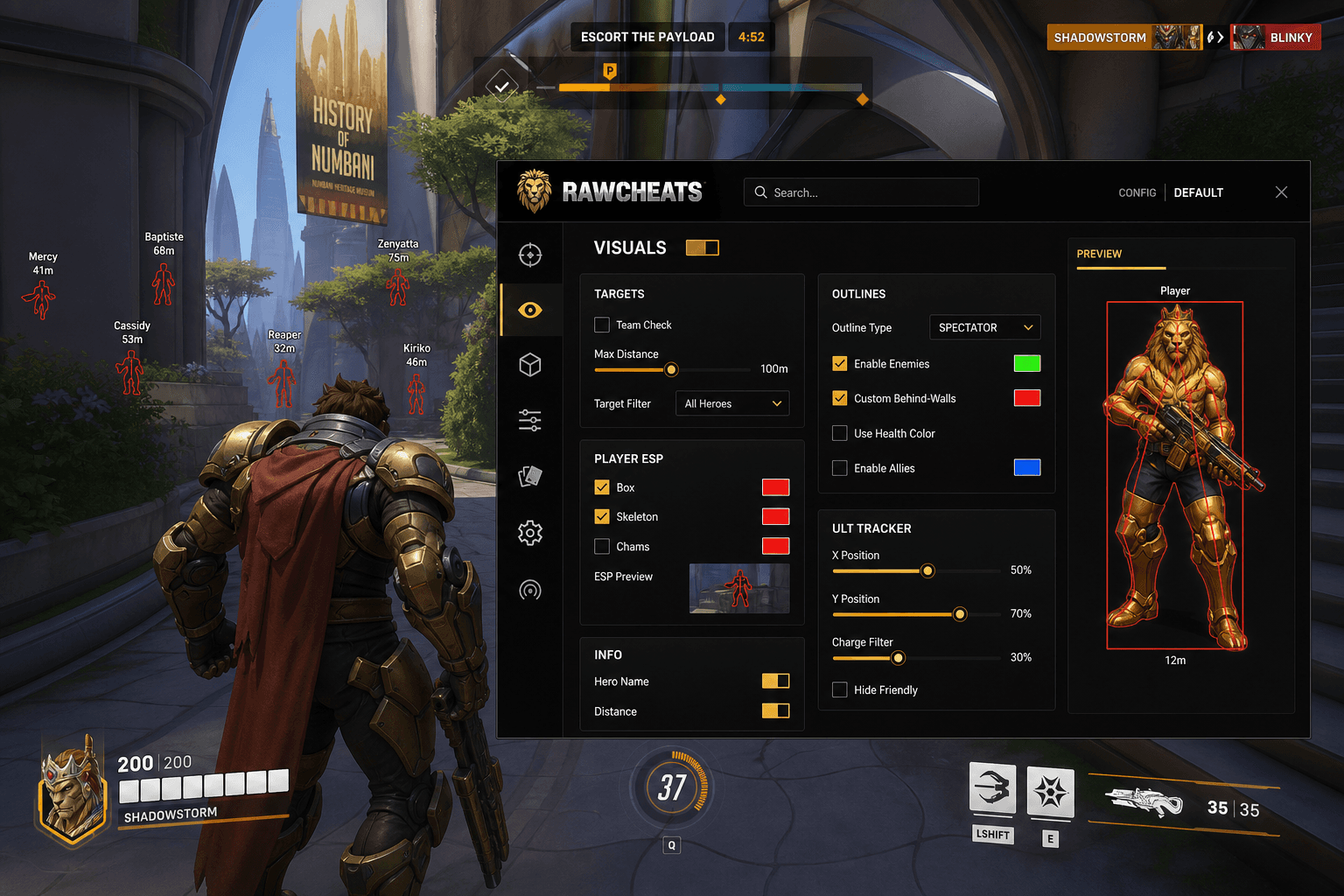
Why HWID spoofer priority is lower for Overwatch than EAC/BattlEye games — but still recommended. Cross-Battle.net ban risk to Diablo, WoW, others.
This post is a cluster of the Overwatch Cheats Complete 2026 Guide pillar. The pillar covered Defense Matrix architecture broadly; this piece goes deep on the HWID layer — what Battle.net fingerprints, how cross-Battle.net bans propagate, and why HWID spoofer priority is different from EAC/BattlEye titles.
Most "Overwatch HWID spoofer" content online assumes the same enforcement model that applies to Fortnite (EAC) or Rust (EAC) or PUBG (BattlEye). It is not the same. Defense Matrix runs entirely in usermode as of May 2026 — there is no kernel driver reading hardware identifiers ring-0-style. Battle.net's fingerprinting is more limited than EAC's or BattlEye's. That does not mean you can skip the spoofer, but it does change the calculus around what a spoofer needs to do and how aggressive you need to be about HWID hygiene.
What Battle.net Actually Fingerprints
Battle.net's launcher and the in-game Defense Matrix telemetry collect a hardware fingerprint subset that is meaningfully smaller than EAC's. Based on observed behavior across 2024-2026 Defense Matrix posts and community reverse-engineering:
Confirmed reads:
- Battle.net Account ID (your BattleTag — the primary identity layer; not a hardware value but the most important fingerprint)
- MAC address (network interface, the historically primary hardware identifier)
- HDD / SSD serial number (storage volume identifier)
- Motherboard serial (read from SMBIOS / DMI tables)
- CPU model and stepping (CPUID, not unique-per-CPU but a fingerprint component)
Suspected but unconfirmed:
- GPU model identifier (not unique-per-GPU, but a fingerprint component)
- Windows install GUID (Windows machine identifier read from registry)
- Battle.net hardware unique ID (a derived value the launcher computes during account creation)
NOT read by Battle.net (as of May 2026):
- TPM 2.0 endorsement keys (Riot Vanguard does this; Defense Matrix does not)
- IOMMU device identifiers (Epic Games introduced this for Fortnite tournaments Feb 2026; not on Overwatch)
- Monitor EDID (some kernel anti-cheats read this; Defense Matrix does not)
- PCIe device tables ring-0 enumeration (impossible — Defense Matrix has no kernel driver)
- BIOS UUID full read (partial read via SMBIOS but not the kernel-mode forensic-grade read EAC does)
The smaller fingerprint surface is the structural reason Overwatch HWID enforcement is less aggressive than EAC/BattlEye games. Fewer values to read means fewer values to ban on.
How Battle.net's HWID Bans Work
When Defense Matrix issues a ban, the enforcement chain has two layers:
Account-level ban. The BattleTag is suspended or permanently banned. Cannot log into Overwatch (or any other Battle.net game with the same BattleTag) on that account. Most common enforcement action.
Hardware-level ban (HWID ban). The hardware fingerprint hash is added to a blocklist. Creating a new Battle.net account on the same machine becomes restricted — the new account either cannot log in to Overwatch at all, or gets shadow-flagged for accelerated detection on the next anomaly. Less common but documented in community reports.
The HWID ban is the layer the spoofer addresses. The account-level ban is unfixable post-issuance — the spoofer cannot resurrect a banned BattleTag, only enable a new BattleTag to play normally on the same hardware.
The Cross-Battle.net Ban Risk
Here is the under-discussed risk: Battle.net is not Overwatch-specific. The platform also hosts Diablo IV, Diablo II Resurrected, World of Warcraft, StarCraft II, Hearthstone, Heroes of the Storm, Warcraft III Reforged, and several others. Your BattleTag is the same identity across all of them.
In theory, an Overwatch cheating ban could propagate to your Diablo / WoW / SC2 accounts under the same BattleTag. In practice, this rarely happens as of 2026 — Blizzard's typical enforcement is Overwatch-specific even when the BattleTag is shared. But the policy reserves the right to apply, and the risk is real for high-value accounts.
The mitigations:
- Separate Battle.net accounts. Use a dedicated BattleTag for Overwatch cheat play. Different email, different account creation, different identity.
- HWID spoofer at session boundaries. Raw Spoofer at $4.99 randomizes the hardware fingerprint before each cheat session. If your cheat-Tag gets banned and the HWID is randomized, the ban does not propagate to your other accounts that played from the same machine because their hardware fingerprint was different at the time.
- Don't link Battle.net accounts socially. Do not add your cheat-Tag to your main-Tag's friends list. The social-graph correlation is what triggers account-link bans (covered in the pillar).
When to Run the Spoofer
The disciplined workflow:
- Cold-boot Windows. Don't open Battle.net or Overwatch yet.
- Run Raw Spoofer. Administrator privileges required. Enter spoofer license. Identifiers randomize for the session. Confirmation screen shows new values.
- Launch Battle.net. First time post-spoof, the launcher will treat the machine as a new device — may trigger SMS verification on accounts with 2FA. This is expected.
- Launch Overwatch. Inject Raw Overwatch loader after the game reaches main menu.
- Play.
- Reboot after the session. The spoofer state does not persist across reboots; the next session is a fresh randomization.
The spoofer is not a one-time-install fire-and-forget product. The randomization is session-bound. Running the spoofer once a month and then playing dozens of cheat sessions on the same fingerprint defeats the purpose — every session shares one fingerprint, and if any one session is detected, every prior session is now associated.
Spoofer + Cheat Compatibility
Raw Spoofer is designed to run alongside Raw Overwatch and the other Raw products. The spoofer randomizes hardware identifiers; the cheat reads game state and renders the menu. The two products are in-house engineered together, so the spoofer does not collide with the cheat's loader infrastructure.
Third-party spoofers (HWID Patcher, others) are not guaranteed compatible. Some randomize values that Raw Overwatch's loader needs to read for its own session-initialization, which produces loader errors. If you are running a non-Raw spoofer, expect more setup friction.
Why HWID Spoofer Priority Is Lower for Overwatch
Compared to other titles in our lineup:
Fortnite / Rust / Marvel Rivals (EAC). HWID spoofer is mandatory. EAC reads a forensic-grade hardware fingerprint via its kernel driver, including TPM endorsement-key reads, motherboard serial, GPU device serial, RAM module IDs, monitor EDID, USB controller IDs, BIOS UUID. The fingerprint is comprehensive and persistent. EAC HWID bans propagate across every EAC game (Fortnite ban affecting Rust, Apex, Star Citizen, dozens more).
PUBG / Arc Raiders (BattlEye). HWID spoofer is mandatory. BattlEye reads a similar forensic-grade fingerprint via its kernel driver. BattlEye HWID bans propagate across every BattlEye game.
Overwatch (Defense Matrix). HWID spoofer is recommended but lower-priority. Defense Matrix's fingerprint is shorter and shallower (no kernel reads). Cross-Battle.net ban risk exists but is less aggressively enforced than cross-EAC. The spoofer's value is real but the urgency is meaningfully lower than for EAC or BattlEye titles.
Translation: if you have one spoofer subscription budget and you are choosing what to protect first, Fortnite / Rust / Arc Raiders / PUBG / Marvel Rivals all benefit more from the spoofer than Overwatch does. Overwatch is the easiest game in our lineup to play without a spoofer — but easier is not zero-risk. The $4.99 monthly for Raw Spoofer is still the right call.
Common HWID Spoofer Mistakes
Running the spoofer after Battle.net is already open. Battle.net reads the fingerprint on launcher startup; spoofing after the read changes nothing for the current session. Spoof first, then launch Battle.net.
Running the spoofer without admin rights. The spoofer needs administrator privileges to modify the kernel-accessible identifiers (motherboard serial via SMBIOS write). Without admin, it silently fails partial-coverage and you think you are protected when you are not.
Sharing one BattleTag between cheat sessions and legit play. Defeats the purpose of the spoofer entirely. The BattleTag is the primary identity — if it is banned, the spoofer cannot save the account. Use separate BattleTags.
Skipping the spoofer because Defense Matrix has no kernel AC. True that the fingerprint is shorter, but the cross-Battle.net propagation risk still exists. The spoofer is cheap insurance.
Running the spoofer once and assuming protection lasts forever. The randomization is session-bound. Every session should start with a fresh spoof.
What HWID Bans Actually Look Like
If you eat an HWID ban on Overwatch, the symptoms:
Immediate symptom. Creating a new BattleTag on the same hardware results in either an immediate ban on the new account (rare — usually requires Defense Matrix flagging the new account as suspicious first) or an immediate shadow-flag where the new account gets accelerated detection on the next anomaly (more common).
Persistent symptom. The hardware fingerprint hash is in Blizzard's blocklist. Defense Matrix will continue to apply heightened scrutiny to any account playing Overwatch from that hardware until the fingerprint is randomized.
Recovery. Run Raw Spoofer with admin rights. Confirm the randomization output. Create a new BattleTag with a fresh email. Launch Battle.net, then Overwatch. The new account starts at zero scrutiny.
Frequently Asked Questions
Does Overwatch have HWID bans? Yes. Defense Matrix issues HWID bans on confirmed cheaters, though less aggressively than EAC or BattlEye. The HWID ban adds the hardware fingerprint hash to a blocklist that affects new accounts created on the same machine.
Does an Overwatch HWID ban affect my Diablo or WoW account? Rarely in practice as of 2026 — Blizzard's typical enforcement is Overwatch-specific. But the policy reserves the right. For high-value Diablo / WoW accounts, use a separate BattleTag for Overwatch cheat play and run Raw Spoofer.
Do I need a spoofer to play Raw Overwatch? Not strictly required for the cheat to function, but strongly recommended for clean operations. Of all six game cheats we ship, Raw Overwatch has the most generous HWID-side margin (Defense Matrix's smaller fingerprint surface), but spoofer use is still the disciplined baseline.
How is Battle.net's fingerprint different from EAC's? EAC reads ~12-15 hardware identifiers via its kernel driver including TPM endorsement keys, motherboard / GPU / RAM serials, monitor EDID, BIOS UUID, USB controller IDs. Battle.net reads a smaller subset (~4-7 values) via usermode launcher code without TPM, without monitor EDID, without ring-0-grade forensic detail. Fewer values = smaller ban surface = less aggressive enforcement.
Can I share a BattleTag with my main account? Don't. The BattleTag is the primary identity layer. Bans target BattleTags directly. Use a separate BattleTag with a different email and different account creation for cheat play.
Will a Battle.net 2FA SMS verification be triggered by the spoofer? Often yes. The spoofer makes the launcher think the machine is a new device, which triggers Battle.net's "new device" 2FA challenge on accounts with SMS protection enabled. Expected and not a sign of detection.
Does Raw Spoofer work with Vanguard or Ricochet too? Different games have different fingerprint surfaces. Raw Spoofer is engineered to cover the common surface across the games we support (EAC, BattlEye, Defense Matrix, Anybrain, FairFight, RICOCHET to varying degrees, FACEIT to varying degrees). For Vanguard specifically (Valorant), specialized spoofers exist; we do not currently support Valorant.
Ready to clean up your Battle.net HWID hygiene? Get Raw Spoofer for $4.99. Pair with Raw Overwatch for Defense Matrix-aware aim humanization. The pillar covers the full anti-cheat layer architecture. Cross-reference the HWID Spoofer Complete 2026 Guide pillar for the broader spoofer market.