Free Overwatch Cheats — Why They Get Detected (and Steal Your Account)
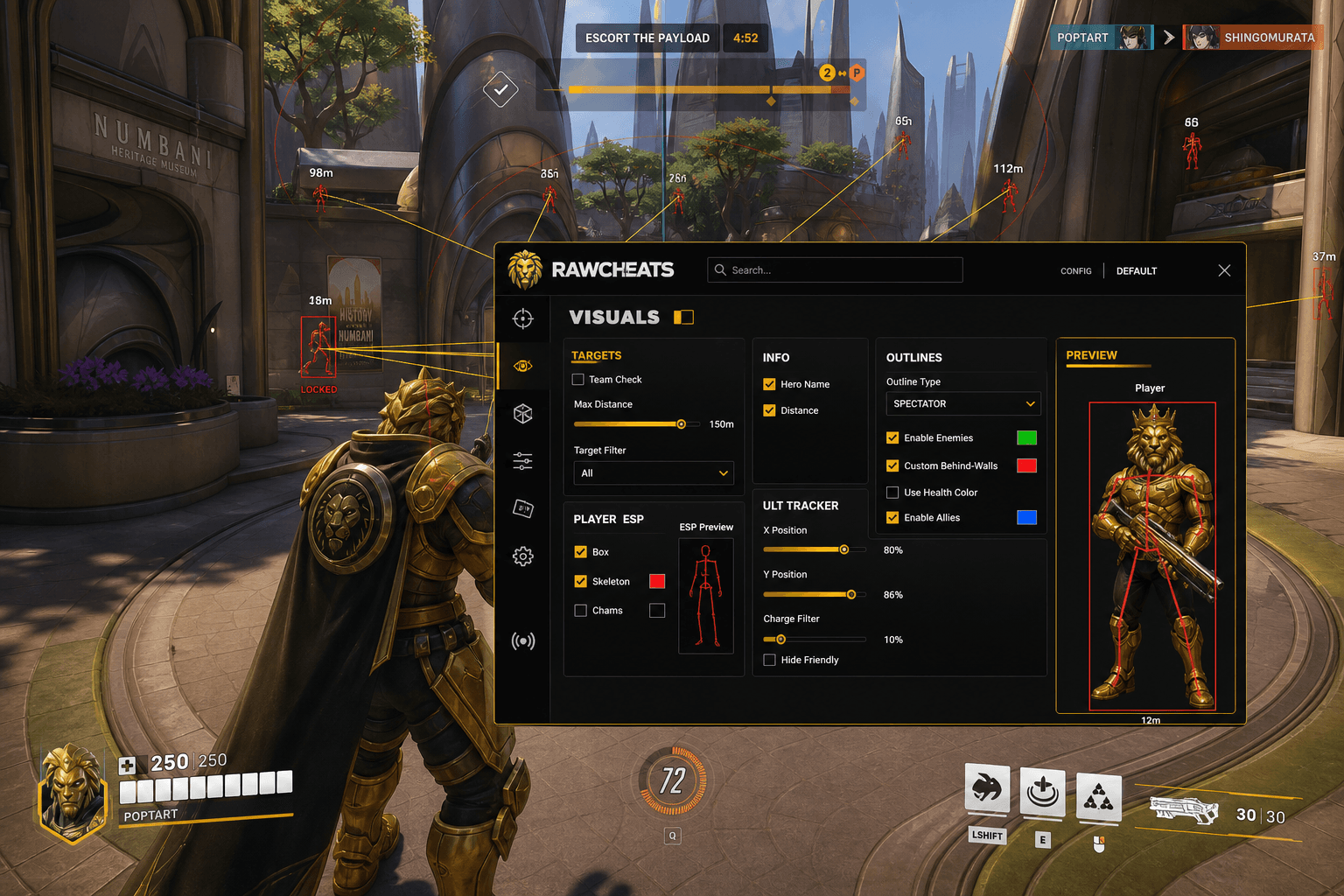
Free Discord-distributed Overwatch cheats are concentrated with Lumma / Vidar 2.0 infostealer payloads. Why account-link bans amplify the cost of infections.
This post is a cluster of the Overwatch Cheats Complete 2026 Guide pillar. The pillar covered the broader 2026 market; this piece goes deep on the bottom of the market — free Overwatch cheats distributed via Discord, Telegram, GitHub, and shadier corners of the internet.
If you searched "free Overwatch cheats" in 2026 you probably hit GitHub repositories with star counts in the hundreds, Discord servers promising "undetected aimbot," YouTube videos with executable downloads in the description, and Telegram channels listing version numbers. Almost all of them are infostealer payloads. The malware exfiltrates Steam tokens, Discord tokens, Battle.net credentials, browser-saved passwords, crypto wallet keys, and any other valuable data the binary can scrape from your machine. The Acronis Threat Research Unit has published detailed analysis of Vidar Stealer 2.0 specifically distributed through fake game cheats; the same pattern applies to Overwatch.
Reading this if you are considering downloading a free cheat: stop, close the tab, come back when you have the spare $5 for a real one or use Raw Overwatch's $4.99 daily. The economics of the free-cheat market are not what they appear.
The Free Cheat Market Economics
Why does a free Overwatch cheat exist? Cheats cost engineering effort to build. Defense Matrix-aware tuning, ESP rendering, ult tracker implementation, Battle.net launcher compatibility — these are weeks of skilled engineering. Nobody builds free cheats out of love for the cheat market.
The economics of the free cheat distribution model:
Infostealer payload distribution. The cheat binary is a delivery mechanism for malware. The "cheat" works (sometimes — most free cheats are non-functional shells anyway) but the actual purpose is to drop Lumma Stealer, Vidar 2.0, StealC, or similar infostealer onto your machine. The stealer exfiltrates everything valuable and the cheat operator monetizes the stolen credentials. Acronis TRU's analysis shows this is the dominant distribution model for free game cheats across the entire gaming market.
Stolen account resale. Stolen Steam accounts with hours played and inventory items have direct resale value on stolen-account marketplaces. Battle.net accounts with Diablo / WoW progression have direct resale value. Discord accounts with verified Nitro have direct resale value. Crypto wallet keys have direct resale value (or direct drainage). The infostealer monetizes by selling the harvested credentials in bulk.
Cryptocurrency drainer. Some free cheats include a hot-wallet drainer that reads MetaMask / Phantom / browser-extension wallet seed phrases from local storage and drains them. The drainer is the second-most-common revenue stream after credential resale.
Botnet recruitment. Some free cheats install a botnet client that joins your machine to a DDoS-for-hire botnet or a cryptocurrency miner. Less common in 2026 (mining returns are bad) but documented.
A free cheat that "just works" without any malware payload does not exist commercially because no one is building it.
What the Infostealers Actually Steal
A representative Lumma Stealer / Vidar 2.0 payload (per Acronis TRU's documented samples) exfiltrates:
Browser data:
- Saved passwords from Chrome, Firefox, Edge, Brave, Opera, others
- Browser cookies (session tokens for every logged-in site)
- Browser extension data (MetaMask, Phantom, other wallet extensions)
- Browser bookmarks (used to identify which sites you frequent for follow-on phishing)
- Browser autofill data (credit cards, addresses)
Application credentials:
- Steam session tokens (logged-in Steam account access)
- Discord tokens (logged-in Discord account access)
- Battle.net stored credentials
- Epic Games, EA, Ubisoft launcher tokens
- Telegram Desktop session data
- Microsoft Outlook / Teams session data
Cryptocurrency:
- Wallet seed phrases stored locally
- Wallet.dat files from desktop wallets
- Browser extension wallet data
- Hardware wallet helpers (Ledger Live, Trezor Suite) if present
System data:
- Saved Wi-Fi passwords
- VPN client credentials
- FTP / SSH stored credentials
- Anything else the stealer's exfiltration list targets
The exfiltration happens fast — typical Lumma sample completes its first round in 30-90 seconds after first execution. By the time you realize the "cheat" doesn't work, your credentials are already on the infostealer operator's collection server.
The Account-Link Ban Amplification
Specific to Overwatch: the account-link ban policy (active since February 2023, Blizzard blog 23910164) means that even if the free cheat itself works briefly before Defense Matrix catches it, your account ban can propagate to your legitimate friends who party with you.
The scenario:
- You download a free "Overwatch aimbot" from Discord.
- The infostealer in the binary scrapes your Battle.net credentials and any browser-stored credentials.
- Operator immediately changes your password and starts using your Battle.net account from their machine to grief or cheat.
- Defense Matrix catches the operator's cheating on YOUR account within hours.
- Your account gets banned.
- Your legitimate friends who regularly party with you become eligible for account-link bans because they "willingly group up regularly" with a confirmed cheater.
Step 6 is the worst outcome. Your friends did nothing wrong. Their accounts get suspended because they trusted you to play legitimately. The "free" cheat cost you and your friends their Battle.net accounts.
Why Free Cheats Get Detected Fast
Even if a free cheat's binary is somehow free of infostealer payload (rare), the cheat itself gets detected within hours to days. The reasons:
Public distribution = known signature. The moment a cheat is published on GitHub or a Discord server, its binary is publicly available. Defense Matrix's Warden signature scanner downloads the binary, hashes it, adds the hash to the signature database. Within hours every Overwatch session running that cheat gets flagged.
No engineering investment in evasion. Paid cheat vendors employ engineers full-time to evade signature scanning, monitor for new Defense Matrix detection patterns, and patch the cheat after every detection event. Free cheats have no equivalent investment. When the signature gets added, the cheat is dead — the operator does not patch it, they release a new "Overwatch aimbot v2.4" with the same code and a different binary hash, and the cycle repeats.
No HWID spoofer integration. Paid cheat vendors bundle or integrate with HWID spoofers. Free cheats don't include spoofers. The first detection event HWID-bans your hardware.
No behavioral humanization. Free cheats max every setting because they don't have the engineering depth to tune for Defense Matrix's behavioral ML. The cheat is detected by Layer 2 (ML) within days even if it survives Layer 1 (Warden).
No active offset updates. Overwatch patches change memory layouts. Paid cheats ship offset-only updates within hours of every patch. Free cheats break the moment Overwatch patches and never get fixed.
The average free Overwatch cheat lifespan in 2026 is 6-48 hours of detection-free play before the signature gets added and the cheater eats a ban. The infostealer in the binary, by contrast, completes its credential exfiltration in 30-90 seconds.
The "But This Specific One Is Different" Trap
Every cheat forum and Discord server has someone claiming "this particular free cheat is different, it's been undetected for months." Treat these claims with extreme skepticism. The patterns to look for:
Sock-puppet endorsements. New accounts with no history endorsing a cheat. The accounts are operated by the cheat distributor or paid for via Fiverr.
Vague "trusted member" markers. "Verified by community" badges that have no verification process. Discord roles handed out by the distributor.
Disabled comments / private channels. Free cheats that hide their distribution channels behind verification gates. The gates are not security — they're laundry to prevent independent reviewers from documenting the malware.
"Pay for premium version" upsells. Free cheat that pushes you to a $30 "premium" version which is the same code with the malware payload swapped for a different payload.
No vendor identity / no GitHub history. The cheat is published from a brand-new GitHub account with no other repos. Same pattern: throwaway distribution.
If a free Overwatch cheat is genuinely undetected, why is it free? The answer: it's not undetected, or it has an infostealer payload, or both.
The Hidden Cost Calculation
Let's run the actual math on a free cheat infection:
Cost of free cheat: $0 Cost of Battle.net account loss: $0-$40 (depending on cosmetic value) Cost of Steam account loss: $50-$5,000+ (depending on inventory and library value) Cost of Discord account loss: $0-$50 (depending on Nitro and server admin roles) Cost of crypto wallet drainage: $0-$50,000+ (depending on holdings — yes, some users have wallets drained by this exact attack) Cost of friend's account-link bans: $0-$200+ (per friend, Battle.net account value) Cost of reputational damage to your friends: Hard to quantify but real.
Expected loss from a single free-cheat infection on the average user: $50-$500. On a user with crypto holdings or valuable Steam library: $1,000-$50,000+.
Cost of a year of Raw Overwatch: $359.88 ($29.99/month × 12) plus optional $59.88 for Raw Spoofer.
The free cheat economics never work out unless you have nothing of value to steal. And if you have an Overwatch account worth cheating on, you have something of value.
What to Do Instead
Three reasonable paths:
1. Pay for a real cheat. Raw Overwatch starts at $4.99/day — less than a pack of cigarettes. The pricing cluster compares the major vendors. Pair with Raw Spoofer at $4.99/month.
2. Don't cheat. Improving at Overwatch is genuinely fun. The game has aim trainers, VOD review communities, coaching, and a deep mechanical skill ceiling. Many high-elo players are good without cheats.
3. Use the game's intended assistance features. Overwatch has aim assist on console, has training modes, has bot lobbies. None of these are cheats; all of them are sanctioned ways to improve.
What is not a reasonable path: downloading a binary from a Discord server with no vendor identity, no payment processing, no Trustpilot, and a description that says "100% undetected." That binary will cost you more than a year of paid subscription would.
Frequently Asked Questions
Are there any legitimate free Overwatch cheats? No. Functional free Overwatch cheats with no malware payload do not exist commercially because building one requires engineering effort that nobody invests for free. Public-distribution cheats have detection windows measured in hours.
What if I scan the cheat with Windows Defender first? Windows Defender catches a fraction of infostealer samples. Modern stealers (Lumma 4.x, Vidar 2.0, StealC, recent variants) are designed for AV evasion. A clean Defender scan is not evidence of no malware. Acronis TRU's reports cover the AV-evasion techniques in detail.
What about open-source cheats with source code? The cheat code being open-source does not protect you from the binary you download. The compiled binary may contain malware even when the source code does not. Compiling cheats from source yourself bypasses this, but requires technical knowledge most users don't have — and the resulting cheat is the same publicly-distributed signature that Defense Matrix catches in hours regardless.
Is downloading from GitHub safer than from Discord? Marginally less convenient for malware distributors but not safer in any meaningful way. GitHub has thousands of malware-laden "cheat" repositories. The platform's automated scanning catches some but not most.
Can I detect if my free cheat has an infostealer? By the time you've executed the binary, the exfiltration has already happened (30-90 seconds typical). Forensic analysis requires tools and knowledge most users don't have. The reasonable assumption is that any free cheat from an unknown distributor is malware.
What about cheats from streamers / well-known sellers giving "free codes"? Same trap with a social-proof layer. Established cheat vendors do occasionally run promotional giveaways but they distribute through verified channels (vendor Discord, vendor email, vendor website). "Free codes" given out by random streamers or Discord members are infostealer delivery with a streamer's reputation as the bait.
How is Raw Overwatch different from a free cheat? Engineering investment, accountability, payment processing (no anonymous payment = recourse), Trustpilot footprint, Discord support, ongoing patch maintenance, HWID spoofer compatibility, Defense Matrix-aware behavioral humanization. The comparison cluster breaks down what you get for the $29.99/month vs $0.
Ready to play with a real cheat? Get Raw Overwatch from $4.99/day. Pair with Raw Spoofer for Battle.net HWID protection. The pricing cluster breaks down what you actually pay across the major vendors. The pillar covers the full Defense Matrix architecture.