
Marvel Rivals HWID Spoofer — The Cross-NetEase Ban Trap
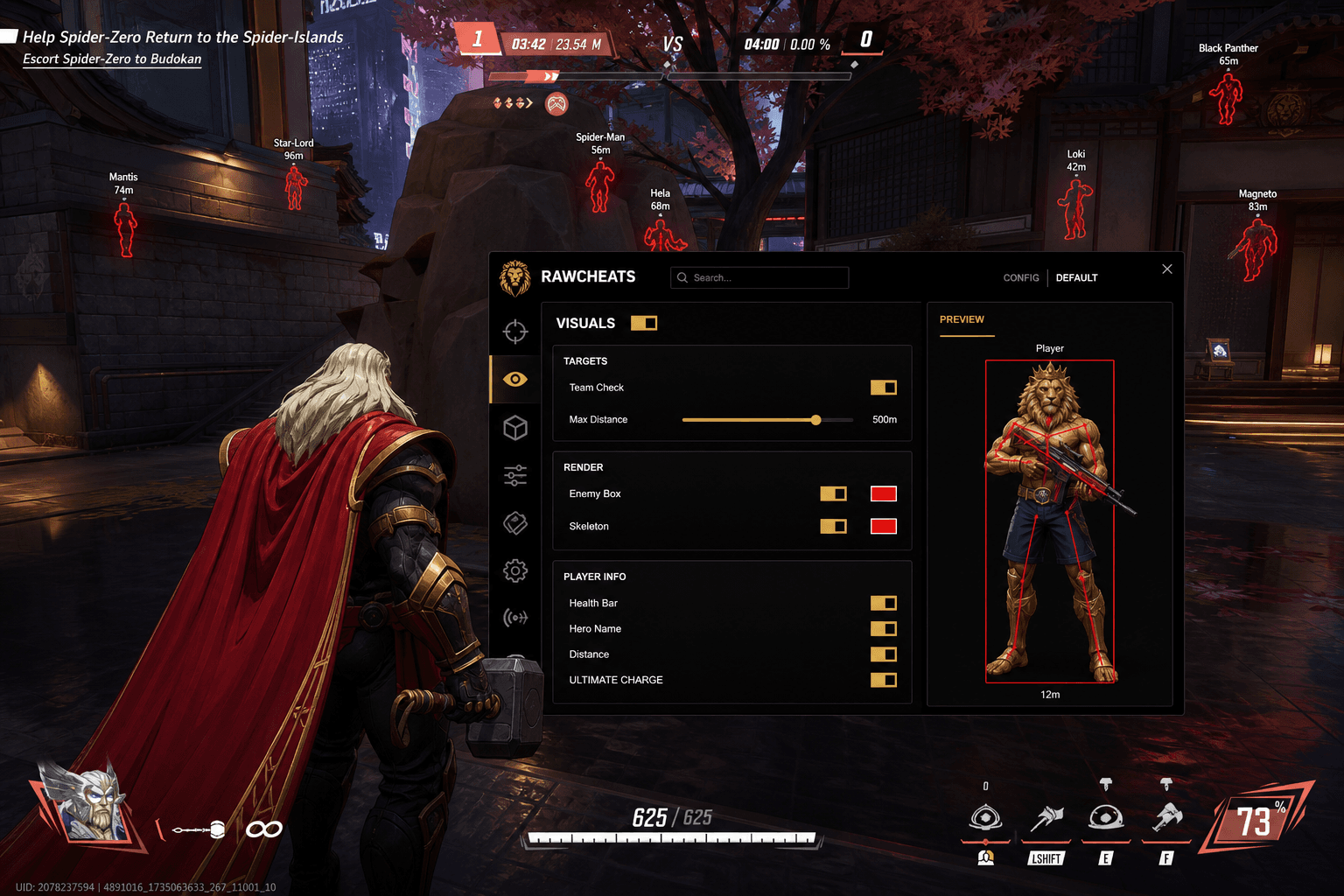
One detection in Marvel Rivals locks you out of Naraka, Identity V, Once Human. The 16 identifiers NeacSafe reads. Why spoofers are non-optional.
You eat a HWID ban in Marvel Rivals. You shrug, accept the loss of one game, and decide to move on to Naraka: Bladepoint instead. You launch Naraka — and it doesn't load. Your account works, your hardware works, but the launcher closes silently. Same on Identity V. Same on Once Human. Your hardware fingerprint is in NetEase's shared cross-game ban table, and you've just lost the entire NetEase portfolio. This is the cross-NetEase HWID ban trap, and most Marvel Rivals cheat marketing doesn't acknowledge it exists.
This post is a cluster of the Marvel Rivals Cheats Complete 2026 Guide pillar. The pillar covered why HWID spoofers are non-optional for Marvel Rivals at a high level. This piece is the technical walkthrough — what NeacSafe reads, what's spoofable, what's not, and why single-component spoofers fail against NetEase's 16-identifier composite hash.
The cross-NetEase HWID architecture
NetEase doesn't run separate ban tables per game. There's one shared hardware-identity service that backs every NetEase title using NeacSafe. The mechanic, end to end:
- NeacSafe reads ~16 hardware identifier categories at session start (covered below in detail).
- The identifiers get composed into a single hash and sent to NetEase's identification server.
- The hash is logged against your account.
- When a cheat detection fires in any NetEase game, the hash goes into a shared ban table.
- Every NetEase game's launcher checks the table at session start; a hit blocks the launch.
The shared-table design means a detection in Marvel Rivals propagates to Naraka: Bladepoint (NetEase's mobile-PC battle royale, ~10M monthly actives), Identity V (1v4 asymmetric horror, large mobile + PC base), Once Human (NetEase's survival shooter), and every other NetEase PC title. The launcher-level check happens before NeacSafe even loads on the second game — it's a hash-table lookup, not a behavioral check.
The economic implication. A Steam library ban locks you out of one game's account, but you can buy another copy on a new account and your hardware still plays. A cross-NetEase ban locks you out of every NetEase game on the same hardware, even with fresh accounts. The recovery cost is "buy completely new hardware" rather than "buy a new account key."
Most spoofer marketing in this space is written for single-game ban risk. Marvel Rivals breaks that assumption. The risk surface is portfolio-wide, not game-specific.
The 16 identifier categories NeacSafe reads
Per the 0x90.sh June 2025 driver analysis plus corroborating community RE work on Naraka and Identity V, NeacSafe reads at minimum the following identifier categories. Each gets composed into the session hash sent to NetEase's identification server.
Category 1: SMBIOS UUID — the motherboard's primary unique identifier. Same field every kernel AC reads. Set by the motherboard manufacturer at production time; never changes on the physical hardware.
Category 2: Motherboard serial number — SMBIOS Type 2 (Baseboard Information). Separate from the UUID; some boards have both, some have only UUID.
Category 3: Motherboard manufacturer + product strings — SMBIOS Type 1 (System Information) and Type 2 (Baseboard). These are short text fields like "ASUS" + "ROG STRIX Z690-E" that identify the board model.
Category 4: Disk serials (SATA + NVMe) — every drive attached to the system. NeacSafe enumerates them at session start. If you have an OS drive, a game drive, and a backup drive, all three serials end up in the hash.
Category 5: MAC addresses — every active network adapter, including virtual adapters (VPN clients, VMware, Hyper-V virtual switch). The MAC is a 48-bit hardware ID assigned to the NIC chip at production.
Category 6: GPU device UUID — NVIDIA / AMD / Intel. Not the human-readable "GeForce RTX 4090" name; the device-level UUID stored in the GPU's PCIe configuration space. Unique per physical card.
Category 7: RAM module serial numbers — SMBIOS Type 17 (Memory Device). Newer RAM modules (DDR4 and later) expose a per-module serial; older RAM modules may not.
Category 8: MachineGuid — Windows registry value at HKLM\Software\Microsoft\Cryptography\MachineGuid. Set at Windows installation time; persists through driver updates but resets on OS reinstall.
Category 9: BIOS version + release date — SMBIOS Type 0 (BIOS Information). Version number string + the date string of the current BIOS firmware.
Category 10: CPU serial — where available. Intel CPUs since vPro / AMD CPUs via the Platform Security Processor (PSP) expose a per-CPU identifier; consumer-grade CPUs often have this disabled in firmware but readable when enabled.
Category 11: Volume serial numbers — the NTFS volume identifier for each mounted filesystem. Different from disk serial; the volume serial is set at format time.
Category 12: Network adapter hardware IDs — the physical NIC's hardware ID (separate from MAC). Identifies the chip itself, not the MAC assignment.
Category 13: Monitor EDID — the Extended Display Identification Data block reported by your monitor. Includes manufacturer + serial. NeacSafe reads this for the primary monitor; some configurations expose secondary monitors too.
Category 14: USB controller IDs — the host USB controller hardware identifiers (not connected device IDs). Identifies the USB host chipset on your motherboard / add-in card.
Category 15: TPM endorsement key — where TPM 2.0 is present and exposed. The TPM EK is a permanent identifier baked into the TPM chip at manufacture time. Windows 11 systems primarily; some Win10 systems have TPM 2.0 enabled.
Category 16: BIOS UUID — separate from SMBIOS UUID in some implementations (older BIOSes used a different UUID field that's still queried for compatibility).
The composite hash makes the fingerprint resilient to single-component swaps. This is the architectural reason single-component spoofers fail on NetEase.
What's spoofable, what's not — the per-category matrix
Not every identifier is equally spoofable. Some are read at the firmware level and require kernel-mode tricks to fake; some are software-level and can be modified directly. A serious HWID spoofer covers all 16; a cheap spoofer covers 4-6 and fails the cross-NetEase ban table check.
Easily spoofable (software-level, no kernel required):
- MachineGuid (registry write)
- Volume serial numbers (volume metadata write)
- BIOS UUID via WMI (where WMI is the read path; falls back to firmware if WMI is bypassed)
Spoofable with kernel-mode work:
- SMBIOS UUID + motherboard serial + manufacturer + product strings (firmware-level reads; require kernel hooks to intercept and replace)
- Disk serials (intercept ATA/NVMe identify commands at the kernel level)
- MAC addresses (intercept NDIS-level network adapter reads)
- GPU device UUID (intercept PCIe config-space reads)
- RAM module serials (firmware-level; harder than SMBIOS UUID because the read path is different)
- Network adapter hardware IDs (NDIS-level intercept)
- USB controller IDs (intercept enumeration)
- Monitor EDID (intercept display driver EDID query)
Harder / firmware-dependent:
- BIOS version + date (some implementations cache the BIOS in firmware; spoofer-side intercept covers most)
- CPU serial (where present; requires CPU model-specific intercept)
Currently impossible to spoof:
- TPM endorsement key (the TPM chip has internal logic preventing EK replacement; the EK is generated during TPM manufacture and is permanent). Some spoofers attempt to disable TPM at the firmware level rather than spoof the EK directly — this works but has side effects (BitLocker may break, Windows 11 features may degrade).
Raw Spoofer covers categories 1-14 at the kernel level with per-session randomization. Category 15 (TPM EK) is handled via the disable-rather-than-spoof approach by default; users can configure TPM passthrough if they need TPM for other applications. Category 16 falls back to whatever category 1 is spoofed to.
Why single-component spoofers fail on NetEase
The economics of cheap spoofers favor "spoof the easy stuff and call it done." MachineGuid alone, plus motherboard serial maybe. This works against AC systems that read 6-8 identifiers because the spoofer covers the majority and the unchanged identifiers don't trip a clear "this is the same machine" pattern.
NeacSafe's 16-category read flips this math. If your spoofer covers 5 out of 16 identifiers, the unchanged 11 identifiers compose into a hash that's still nearly identical to your pre-ban hash. NetEase's hash composition is sensitive enough that an 11-of-16 match flags as "same hardware with cosmetic changes."
This is why cheap spoofers — the $5/month products you see advertised in dubious Discord servers — fail against NetEase but work against simpler ACs. The component count is the test. A spoofer's marketing should explicitly list which identifier categories it covers; if it can't, assume it covers fewer than 10.
The HWID Spoofer Complete 2026 Guide pillar covers the per-AC fingerprint matrix in detail — including comparisons to Vanguard, EAC, BattlEye, and NeacSafe.
The hardware-swap-doesn't-help corollary
Players who eat HWID bans often think "I'll just swap the motherboard." The math doesn't work.
Imagine you swap the motherboard alone. Categories 1, 2, 3, 9, 12, 14 change (SMBIOS UUID, motherboard serial, manufacturer/product strings, BIOS, network adapter HW IDs on the new board, USB controllers on the new board). Categories 4, 5, 6, 7, 8, 10, 11, 13, 15, 16 do not change — disk serials, MAC addresses (you migrated your NIC or your USB Wi-Fi adapter), GPU UUID, RAM serials, MachineGuid, CPU serial, volume serials, monitor EDID, TPM EK, BIOS UUID. That's 10 of 16 identifiers unchanged. The composite hash is still close enough to flag.
Full hardware replacement (motherboard + CPU + GPU + RAM + all drives + new NIC + new monitor) costs $1,500-$5,000 depending on your tier. A subscription to a serious spoofer is $4.99-$15/month. The math has been done a million times.
There's a corollary in the other direction too — if you've been spoofing successfully and you upgrade your hardware (legitimately), the spoofer should adapt to the new physical hardware. Raw Spoofer re-fingerprints automatically on hardware change, so a real upgrade doesn't break your spoofer state.
Spoofer workflow on Marvel Rivals — step by step
Standard pre-flight before any Marvel Rivals session:
Step 1. Cold-boot Windows. Don't open Steam yet; don't open the NetEase launcher; don't run any game.
Step 2. Run Raw Spoofer as administrator. Enter your spoofer license. The spoofer randomizes identifiers in the 14 categories it covers; status shows "Spoofed."
Step 3. Launch the Raw Rivals loader. Enter cheat license. Select Marvel Rivals from the game dropdown.
Step 4. Launch Marvel Rivals through Steam. The NeacSafe driver loads and reads hardware identifiers. Because the spoofer is intercepting the reads at the kernel level, NeacSafe sees the spoofed identifiers — different from your real hardware, different from your last session's spoofed identifiers.
Step 5. When you reach the main menu, click "Inject" in the Raw Rivals loader. Cheat menu overlays. Play.
Step 6. When you close Marvel Rivals, the spoofer state persists for the rest of the boot session. When you reboot, run Raw Spoofer again before re-launching.
The order matters. Spoofer first, then cheat loader, then game. Launching Marvel Rivals without the spoofer is the single highest-risk action you can take on this game given the cross-NetEase ban implications.
Cross-NetEase coverage — does the spoofer work for other NetEase games too?
Yes. Raw Spoofer reads as a different machine across the NetEase launcher and across NeacSafe in any NetEase title. If you're playing Marvel Rivals with the spoofer, then quit and launch Naraka: Bladepoint, the spoofer state from your session applies — Naraka sees the spoofed machine, same as Marvel Rivals saw it.
The session-randomization means a different hash is presented on the second game, which is fine. The point of the spoofer isn't presenting a consistent fake identity; it's presenting an identity that isn't your real hardware. Whether the fake identity is the same across games is irrelevant — both fakes are different from your real machine, which is what matters for ban-table evasion.
One operational note. If you only ever play Marvel Rivals, this is the working setup. If you also play Naraka or Identity V or Once Human regularly with the same hardware, you may want to run the spoofer for those sessions too — even if you're not cheating in them — because the cross-NetEase ban table only protects you if your fingerprint is consistently spoofed across all NetEase games. Running Naraka un-spoofed presents your real fingerprint to NetEase's identification service, and that fingerprint then becomes the comparison baseline if you ever eat a ban in Marvel Rivals (the spoofed Marvel Rivals fingerprint won't match the real Naraka one and the ban-table cross-check works less well).
What gets caught — the spoofer failure modes
Three failure modes for spoofers on Marvel Rivals specifically:
Failure mode 1: incomplete coverage. Spoofer covers 6-10 of the 16 categories; NeacSafe's composite hash flags as matching the pre-ban hash. Cheap spoofers fail here.
Failure mode 2: spoofer detected. NeacSafe's behavioral telemetry includes "did the SMBIOS-read result match what we expected for a real motherboard?" — sanity checks that flag when the spoofed identifier is obviously fake (all zeros, sequential pattern, identical to a known-spoofer signature). Raw Spoofer generates plausibly-real identifiers (realistic vendor strings, realistic serials, realistic patterns) to defeat the sanity-check layer.
Failure mode 3: spoofer load order wrong. If the spoofer doesn't load before NeacSafe, the kernel reads your real hardware first and the spoofer's intercept happens after the fact. This is why the cold-boot + spoofer-first workflow matters — running the spoofer after launching the game is a no-op (you're spoofing future reads, not the one already done).
The third failure mode is the most common user error. Always run the spoofer before launching any NetEase game.
Cost analysis — spoofer ROI for Marvel Rivals
Marvel Rivals players who eat unpacked cross-NetEase HWID bans typically lose:
- Marvel Rivals account (cosmetic / progression investment, varies)
- Naraka: Bladepoint account (if owned; cosmetic / battlepass investment)
- Identity V account (if owned)
- Once Human account (if owned)
- Any future NetEase title on the same hardware until you replace hardware
The aggregate replacement cost depends on your portfolio depth, but a player with all four NetEase titles plus a moderate cosmetic spend is looking at $500-$2,000+ in lost progression and the practical loss of all four games on current hardware.
Spoofer cost: $4.99/month or $40-something annually. The break-even is roughly "if there's even a 0.1% chance of a ban per year, the spoofer pays for itself." For anyone running cheats, the probability is materially higher than 0.1% — closer to several percent annually depending on cheat hygiene. The math has never favored skipping the spoofer for Marvel Rivals.
For non-cheaters worried about false-positive bans (the Jan 2025 macOS/Steam Deck wave is the canonical reference — see the Marvel Rivals ban wave history cluster), a spoofer is over-engineered. False-positive risk is real but rare; you don't need a kernel-level spoofer to handle it. You'd just contest the ban through support.
Wrap
The Marvel Rivals HWID spoofer requirement isn't generic "you should spoof when cheating" advice. It's specific to NetEase's cross-game ban architecture and NeacSafe's 16-category read profile. The cumulative risk surface — losing the entire NetEase portfolio on a single detection — makes the spoofer cost trivial relative to the downside.
Raw Spoofer is built to NeacSafe's 16-category spec with per-session randomization. The HWID Spoofer Complete 2026 Guide pillar covers the per-AC matrix; the Marvel Rivals Cheats Complete 2026 Guide pillar covers the broader Marvel Rivals product context. The setting up safely cluster walks through the full spoofer-first workflow.