
How Fortnite Anti-Cheat Actually Works in 2026 — EAC, BattlEye, and Epic's Behavioral Layer
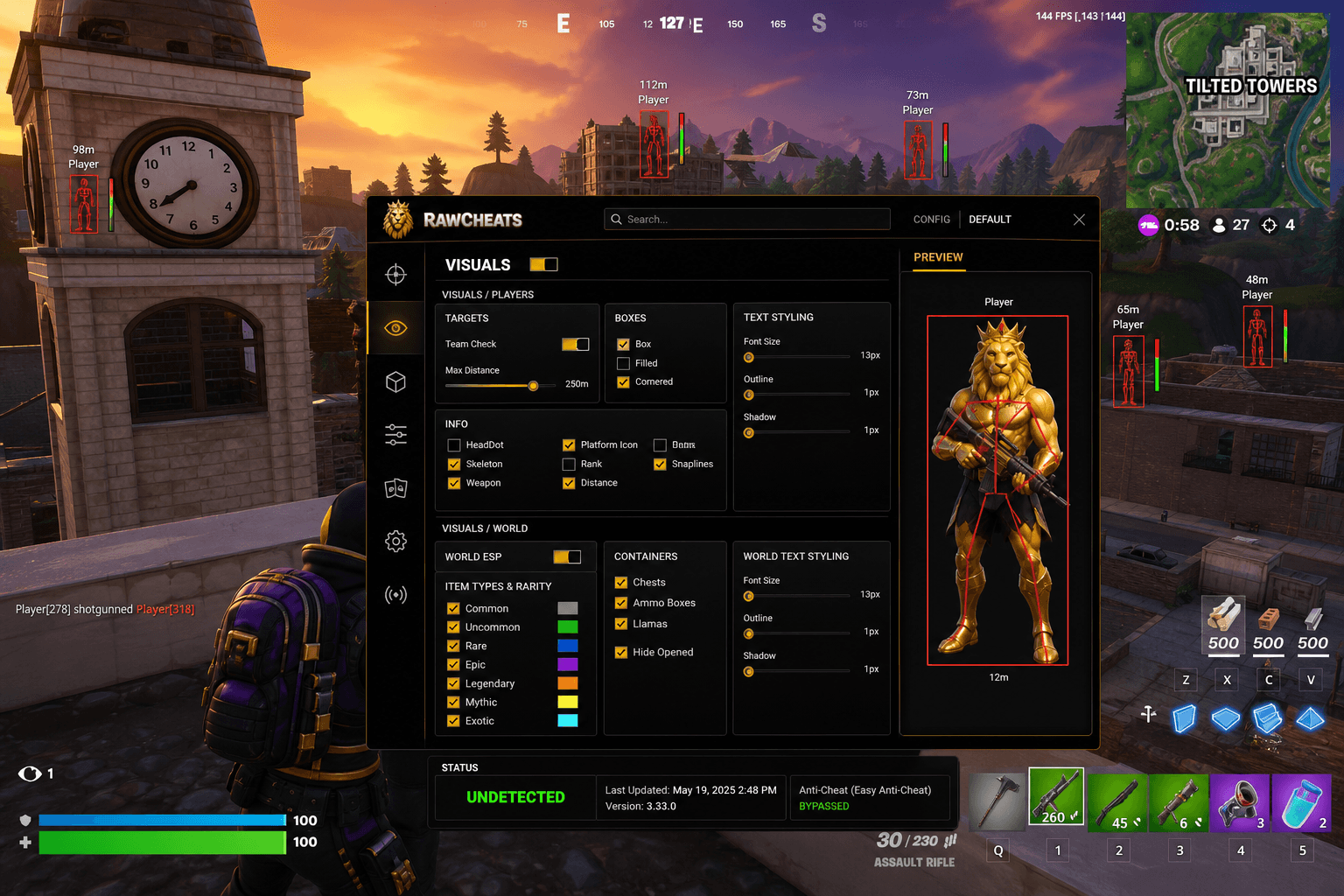
A surgical walkthrough of Fortnite's 2026 anti-cheat stack: EAC's post-rebuild kernel scanner, what BattlEye still does, Epic's behavioral telemetry, and the IOMMU mandate that reset the market.
After the February 19, 2026 IOMMU mandate, the Q1-Q2 2026 EAC kernel-driver rebuild, and the $175,000 Epic v. RepulseGod federal judgment, Fortnite's anti-cheat in May 2026 is the most aggressive it has ever been. Most "how anti-cheat works" articles you'll find online describe the 2022 version of EAC. Here's what's actually running at ring 0 when you launch Fortnite today.
This post is a cluster of the Fortnite Cheats Complete 2026 Guide pillar. The pillar covers the broader market context; this piece goes deep on the technical architecture of the anti-cheat stack itself.
The three-layer architecture
Fortnite's anti-cheat in 2026 isn't a single product. It's a three-layer defense, and only the bottom layer is what most players think about when they hear "Fortnite anti-cheat."
Layer 1 — Easy Anti-Cheat (EAC) kernel driver. This is the kernel-level signature scanner. EAC was acquired by Epic in 2018, so it gets internal development priority that third-party kernel anti-cheats don't. The driver loads when you launch Fortnite, runs in ring 0 (the highest-privilege CPU mode on Windows), and scans process memory, loaded drivers, image regions, and a growing list of kernel memory pools.
The Q1-Q2 2026 rebuild materially expanded the scanner's reach. Reverse-engineering reports describe roughly 3-4× faster signature comparison than the prior generation, plus coverage of kernel memory pools EAC previously didn't touch. Ban cadence moved from monthly to every two to three weeks.
Layer 2 — Epic's proprietary behavioral analysis. This is the layer almost nobody talks about because it's not in the kernel and you can't reverse-engineer it. Epic's servers ingest a high-frequency feed of player telemetry — aim velocity deltas, headshot percentages, reaction-time consistency, kill-streak distributions, and the gap between matchmaking-bracket-expected performance and actual performance.
The models flag statistical anomalies for either automated soft action (shadow queue, MMR throttling) or manual replay review at FNCS-tier matches. This is the layer that catches well-built private cheats that pass EAC's signature scanner clean. It's also what caught Bugha and the ~20 other pros in the April 2026 FNCS Major 1 DQ wave — replay review, not signature detection.
Layer 3 — Hardware fingerprinting plus ring-0 callbacks. EAC reads motherboard serial, GPU device serial, RAM module IDs, monitor EDID, USB controller IDs, BIOS UUID, and TPM endorsement keys at session start. It also registers kernel callbacks on process creation, thread creation, image (DLL/driver) loading, and handle operations. A cheat driver that loads after Fortnite gets observed in real time. The hardware fingerprint is the foundation of HWID bans — when you eat one, EAC knows it's you the moment your next account boots Fortnite on the same hardware. We cover the spoofing side in detail in Fortnite HWID Spoofer Guide 2026.
BattlEye is still here, but it's not the primary
A handful of older Fortnite-related integrations still use BattlEye's BEDaisy.sys driver. The BattlEye FAQ explicitly names Fortnite in its compatibility list. But EAC has been the load-bearing kernel scanner for years, and the 2026 rebuild made that more pronounced.
When you read "Fortnite uses BattlEye" on a competitor's blog, they're either copying 2018-era information or didn't bother to check the current state. A cheat vendor whose pitch leads with "bypasses BattlEye" and never mentions EAC is signaling they haven't done the research.
What EAC's kernel driver actually does at runtime
The EAC driver is signed (so Windows lets it load under Secure Boot, which is required for all Fortnite tournaments since February 2026). On Fortnite launch, the kernel loads EAC before the game itself fully initializes — this matters because cheats that load after EAC are visible to it via the kernel callbacks it registered. Cheats that try to load before EAC have to navigate the Early Launch Anti-Malware (ELAM) layer, which Microsoft tightened in Windows 11.
Once running, EAC's hot loop includes:
- Periodic memory scans against signature databases streamed from EAC's servers. Signatures are hashes of cheat-code patterns the company has flagged. The 2026 rebuild expanded the regions scanned (game memory + selected kernel memory pools).
- Process and thread callbacks. Every time a new process or thread is created system-wide, EAC gets a notification. Same for DLL and driver image loads.
- Handle operation monitoring. When code opens a handle to the Fortnite process (a precursor to reading its memory), EAC sees it.
- Anti-debug and anti-tamper checks. EAC validates that its own driver hasn't been tampered with by an attacker who got kernel access.
- Statistical telemetry export. EAC sends per-frame data to Epic's behavioral analytics pipeline so Layer 2 has data to model.
What EAC does not do well, historically: catch external memory readers (DMA cards) that read game memory without ever loading into the OS. That's the gap the February 2026 IOMMU mandate closed at the hardware level.
The February 2026 IOMMU mandate
The most consequential anti-cheat policy change of 2026 wasn't a kernel-driver update. It was a single rule: effective February 19, 2026, every Fortnite PC tournament (from $5 cash cups to FNCS qualifiers) requires Secure Boot + TPM 2.0 + IOMMU enabled in BIOS. The first two had been mandatory at higher tournament tiers since 2024. IOMMU was new.
IOMMU (Intel VT-d / AMD-Vi) is a hardware feature that gates which physical-memory regions a PCIe device can read or write. Without it, a consumer-grade DMA cheat card plugged into your motherboard can read any region of system RAM — including the chunk where Fortnite's game state lives. The card pulls player positions and weapons straight from RAM and renders the overlay on a secondary screen. The PC playing Fortnite has no software cheat installed.
Once Epic mandated IOMMU enabled, the chip-level memory wall blocks every PCIe device — including DMA cards — from touching arbitrary memory regions. The cards still enumerate. They still talk over PCIe. But their RAM-read attempts fail at the IOMMU layer. They stop working. All of them, simultaneously, the moment IOMMU was mandated. Coverage from PC Gamer, VideoCardz, and TechSpot triangulated the change at the time.
The structural implication for the cheat market: consumer-grade DMA was the high-end of the Fortnite cheat stack in 2024-2025. February 19, 2026 reset the upper market. Software cheats that run inside the same OS as Fortnite are now the only viable architecture for the average buyer. (See Free Fortnite Cheats for the bottom of the market and what survives.)
Why kernel anti-cheats are described as rootkits — and why it doesn't matter
Two pieces of academic work are worth citing because they're the only honest external takes available. The ACM paper If It Looks Like a Rootkit and Deceives Like a Rootkit analyzes kernel anti-cheats including EAC and concludes they operate as rootkits by every technical measure — kernel-level code execution, hiding from user-mode tools, monitoring everything. That's literally what a rootkit is.
The point isn't that EAC is malicious. The point is that cheats also operate at ring 0, so the anti-cheat has to operate at ring 0 to detect them. The kernel-vs-kernel war is structural. The University of Birmingham's 80-cheat-site market study reached the same conclusion: every "undetected" claim has a timestamp. The question is how short the detection window is.
For Fortnite specifically in 2026: free public cheats get detected in hours. Mid-tier paid cheats in weeks. Top-tier private cheats with active engineering — like Raw Fortnite — sustain detection-free windows that span multiple EAC rebuild cycles. The vendors who survive long-term aren't the ones with the cleverest single bypass. They're the ones with multi-layered infrastructure that treats bypass as a moving target.
Epic's behavioral layer is the actual long-term threat
Most cheat content focuses on EAC because EAC is the visible layer — the kernel driver, the signature scans, the things that show up in process lists. But the cheats that get caught at scale are caught by Layer 2 — Epic's proprietary behavioral analysis.
The models look at things like:
- Headshot rate distribution. Real players' headshot percentages vary engagement to engagement. A player consistently hitting 70%+ headshots across hundreds of engagements stands out statistically — even if every individual shot looks plausible.
- Angular velocity profile. When a real player flicks to a target, the aim curve has a characteristic acceleration-and-overshoot shape. Aimbots with pure mathematical interpolation produce cleaner curves that read as machine-generated to spectral analysis.
- Reaction time consistency. Humans have variable reaction times — 180ms one engagement, 240ms the next, 210ms after that. Cheats with fixed reaction delays produce suspiciously tight distributions.
- Kill-streak vs MMR-bracket mismatch. A player in a Diamond lobby suddenly producing GM-tier performance triggers anomaly flags faster than the kill streak alone would.
- Pre-fire timing. Real players have to see a peek and react. Cheats with wallhack can fire before the peek finishes. The timing gap between "enemy crosses peek threshold" and "first shot" is a Layer 2 signal.
This is why we tune Raw Fortnite's aim curves around statistical-plausibility defaults: smoothness 200-400 range (not 0-50), randomized per-engagement reaction timing, visible-only filtering, FOV cones in the 30-60° band for casual / 15-30° for ranked. Most casual cheat buyers max everything and get caught by Layer 2 within 14-30 days. The disciplined ones running conservative settings sustain accounts indefinitely.
What this means for cheat-buyer decisions
If you're shopping for a Fortnite cheat in 2026, the anti-cheat architecture above translates into specific buyer-side tests:
- Does the vendor address all three layers, or just EAC? A vendor whose pitch is exclusively about "EAC bypass" is half-equipped. Layer 2 catches well-built cheats too — humanization matters as much as signature evasion.
- Did they update for the Q1-Q2 2026 EAC rebuild? Vendors whose status pages haven't moved since late 2025 are running stale builds against a new kernel scanner. That's how you get caught in week one.
- Is the cheat external or internal? External design is harder for EAC to scan (it can't sweep memory regions outside its own process). Raw Fortnite is external for this reason. Future plans for an internal-mode complement for rage-tier exploits are separate from the legit-mode core.
- Is HWID spoofing bundled or upsold cleanly? Layer 3's hardware fingerprint is what makes a single ban into a long-term problem. Always run Raw Spoofer alongside the cheat. The Fortnite HWID Spoofer Guide 2026 cluster covers what EAC fingerprints specifically.
Frequently asked questions
Does EAC use kernel-mode protection like Vanguard? Yes. EAC has been kernel-mode since 2016. The Q1-Q2 2026 rebuild deepened its kernel reach but the architectural model — ring 0 kernel driver plus user-mode helper service plus server-side telemetry — has been stable for years. Vanguard's distinction is its ELAM (Early Launch Anti-Malware) boot driver and TPM endorsement-key reads, which EAC does not currently do on Fortnite.
Can EAC detect cheats running from a virtual machine? Yes, modern EAC fingerprints VM environments via CPUID anomalies, timing inconsistencies, and known hypervisor artifacts. VM-based Fortnite cheating is not viable in 2026.
What happens when EAC ships a signature update? Existing cheats running outdated signatures get flagged on the next session. Cheat vendors with active engineering ship patched builds within 6-12 hours of every signature push. Loaders typically auto-pause subscription clocks during the downtime so customers don't pay for unusable hours.
Is BattlEye involved at all in Fortnite 2026? Yes, in some legacy integrations, but EAC is the primary kernel scanner. BattlEye's BEDaisy.sys driver still appears in BattlEye's official compatibility list for Fortnite, but the load-bearing detection work is EAC's.
Can a cheat avoid all three anti-cheat layers? In a strict technical sense, no — there's no architectural escape hatch that defeats kernel signature scanning + behavioral telemetry + hardware fingerprinting simultaneously. What working cheats do is operate cleanly enough across all three layers to extend detection windows. Multi-layered bypass design, statistical-plausibility tuning, and HWID spoofing combine to produce sustained survival.
Why is Fortnite ranked still full of cheaters despite all this? Detection at scale takes time. EAC catches signature-detectable cheats in hours. Layer 2 catches well-built private cheats in weeks. A player who's actively cheating at any given moment may not be banned yet — they will be eventually. The visible-cheater perception lags actual enforcement by 2-4 weeks under normal operation.
Ready to play under Fortnite's 2026 anti-cheat? Raw Fortnite is tuned for the post-rebuild EAC plus Layer 2 behavioral plus the IOMMU-mandate world. Pair it with Raw Spoofer for cross-EAC HWID protection and check the live undetected status before every session.