
Free Fortnite Cheats — Why They Get Detected (And Why You Get Robbed)
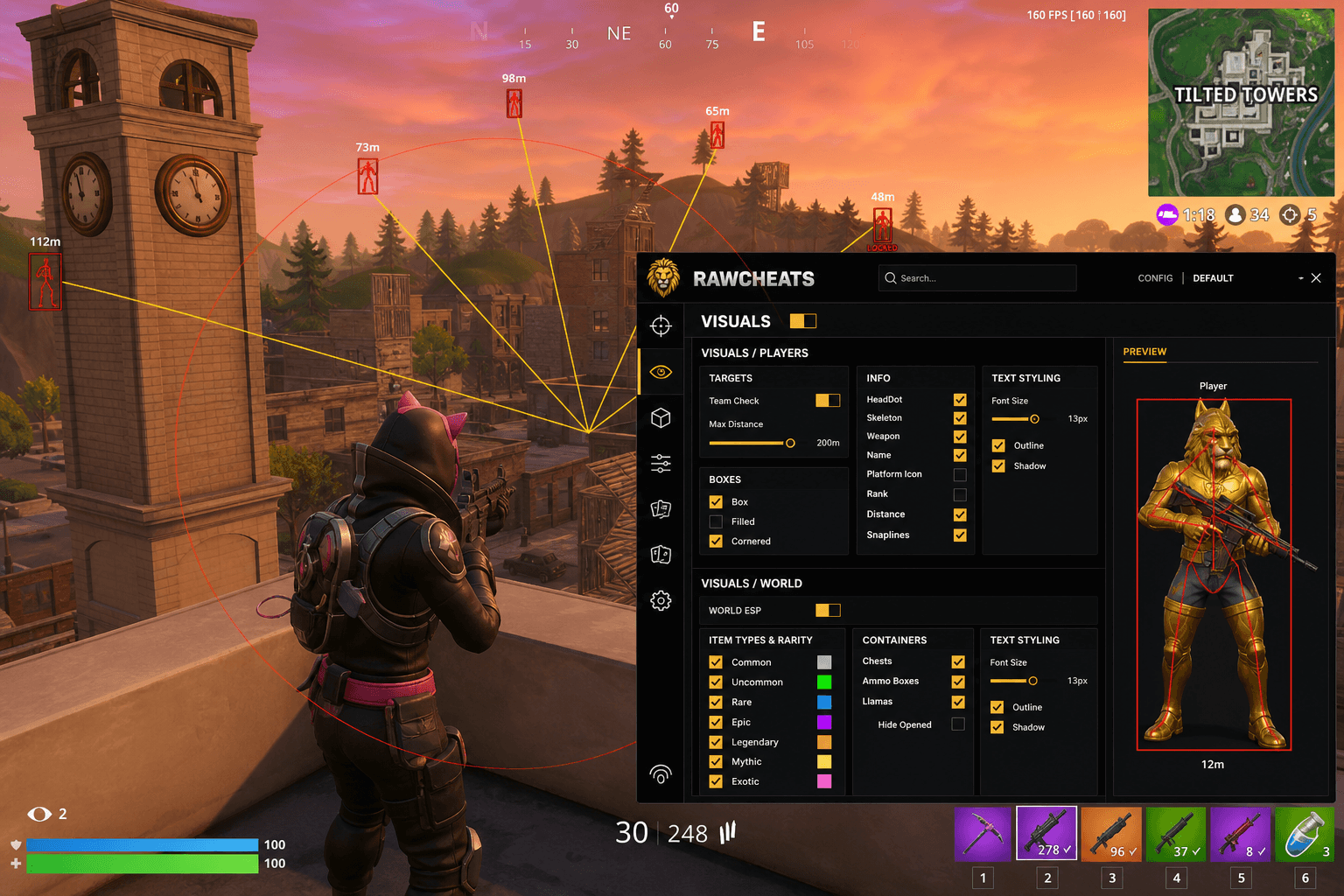
Free Fortnite cheats in 2026 are almost always infostealer malware. Vidar Stealer 2.0, Lumma, StealC payloads — the real cost is your Steam, Discord, and crypto wallets.
This post is a cluster of the Fortnite Cheats Complete 2026 Guide pillar. The pillar covered free cheats briefly in Section 7; this is the full breakdown — what actually happens when you run a "free Fortnite cheat" from GitHub or YouTube in 2026, what malware is hiding inside, and why getting banned on Fortnite is the least bad outcome.
If you searched "free Fortnite cheat download" in May 2026 and clicked the first GitHub repo or YouTube link, you've already installed (or nearly installed) Vidar Stealer 2.0, Lumma, StealC, or RedLine — depending on which campaign you happened to hit. The cheat doesn't actually work. The infostealer absolutely does. Your Steam session, Discord token, browser-saved passwords, and crypto wallet keys are exfiltrated to a command-and-control server in another country within minutes of execution. Your Fortnite ban — if it comes at all — is a footnote next to the actual damage. This isn't speculation: Flare's threat research reported that 41.47% of all infostealer infections trace back to gaming-related file downloads, and Fortnite is the largest single contributor by player base.
The 2025-2026 infostealer landscape — what's actually in those downloads
Four malware families dominate the fake-cheat distribution market in 2025-2026:
Vidar Stealer 2.0 — The most common payload in fake game cheats as of late 2024 through 2026. Acronis Threat Research Unit's analysis tracked Vidar 2.0 specifically through GitHub and Reddit distribution channels and identified it as the primary infostealer behind the fake-cheat-as-malware phenomenon. Vidar 2.0 features upgraded data exfiltration speed, encrypted C2 communication, and a modular plugin architecture that lets operators add per-victim functionality (cryptominer drops, ransomware payloads, follow-on RATs).
Lumma Stealer — In May 2025, Microsoft's Digital Crimes Unit seized 2,300 Lumma-distribution domains in a coordinated takedown. Within weeks, Lumma operators had migrated to new domains and resumed distribution. The takedown was meaningful but didn't end the threat — it just changed which URLs are dangerous. Lumma is engineered specifically for low-effort, high-volume credential harvesting; it scrapes Chrome / Firefox / Edge saved passwords, cookies, autofill data, crypto wallet extension data, and Steam / Discord / Epic Games session tokens.
StealC — A newer variant that appeared in late 2023 and proliferated through 2024-2026. Specializes in browser cookie harvesting (including session-active cookies that allow account takeover without password reset). Frequently distributed alongside Vidar 2.0 in dual-payload bundles.
RedLine — Older but still active. Targets crypto wallets specifically — MetaMask, Phantom, Exodus, Trust Wallet, hardware wallet companion apps. Has a documented track record of clearing five-figure crypto holdings within hours of infection.
The detection rate on these payloads when uploaded to VirusTotal is typically 30-50 / 70+ AV vendors. The bad ones get caught by Microsoft Defender. The cleverly packaged ones (signed binaries, polymorphic packing, embedded steganography) frequently slip past Defender for the first 24-72 hours of a fresh campaign.
The GitHub honeypot — anatomy of a fake-cheat repo
If you go to GitHub right now and search "Fortnite cheat free undetected", you'll see dozens of repositories with similar profiles. Recognizing the pattern lets you spot one in under 30 seconds:
The account profile — Fresh GitHub account, created in the last 1-6 months. 0-3 followers. No other repos or only similarly-themed cheat repos. Profile picture is either a default avatar or a stock anime / gaming image.
The repo activity — Created in the last 30-90 days. Single commit titled "Initial commit" or "v1.0". README updated once, never again. No meaningful issue tracker activity. Stars are typically inflated via bot networks.
The README — Claims undetected status as of the current date. Promises "free forever" access. Lists feature names that pattern-match marketing copy of paid cheats (often word-for-word). Includes a Discord invite link to a server that's also fresh and quiet.
The Releases tab — A single .exe with a generic name (FortniteLoader.exe, FN_Cheat_v2.exe). File size is typically 5-15 MB. VirusTotal score on the file is in the 30-50 / 70+ range.
The "fix" instructions — Almost always include a step asking the user to add a Microsoft Defender exclusion for the install folder, or to disable real-time protection entirely. This is the smoking-gun pattern. Legitimate software has no reason to ask you to disable your AV. The README usually frames it as "to prevent false positives" — which would be plausible if AV vendors were collectively false-positive-flagging a real cheat, but they aren't. They're correctly flagging malware.
The pattern is documented in detail in GBHackers' analysis of free game cheat malware and in Game Developer's coverage of the Fortnite-specific fake-cheat-as-credential-stealer phenomenon.
What gets exfiltrated when you run one
The standard infostealer payload, executed once with admin permissions on a typical user PC, exfiltrates the following within 30-90 seconds:
Browser data — Chrome, Firefox, Edge, Brave, Opera saved passwords, cookies (including session-active ones), browsing history, autofill data, credit card details if saved, bookmarks. The session cookies are the dangerous part — they allow direct account takeover without needing the password.
Steam credentials — loginusers.vdf, ssfn files (the persistent session tokens), and steam guard codes if saved. With these, an attacker can authenticate to your Steam account as you, transfer your trade-up-able inventory, sell skins from your library, and (if you have a wallet balance) drain it.
Discord — Both the discord.com session token (allows direct API access to your account) and any saved local message archives. With the token, an attacker can take over your account, message your friends with malware links, and (in many cases) bypass 2FA because the session is already authenticated.
Epic Games credentials — Same pattern. Session token + cached login data allows account access; if you have V-Bucks balance, paid skins, or Save the World access, those become attackable assets.
Crypto wallet keys — MetaMask, Phantom, Exodus, Trust Wallet, hardware wallet companion apps. Browser extension wallets are especially vulnerable because the encrypted vault file is on disk and the password can be brute-forced offline if the user picked a weak one. RedLine-family malware specifically targets crypto wallets and has cleared five-figure holdings within hours.
2FA backup codes — If you've saved 2FA recovery codes as a text file (a common mistake), the infostealer harvests them. With backup codes, the attacker can bypass 2FA on every account where you reused the same codes.
System info — Hardware fingerprint, IP address, geolocation, OS version, installed software list, Wi-Fi network list. Used for follow-on targeting.
Screenshots + webcam captures — Some payloads (including Vidar 2.0 with the right plugins) take periodic screenshots and webcam photos. Used for blackmail in subsequent campaigns.
All of this is exfiltrated to a command-and-control server within minutes. By the time you notice anything is wrong, the data is already on a buyer's hands or in a marketplace listing.
The math comparison — paid vs "free"
A paid Fortnite cheat from a reputable provider costs:
- 24 hours: $4-7
- 7 days: $20-30
- 30 days: $30-60
- Plus spoofer: $5-15
A free Fortnite cheat costs nothing upfront. Expected loss from a single infostealer infection (averaging across users with various levels of crypto exposure, Steam library value, and credential reuse):
- Steam library compromise: $200-5,000+ in skins / games depending on library
- Crypto wallet drain (when applicable): $500-50,000+ depending on holdings
- Discord account takeover: friend / family social engineering risk, sextortion campaigns, follow-on infections of your network
- Bank account compromise (via password reuse + 2FA bypass): variable, potentially total
- Identity theft followup: months of recovery effort
Even ignoring the worst-case outcomes and assuming you have no crypto and a $300 Steam library, the expected loss from a single infostealer infection is roughly 50-100× the cost of paying for a legitimate cheat for a year. The risk-adjusted expected value is grotesquely one-sided.
Why the public "free" cheats don't actually work as cheats anyway
Even setting aside the malware payload, the public cheats that aren't malware (a small minority of free downloads) almost universally don't work as cheats either. Reasons:
EAC signature-detects public binaries within hours. Every free cheat that gets distributed to >100 users is in EAC's signature database within 24-48 hours. Running it gets you banned on the first match.
Offsets break with every Fortnite update. Fortnite ships patches roughly every 2 weeks. Each patch shifts the memory offsets the cheat reads. A free cheat with no active developer maintenance breaks at the first patch and never recovers.
No spoofer integration. Eating a HWID ban from a free cheat means your hardware fingerprint is now flagged. Future accounts on the same PC are flagged on creation.
No replay-system protection. Free cheats use legacy overlay rendering that's visible in OBS and Fortnite's native replay. Any match you play with it can be reviewed manually after the fact.
The honest truth: the "free Fortnite cheat" ecosystem is malware distribution with cheat-themed packaging. It's not a parallel market to paid cheats — it's a parallel market to phishing emails.
What to do if you've already run one
If you ran a free Fortnite cheat from any GitHub / YouTube / forum link in the last 6 months, assume:
- Your Steam, Discord, Epic, and any browser-saved credentials are compromised. Change every password from a different, clean device. Rotate 2FA on every account.
- Your active sessions need to be revoked. Discord, Steam, Epic, Google, every social account — go through "active sessions" in security settings and revoke everything that isn't your current device.
- Audit your crypto wallet transaction history immediately. If you see unfamiliar transactions, the exfil already happened and the funds may already be moving. Move remaining funds to a new wallet on a clean device.
- Check your email for password reset requests, login alerts, or new device sign-ins. Attackers often try low-value pivots first to confirm their credentials work.
- Reformat the infected PC. Reinstall Windows from clean media — don't trust the existing install. Infostealer persistence mechanisms can survive most cleanup attempts.
- Run Have I Been Pwned and Have I Been Pwned for Stealer Logs (if you have Pwned Premium) against your email. Stealer log dumps surface in days-to-weeks after exfiltration.
This is recovery, not prevention. The prevention is: don't run free cheats.
Frequently asked questions
Are ALL free Fortnite cheats infostealers? Not literally all, but the overwhelming majority. Independent estimates (Flare, Acronis TRU) put the figure above 90% for free Fortnite cheat downloads distributed through GitHub, YouTube, and forum links. The remaining ~5-10% are either non-functional joke programs or genuinely-attempted-but-detected cheats that don't work anyway.
What about open-source cheats with full visible source code? A small number of educational open-source cheats exist (rust implementations, demo aimbots for academic purposes). They're not the cheats getting distributed as "free Fortnite cheats." The distribution pattern is what matters: a curated educational repo with verifiable maintainer history is very different from a freshly-created repo with a single .exe and an AV-exclusion-required README.
Will Microsoft Defender catch the cheat-as-malware payloads? Sometimes, not always. Mature payloads with stable signatures are caught reliably. Fresh campaigns or polymorphic variants slip past Defender for 24-72 hours typically. Adding the AV exclusion (as the malware authors request in their READMEs) makes the user invisible to their own AV.
If I run a free cheat in a virtual machine, am I safe? Marginally safer, not safe. VM escape exploits exist for every major hypervisor. More common: users execute the malware in the VM and accidentally have their host browser session open, or the malware exfiltrates VM-shared folder data. The VM approach gives a false sense of security.
What's the difference between an infostealer and a "cracked" cheat? A "cracked" cheat is a paid cheat whose protection has been bypassed for free redistribution. Cracked cheats are themselves typically infostealer-laced — the people cracking them aren't doing it for free, they're monetizing the redistribution via the malware. Cracked Fortnite cheats are statistically the most infostealer-laden category of all.
How is Raw Fortnite different? We're a paid product with transparent pricing, refund policy, public Discord, and active customer support. The cost ($4.99 / 24h) is the price of not having your Steam, Discord, and crypto wallets exfiltrated. See Fortnite cheat pricing comparison for the math across providers.
Is YouTube tutorial / "no virus" / "100% safe" reassurance reliable? No. Those tutorials are part of the distribution chain. Comment sections are bot-curated; "thank you, works great" comments are paid or generated. The video creator gets paid per download via affiliate / dropper links. The thumbnail says "no virus" because the malware authors know you'll search for that.
The trade-off is straightforward: $4.99 for Raw Fortnite plus Raw Spoofer versus the expected loss from a single infostealer infection (often four to five figures). Don't run free cheats. Live status: Fortnite Cheat Status. For the broader free-cheat landscape across games, see the HWID spoofer pillar. For the comparable paid-cheat math, see Fortnite cheat pricing comparison.