
Fortnite HWID Spoofer Guide 2026 — What EAC Reads, What You Can Spoof
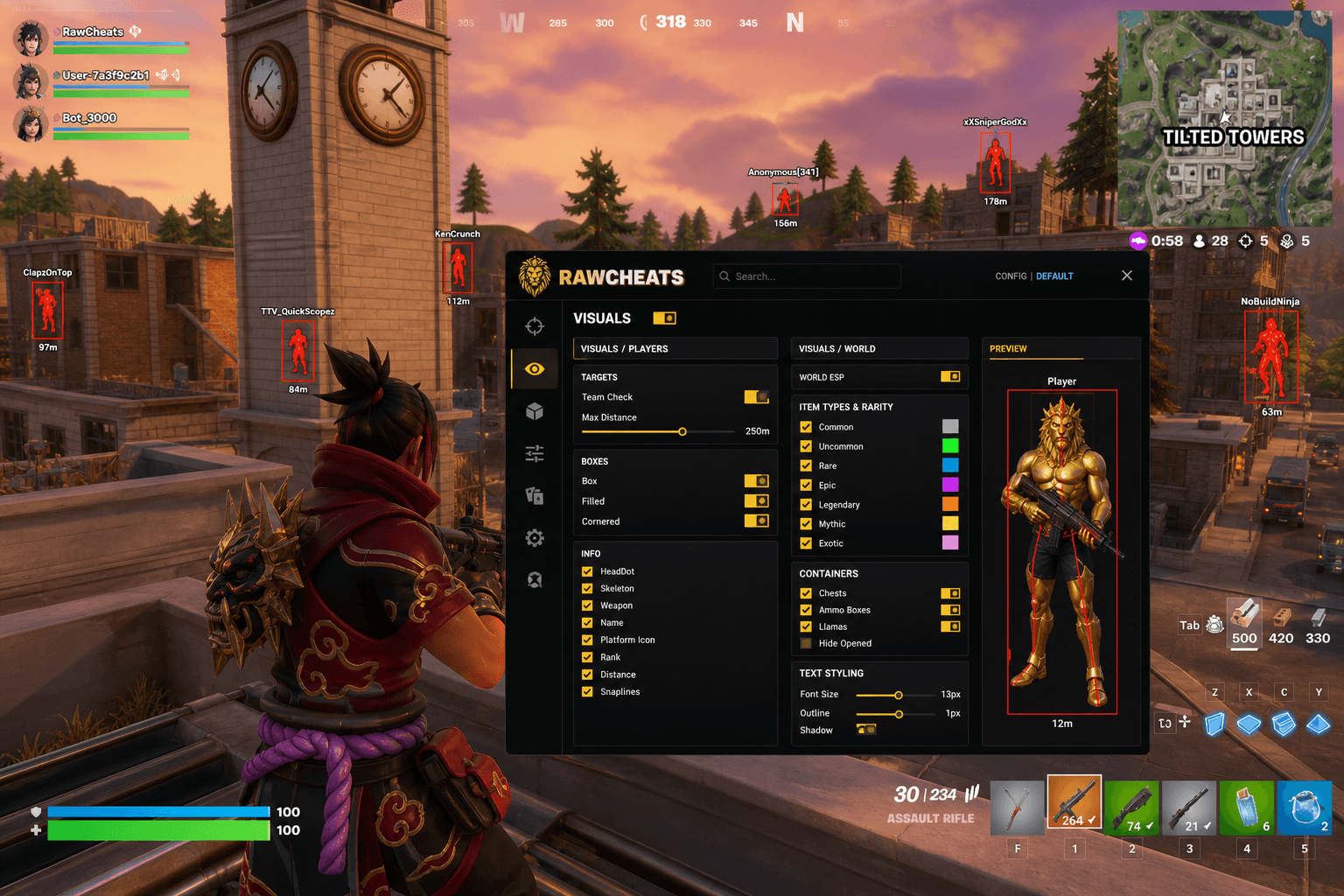
The full Fortnite HWID spoofer reference for 2026. What EAC fingerprints, what is spoofable, what isn't, and the correct cold-boot order.
This post is a cluster of the Fortnite Cheats Complete 2026 Guide pillar. The pillar covered HWID fingerprinting at a high level; this is the detailed working reference — what Easy Anti-Cheat reads from your hardware in 2026, what a spoofer can change, what it physically can't, and the exact session order you need to run.
If you ate a Fortnite ban in 2024 and your fix was to wipe your Epic account, you've already learned the hard way that HWID bans don't care about which account you use. In 2026 — post-TPM-2.0 mandate, post-IOMMU mandate, post-EAC kernel rebuild — the hardware fingerprint EAC composites has grown. The University of Birmingham anti-cheat market study reviewed 80 cheat-selling sites and concluded the spoofer-vs-fingerprint arms race is open-ended; the ACM "Looks Like a Rootkit" paper confirms kernel anti-cheats operate at ring 0 with full read access to system identifiers. This guide walks through what that means for Fortnite specifically in May 2026.
What EAC actually reads at session start
Reverse engineering of EAC (the public adrianyy/EACReversing repo plus the leaked EasyAntiCheat.sys source surfaces from 2023-2024) confirms EAC reads at minimum the following identifiers when Fortnite launches:
SMBIOS — UUID, manufacturer string, product name, and motherboard serial. Read via NtQuerySystemInformation class 76 (SystemFirmwareTableInformation). This is the marquee "motherboard fingerprint" most casual readers assume HWID bans mean — but it's only one of ~12 inputs.
Disk identifiers — SCSI port names, hardware ID strings, disk serial numbers. Read via the registry under HKLM\Hardware\DeviceMap\Scsi\Scsi Port [n] plus direct IOCTL_STORAGE_QUERY_PROPERTY calls on each physical drive.
CPU registry block — The HKLM\HARDWARE\DESCRIPTION\System\CentralProcessor\0 key including ProcessorNameString, Identifier, and Update Revision (microcode version).
Network adapter GUIDs — Class GUIDs under the {4d36e972-e325-11ce-bfc1-08002be10318} GUID, which enumerates every installed NIC including virtual / loopback / vendor management adapters.
Windows MachineGuid — HKLM\SOFTWARE\Microsoft\Cryptography\MachineGuid. A 128-bit value Windows generates at install time and never changes unless the OS is reinstalled.
Windows Activation Technologies key — Under HKLM\SOFTWARE\Microsoft\Windows NT\CurrentVersion\Software Protection Platform\WAT\AdminObject\Store. Holds Windows licensing identifiers.
WMI block — Read via IoWMIOpenBlock / IoWMIQueryAllData to extract motherboard product strings, BIOS vendor, and BIOS release date.
Monitor EDID — Display panel firmware identifier. Read via EDID registry blob under each \HKLM\SYSTEM\CurrentControlSet\Enum\DISPLAY\ device.
USB controller hub IDs — Each USB root hub registers a ContainerID GUID that survives across reboots.
TPM endorsement key — On systems with TPM 2.0 (required for Fortnite tournament play since 2024 and all tournament play since Feb 2026), EAC reads the TPM's Endorsement Public Key + the attestation chain. Cryptographically rooted in the TPM chip itself.
GPU device serial — Vendor-specific. NVIDIA exposes per-card UUIDs via NVAPI; AMD exposes via ADL; Intel exposes via the Graphics Command Center DLL.
BIOS UUID — Separate from SMBIOS UUID; read from a different SMBIOS structure.
RAM SPD identifiers — Some EAC builds read the SPD (Serial Presence Detect) data from each DIMM via SMBus access.
Every one of these is hashed (SHA-256 in the leaked source) and the resulting composite is sent to EAC's cloud at session start, before Fortnite finishes loading. If your composite matches a flagged composite from a prior ban, the new session is silently flagged in seconds — your matchmaking gets throttled, your account gets a tracking marker, and the next ban wave nukes you.
What's spoofable — the realistic feature list
Most of the identifiers above can be intercepted at the kernel level by a spoofer driver that loads before EAC's session-start read. The realistic list of spoofable items:
- SMBIOS UUID + serial + manufacturer — Hookable via the kernel firmware-table read path.
- Disk serials + SCSI port names — Override at the
storport.sys/disk.sysdispatch level. - Registry-backed CPU strings — Rewrite the registry key before EAC reads. Note: this does NOT change the silicon-baked CPUID.
- Network adapter MACs — Trivially randomizable via the NDIS registry layer; persists for the session.
- MachineGuid — Rewrite the registry value before EAC reads.
- Windows Activation Technologies key — Same approach as MachineGuid.
- Monitor EDID — Override the EDID blob in registry. Caveat: in 2026, EAC has begun secondary attestation on EDID for high-profile tournament builds — software-level EDID spoof works for casual / ranked but may flag tournament-tier replay review.
- USB ContainerIDs — Spoof via registry.
- BIOS UUID — Hookable at the same path as SMBIOS UUID.
- GPU device serial — Spoofable for NVIDIA / AMD via shim drivers that intercept NVAPI / ADL calls.
Raw Spoofer covers all of the above. The session flow is: kernel driver loads on a cold boot, installs hooks on every identifier read path, randomizes values within plausible ranges (a fake SMBIOS serial that looks like a real ASUS / MSI / Gigabyte serial, not a clearly-random string), persists the new values for the session, and unwinds cleanly on shutdown.
What's NOT spoofable — and what to do about it
A handful of identifiers are firmware-rooted and survive any software-level intervention:
CPU ID (silicon-baked CPUID) — The actual processor ID baked into the silicon. Reading it via CPUID instruction returns the hardware-rooted value, not the registry copy. Spoofing this requires either a hypervisor (heavy implementation with its own detection surface) or physically replacing the CPU. In 2026, only a small handful of paid spoofers ship a hypervisor module for CPUID spoof, and we don't currently expose one in Raw Spoofer — the trade-off (additional detection surface from running a custom hypervisor) hasn't favored it for typical Fortnite use cases.
TPM Endorsement Key — The TPM chip's cryptographic identity. Embedded in the chip at manufacture, signed by a certificate chain that's verifiable against the manufacturer's root key. The only public attempt to spoof this is Samuel Tulach's tpm-spoofer proof-of-concept, and it has documented reliability issues. For Fortnite specifically, EAC has started checking TPM EK consistency against the rest of the hardware fingerprint — meaning a mismatched TPM EK (one that doesn't correlate with the SMBIOS / GPU / disk profile of a real PC build) gets flagged as a spoofing attempt. The practical implication: if you intend to play tournament-tier Fortnite in 2026, your TPM EK is fingerprinted and your only reliable defense is using a clean PC where the TPM EK has no prior detection history.
Monitor EDID secondary attestation — Mentioned above. EAC began cross-checking EDID against display-driver data in tournament builds in early 2026.
GPU firmware-flashed serials — Some NVIDIA cards have firmware-baked serials that survive software override. Spoofing requires re-flashing the firmware, which is a one-way operation that voids warranty and risks bricking the card.
Microsoft Remote Attestation — Used by COD: Black Ops 7 and reportedly being evaluated by Riot Vanguard. Not yet used by Fortnite as of May 2026. This attests the entire boot chain cryptographically to Microsoft's cloud. When (if) Fortnite adopts it, current spoofer technology cannot address it — that's the next generation of anti-cheat threat modeling.
The cold-boot order — non-negotiable
The single most common spoofer failure mode is users running the spoofer in the wrong order. EAC reads your hardware fingerprint at the start of every Fortnite session — before the cheat loader injects, before Raw Fortnite is even running. If the spoofer hasn't already hooked the read paths before EAC reads them, the un-spoofed identifiers get sent to EAC's cloud and the spoof is useless for that session.
The correct order is:
- Cold boot the PC. Not a restart — a full power-off then power-on. This clears any persistent hooks from prior sessions and gives the spoofer driver a clean kernel state to load into.
- Confirm no Fortnite / Epic Games launcher / EAC processes are running. Check Task Manager. Some launchers auto-start on boot — kill them before running the spoofer.
- Run Raw Spoofer as Administrator. It will request the elevation prompt; click yes. Driver loads, hooks install, values randomize.
- Verify the spoof. The Raw Spoofer UI shows your previous identifier values vs the new randomized ones. Confirm each line changed.
- NOW launch the Raw Fortnite loader and inject as normal.
- NOW launch Fortnite via the Epic Games launcher.
Doing this in any other order (spoofer after Fortnite, spoofer after the loader, spoofer on a non-cold-boot) means EAC has already read your real fingerprint and the entire session is un-spoofed.
What hardware swap actually fixes
A common question: "Can I just swap the motherboard and skip the spoofer?"
Sometimes yes, often no. Because EAC composites a dozen identifiers, your disk serials, RAM SPD, MAC addresses, USB ContainerIDs, monitor EDID, and CPU ID all carry over with the old hardware. Swap only the motherboard and you might survive the first re-detection but the composite is still 50%+ matched to your previously banned profile. EAC's fingerprint-comparison logic is fuzzy enough to flag composites that are partial matches, not just exact ones.
The honest minimum hardware-swap list for a clean re-entry:
- Motherboard (changes SMBIOS, BIOS UUID, USB controller IDs)
- Storage (changes disk serials, sometimes MachineGuid if Windows reinstalled)
- All NICs (changes MAC addresses + adapter GUIDs)
- Optionally: monitor (changes EDID for tournament play)
That's effectively the entire upper half of a PC. At 2026 PC component prices, you're looking at $400-800 in hardware to do this correctly versus $4.99 for a spoofer session. The cost-benefit math is one-sided. The HWID spoofer pillar covers the full cross-game economics; the HWID spoofer vs hardware swap cluster goes deeper on the three options head-to-head.
When a spoofer alone isn't enough
There are three scenarios where Raw Spoofer alone won't restore a clean account experience:
You've eaten multiple bans from the same PC. EAC's fingerprint history is cumulative — if your PC has been associated with three banned Epic accounts in the past 6 months, a fresh spoof + fresh account still gets watched closely. Solution: spoof on a cold boot AND use a fresh Epic account that has no prior IP / payment-method overlap.
Your TPM has been baked into a tournament-tier ban. If you played tournament Fortnite with a cheat and the TPM EK was logged as part of the banned composite, no software spoof restores the TPM. Solution: a different physical PC, OR (more practically) accept that you can no longer play tournament-tier Fortnite on that hardware.
You're playing on a corporate / managed device. Some enterprise-managed Windows installs have additional fingerprinting (Intune device IDs, Azure AD device GUIDs) that aren't part of the standard spoofer scope. If your PC is enrolled in a corporate device management program, the spoof leaks data outside Raw Spoofer's hook coverage. Don't cheat on a managed device.
Frequently asked questions
Will Raw Spoofer work alongside Secure Boot enabled? Yes. Raw Spoofer's driver is signed and loads cleanly with Secure Boot enabled. If a spoofer requires you to disable Secure Boot to install, that's a sign of an older / unsigned driver — and disabling Secure Boot leaves you unable to play tournament Fortnite anyway since the Feb 2026 mandate requires it ON.
How often do I need to run the spoofer? Every cold boot before you play. The hooks unload when the spoofer exits or the system shuts down. Per-session is correct; you don't need to spoof every match.
Will the spoofer affect my Windows licensing / activation? The spoof is read-redirect, not a permanent registry write. Your real licensing identifiers are untouched on disk. Windows continues to activate normally because the spoof only affects what EAC reads, not what Windows itself reads via its own ntoskrnl paths.
Does the spoofer work for games other than Fortnite? Yes — see the HWID spoofer pillar. Raw Spoofer is the same product across Fortnite, Rust, Marvel Rivals, Arc Raiders, Overwatch, and PUBG. One purchase, every game.
My SMBIOS shows my real serial after running the spoofer — is it broken?
The spoof only affects reads from the EAC process and other anti-cheat surfaces. Windows-native tools (PowerShell Get-CimInstance Win32_BIOS, msinfo32, etc.) still see your real SMBIOS because Raw Spoofer doesn't hook those user-space paths. This is by design — you want minimal hook surface, and Windows-native tooling doesn't fingerprint you the way EAC does.
Can I be HWID-banned without ever cheating? Rarely, but yes. If your PC was used by a prior owner who got banned (used hardware), or you share a PC with someone who got banned, the composite is still on the watch list. A spoofer resolves both cases. EAC also occasionally flags hardware composites that match a known cheat-developer machine — the spoofer resolves this too.
Ready to lock in your fingerprint? Get Raw Spoofer for $4.99 and run it before every Fortnite session — mandatory in 2026, not optional. Pair with Raw Fortnite for the full setup. Live cheat status: Fortnite Cheat Status. For the deep EAC architecture breakdown, see How Fortnite anti-cheat works in 2026.