
How Arc Raiders' Anti-Cheat Actually Works — EAC, Anybrain, and the New Kernel AC
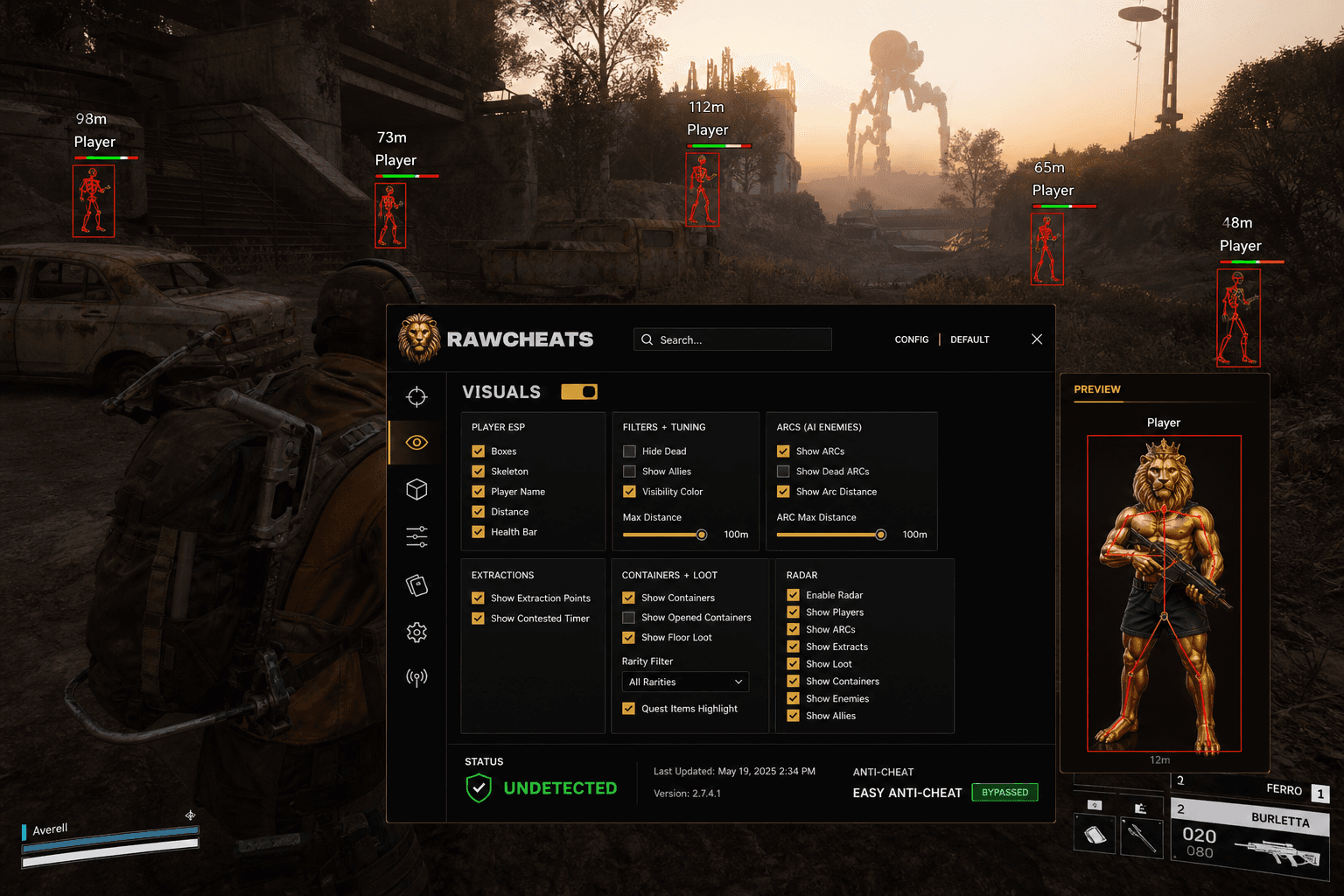
The four-layer Arc Raiders anti-cheat stack — EAC kernel, Anybrain ML behavioral analysis, Abnormal Match Compensation, plus the new kernel AC in testing.
Embark's May 7, 2026 Ensuring Fair Play dev blog confirmed something most cheat-vendor content still hasn't caught up with: Arc Raiders runs a four-layer anti-cheat stack, and only one of those layers is Easy Anti-Cheat. The other three — Anybrain's ML behavioral analysis, the Abnormal Match Compensation loot-return system, and a new kernel AC in active testing as of May 2026 — are what determine whether a cheat survives a session or eats a one-strike permaban. Combined with the late-February 2026 pivot from three-strike to one-strike (more on that elsewhere in the pillar), the practical consequence is that misunderstanding the stack costs you accounts you can't appeal back. Most blog posts you'll find describe Arc Raiders as "EAC-protected" and stop there. Here's the actual architecture running when you launch the game in May 2026.
This post is a cluster of the Arc Raiders Cheats Complete 2026 Guide pillar. The pillar covers the broader policy and market context; this piece goes deep on the technical anti-cheat architecture.
Layer 1 — Easy Anti-Cheat (EAC) kernel driver
EAC is the layer everyone talks about because it's the visible one. It's Epic's kernel-mode signature scanner, the same product that ships across Fortnite, Apex Legends, Rust, DayZ, Squad, Halo Infinite multiplayer, and dozens of other titles. The driver loads when you launch Arc Raiders, runs in ring 0, and scans process memory, loaded drivers, image regions, and a growing list of kernel memory pools.
What EAC does at runtime in Arc Raiders is exactly what it does in Fortnite (we covered the deep mechanics in How Fortnite Anti-Cheat Works): periodic memory scans against signature databases streamed from Epic's servers, kernel callbacks on process creation, thread creation, image loads, and handle operations against the Arc Raiders process. Hardware fingerprinting via SMBIOS reads, GPU device serial, RAM module IDs, monitor EDID, USB controller IDs, BIOS UUID, and TPM endorsement keys at session start. Anti-debug and anti-tamper self-validation.
The bypass techniques for EAC are well-understood by every commercial vendor in the field. This is the layer the cheap end of the market focuses exclusively on, and it's why so many sub-$10 Arc Raiders cheats survive a few hours and then die. EAC alone isn't what catches modern cheats. The next layer is.
Layer 2 — Anybrain ML behavioral analysis
Anybrain.gg is the external partner Embark has worked with since before Arc Raiders' launch for ML-driven behavioral cheat detection. Their models ingest a continuous stream of player input telemetry — mouse-movement curves, aim-velocity deltas, click-cadence patterns, headshot-rate distributions, and engagement-timing fingerprints — and flag patterns consistent with aimbot, triggerbot, or no-recoil even when the cheat itself isn't signature-detected by EAC.
This is the layer that catches well-built cheats. The reason is structural: Anybrain doesn't care what your cheat looks like in memory, it cares what your inputs look like statistically. You can have the cleanest external cheat in the world with zero EAC-detectable signatures, but if your mouse-movement curves show machine-perfect interpolation, your headshot rate sits at 70%+ across hundreds of engagements, or your reaction times have inhumanly tight variance, Anybrain flags you.
The model categories that matter:
- Angular-velocity profile. Real player flicks have a characteristic acceleration-and-overshoot curve. Pure interpolation produces cleaner curves that read as machine-generated.
- Headshot rate distribution. Real-player headshot percentages vary engagement to engagement. Sustained 70%+ across hundreds of fights is a statistical outlier.
- Reaction-time consistency. Humans have variable reaction times — 180ms one engagement, 240ms the next. Cheats with fixed reaction delays produce suspiciously tight distributions.
- Click cadence. Real fire patterns include occasional missed clicks, double-taps that aren't both intentional, and trigger-pull variance. Bot-perfect cadence registers.
- Pre-fire timing. Time between "enemy crosses your line of sight" and "first shot fired" is a Layer 2 signal. Wallhack-aware aim that fires too quickly post-peek flags.
Defending against Anybrain requires humanization, not signature evasion. Aim curves smoothed in the 200-400 range (not the 0-50 max-aggro range), randomized per-engagement reaction timing within ±15-30ms, capped headshot rate output, and visible-only filtering. The conservative-tuning baseline that Raw Arc Raiders ships with by default is specifically constructed to keep your input distribution inside human-plausible bounds.
Layer 3 — Abnormal Match Compensation
This is the layer almost no other publisher has. When EAC + Anybrain confirm a cheater post-match, the Abnormal Match Compensation system automatically mails stolen loot back to victims. If you raided someone, killed them, and stripped their backpack — and the system flags you within the post-match analysis window — the gear gets returned to the people you stole it from. They get a mail in-game with the recovered items.
From a cheater's perspective, this doesn't directly affect you: you still get permabanned, the system just also undoes the in-game harm. From Embark's perspective it's a brilliant design choice — it means cheat detection doesn't leave a long tail of upset legitimate players who lost gear. Less anti-cheat pressure from the playerbase means Embark gets to ramp enforcement at a measured pace rather than under acute community pressure.
The structural implication for cheaters: Abnormal Match Compensation makes your in-game contributions to the cheat ecosystem net-zero. Even if you successfully raid 50 players before detection, those raids don't actually transfer value to you because the system reverses them. The only thing left is your account, your hardware, and your other EAC-game library — all of which the next layer can take.
Layer 4 — The new kernel-level AC in testing (May 2026)
The May 7, 2026 Ensuring Fair Play dev blog confirmed that Embark is testing a new kernel-level anti-cheat alongside EAC. They haven't named the vendor, haven't published a deployment timeline, and haven't specified the technical scope. Embark described it as designed to "sharpen both detection and precision throughout Speranza and the Rust Belt."
A reverse-engineering YouTube video circulating in May 2026 ("ARC Raiders Anti-Cheat Architecture Isn't What You Think") suggests there are undisclosed proprietary layers Embark won't comment on. GamesRadar's May 2026 coverage corroborates the new-kernel-AC angle. The deployment timeline is unconfirmed but the smart money is on a Q3 2026 rollout — meaning vendors who aren't actively engineering for it will start failing by autumn.
The buyer-side implication: a cheat that only handles EAC's signature scanner gets caught by Anybrain today. A cheat that handles EAC + Anybrain humanization survives today, but when Layer 4 deploys it'll need additional bypass infrastructure. The vendors who survive the Layer 4 rollout are the ones doing in-house engineering — reseller storefronts that buy their bypass from upstream suppliers pivot too slowly to keep up. We covered this dynamic in the pillar's section on choosing a provider; the seven-test rubric explicitly flags vendors whose roadmap doesn't mention Layer 4.
Why kernel anti-cheats are described as rootkits — and why it doesn't matter
The same academic context applies to EAC on Arc Raiders that applies on every other EAC title. The ACM paper If It Looks Like a Rootkit and Deceives Like a Rootkit analyzes kernel anti-cheats and concludes they operate as rootkits by every technical measure — kernel-level code execution, hiding from user-mode tools, monitoring everything. That's literally what a rootkit is.
The point isn't that EAC is malicious. It's that cheats also operate at ring 0, so the anti-cheat has to operate at ring 0 to detect them. The kernel-vs-kernel war is structural. The University of Birmingham 80-cheat-site market study reached the same conclusion: every "undetected" claim has a timestamp. The question is how short the detection window is.
For Arc Raiders specifically, the detection windows in 2026 look like this:
- Free public cheats from GitHub: 4-12 hours.
- Mid-tier paid cheats with EAC bypass only: days to a few weeks.
- Top-tier cheats with EAC + Anybrain humanization: months to indefinite, assuming conservative tuning.
The vendors who survive long-term aren't the ones with the cleverest single bypass. They're the ones with multi-layered infrastructure that treats bypass as a moving target — which is exactly the positioning Raw Arc Raiders ships with.
What this means for buyers
The four-layer architecture translates into specific tests when you're shopping. Most of these overlap with the seven-test rubric in the pillar but the technical framing matters:
- Does the vendor address Anybrain explicitly, or just EAC? A vendor pitching "EAC bypass" without mentioning behavioral evasion is half-equipped. Anybrain catches well-built cheats independently of EAC.
- Is the cheat external or internal? External cheats are harder for EAC's kernel scanner to detect because the scanner can't sweep memory regions it doesn't own. Internal cheats need additional anti-detection infrastructure on top.
- Does the cheat ship with humanization by default? Smoothness in the 200-400 range and randomized reaction timing should be the shipped defaults, not options buried in advanced settings.
- Is HWID spoofing bundled or upsold cleanly? Layer 3 (and EAC's hardware fingerprint specifically) means a single Arc Raiders ban cascades across every other EAC-protected game on your hardware. We covered the spoofer side in the Arc Raiders HWID Spoofer Cross-EAC Warning cluster. Always pair the cheat with Raw Spoofer.
- What's the vendor's response posture for Layer 4? Embark's May 7, 2026 announcement is a known incoming change. A vendor without an active-engineering response plan is shipping a product with an expiry date.
Frequently asked questions
Does Arc Raiders use BattlEye? No. Arc Raiders runs EAC exclusively as its kernel-mode signature scanner. BattlEye does not have any role in Arc Raiders. Vendors who claim to "bypass BattlEye on Arc Raiders" are either misinformed or copy-pasting boilerplate from other games.
Is Anybrain detectable as a process or service on my PC? No. Anybrain is server-side. The behavioral analysis runs on Embark's infrastructure using telemetry pushed from the game client. There's nothing on your local machine you can disable or interfere with.
Can I run Arc Raiders in a VM to evade detection? No. EAC fingerprints VM environments via CPUID anomalies, timing inconsistencies, and known hypervisor artifacts. VM-based Arc Raiders cheating is not viable in 2026.
What's the difference between EAC's hardware ban and Embark's account ban? Account bans are linked to your Embark / Steam credentials and can be appealed (manual human review per Embark's Ban Policy FAQ). HWID bans are linked to your hardware fingerprint, are non-appealable per Embark's Hardware Banning FAQ, and propagate across every EAC-protected game on the same hardware.
Will Layer 4 detect cheats that currently survive EAC + Anybrain? We don't know yet — Embark hasn't published technical details, the deployment date isn't confirmed, and the new vendor hasn't been named. The honest answer is that any vendor claiming Layer 4 immunity ahead of deployment is overpromising. Continuously evolving anti-detection infrastructure is the only defensible positioning until the rollout details are public.
How fast does Anybrain detect a cheater compared to EAC? Anybrain detection time depends on engagement volume. A cheater playing 4-6 hours per day with maxed settings typically flags within 24-72 hours. EAC signature detection on a known cheat is near-instant once the signature ships. Anybrain is the layer that catches private builds EAC has never seen.
Does Raw Arc Raiders disable any of the four layers? No. The cheat operates around the anti-cheat stack rather than trying to disable it. Disabling EAC at the kernel level requires unsigned-driver-load workarounds that themselves get detected. The viable architecture in 2026 is conservative behavioral profile + clean external memory access + HWID spoofing — which is exactly what Raw Arc Raiders plus Raw Spoofer ships.
Ready to play Arc Raiders under the actual four-layer stack? Raw Arc Raiders ships with conservative Anybrain-friendly defaults. Pair it with Raw Spoofer for cross-EAC HWID protection and check the Arc Raiders cheat status page before every session. For the broader market context — including the late-February 2026 one-strike pivot — start at the Arc Raiders Cheats Complete 2026 Guide pillar.