
PUBG Ban Wave History 2018-2026 — Full Timeline
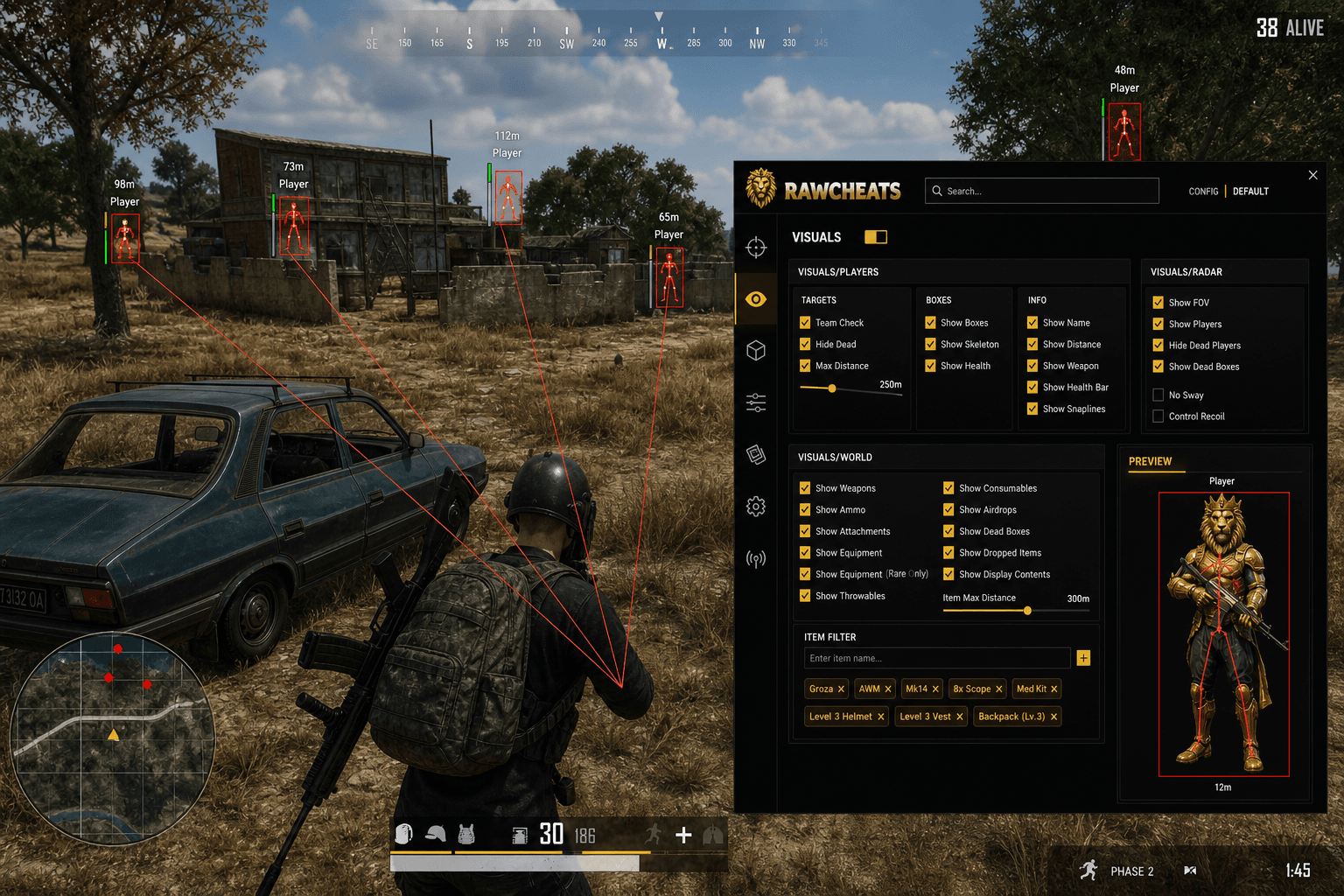
BattlEye 2018 rollout through the Feb 2026 No-Recoil wave. Every major PUBG ban wave with counts, sources, and what each one targeted.
Krafton publishes weekly ban notices, which makes PUBG's ban-wave catalog one of the best-documented enforcement histories in gaming. 7.81 million cumulative bans since PUBG launched in 2017. Approximately 260,000 DMA-specific permabans in 2025 alone. 45,000+ accounts in the Feb 23 - Mar 1, 2026 window targeted specifically at no-recoil scripts via the PUBG Weekly Bans Notice. If you're trying to understand where Krafton's enforcement is heading, the only way to do that responsibly is to map the full trajectory — every wave, every architecture change, every shift in what gets targeted. Here's that timeline.
This post is a cluster of the PUBG Cheats Complete 2026 Guide pillar. The pillar covered the current state at a high level. This piece is the full historical record back to BattlEye's 2018 rollout.
2017-2018 — Pre-BattlEye era and the rollout
2017 (PUBG launch). PUBG: Battlegrounds launched without a serious anti-cheat. The result was predictable — by mid-2017, ranked Asian servers were heavily saturated with aimbot and wallhack users. Krafton's response was reactive (manual bans, weekly notices) without a kernel-level enforcement mechanism.
Late 2017 — BattlEye integration begins. Krafton announced plans to integrate BattlEye. Industry reaction was mixed; PUBG was the largest player base BattlEye had ever onboarded.
April 2018 — BattlEye fully deployed in PUBG. The kernel anti-cheat went live across all PUBG servers. First-week impact: approximately 100,000 accounts banned (BattlEye's first signature-detection sweep against the existing pool of cheaters). This was the first "ban wave" in PUBG history at scale.
Throughout 2018. Weekly ban notices begin. Krafton commits to public transparency on enforcement actions — a practice that's continued ever since and produces the documented timeline that makes this post possible.
2019-2020 — DMA emergence and the cat-and-mouse stabilization
2019 — Public cheat market matures. The combination of BattlEye's signature scanning and Krafton's behavioral analysis pushed the cheap-cheat market off public Steam. Private cheats flourished; the "$15/month forum cheat" became the standard PUBG cheating purchase.
2020 — DMA hardware enters mainstream PUBG cheating. The cost of consumer-grade DMA hardware dropped (Xilinx 7-series FPGA cards became affordable). DMA users targeted PUBG specifically because the long-range engagement profile rewarded radar + ESP at distance — features DMA hardware delivers cleanly. Krafton begins formal investigation of DMA-specific detection methods.
Throughout 2019-2020. Weekly bans averaging 30,000-50,000 per month. Steady-state enforcement with periodic spikes around tournament season. No major architectural changes.
2021-2023 — Detection-rate erosion and BattlEye-only era
2021. Cheat market saturation continues. BattlEye's signature scanning catches the public-cheat tier reliably but private cheats and DMA users survive months at a time. The detection-time-to-ban gap widens.
2022. Krafton invests in server-side behavioral analytics. Statistical-outlier detection begins flagging accounts that pass BattlEye's signature scan but show machine-like aim patterns. Behavioral catches account for a growing share of bans but remain less visible in public ban notices than signature-catches.
2023 — DMA usage explodes in ranked Asian servers. Tournament-tier players report widespread DMA usage at top ranked tiers. Krafton's enforcement is acknowledged but the BattlEye-only architecture struggles to address kernel-DMA cheats that don't load code into the game process.
2024 — DMA formally bannable and anti-ESP optimizations
H1 2024. Krafton ships server-side player culling optimizations similar to what Rust would deploy in 2025. The culling reduces information available to ESP cheats — enemies outside line-of-sight aren't streamed to client memory, making wallhack ESP less informationally complete. Documented in Krafton's 2024 1H Dev Letter.
June 12, 2024 — DMA usage formally permabannable. Krafton's Rules of Conduct update explicitly lists DMA hardware as a bannable category. Source: PUBG Dev Letter at pubg.com/en/news/7584. This is the first time Krafton commits in writing that DMA detection is a priority and that DMA users face permabans, not just account-level actions.
Q3-Q4 2024. DMA-specific detection methodology developed. BattlEye's PCI configuration-space scan, which fingerprints Xilinx 7-series chip patterns, begins producing reliable DMA catches. Krafton issues approximately ~30,000 DMA-specific bans in late 2024.
2025 — Zakynthos launch and the architecture shift
August 2025 — Zakynthos kernel anti-cheat goes live. Krafton's proprietary kernel AC, built specifically for PUBG to address the gaps BattlEye doesn't cover. Per PCGamer's launch coverage, approximately 100,000 accounts banned in week 1 of Zakynthos operation. The signature design property — the Zakynthos kernel driver stays engaged independent of the service it nominally belongs to — was publicly confirmed by PUBG dev Alex on X (status 1470616237692833792). The architecture is the largest single change in PUBG anti-cheat since BattlEye's 2018 integration.
August 2025 (specific). ~30,000 DMA-specific bans in a single month, per esportsinsider.com. DMA detection ramped significantly post-Zakynthos because Zakynthos's kernel scans complement BattlEye's PCI signature work.
September 4, 2025 — DMA Hacks Update published. Krafton's public statement at pubg.com/en/news/9126 breaks down enforcement actions across multiple categories in a single multi-month window: 80,000+ DMA permabans, 50,000+ for AC bypass attempts, 50,000+ for recoil manipulation specifically. Total of approximately 180,000 enforcement actions in one disclosure.
October 2025 — 120,000+ banned in single sweep. Source: ingamenews.com. The largest single-window ban action of 2025.
Throughout 2025. Detection rates went from 30K/month (2024) to ~30K/week (early 2025) to ~100K/week (post-Zakynthos rollout in August). Annual totals: approximately 260,000 DMA-specific permabans, contributing to the cumulative 7.81 million all-time mark.
AI video review deployed. Krafton's machine-learning model for replay-video analysis began producing bans in mid-2025. ~39,000 bans through November 2025 are attributed specifically to AI video review per Krafton's transparency disclosures.
Voice chat NLP deployed. Server-side natural-language processing on voice comms identifies cheat-advertising and cheat-solicitation patterns. Krafton has had this running for approximately 12 months as of mid-2026.
2026 — The Feb wave and the roadmap publication
February 23 - March 1, 2026 — The Canonical No-Recoil Wave. 45,000+ accounts banned in a seven-day window. Daily average 6,400, peak 8,200. Detection distribution: aimbot 35%, wallhack/ESP 28%, radar 15%, no-recoil 12%. Source: PUBG Weekly Bans Notice at pubg.com/en/news/10059 plus the corresponding Dev Letter at pubg.com/en/news/9935.
The 12% no-recoil number is the headline. Historically PUBG was lenient on mouse-script no-recoil because the replay system didn't preserve sufficient input-stream fidelity to identify scripts vs skilled players. The Feb 2026 wave changed that — Krafton deployed "mouse script manipulation" detection that statistically analyzes input regularity across multiple engagements. Pixel-perfect inverse-recoil curves got flagged, including moderately-randomized scripts (±5% jitter) because the underlying mathematical signature was still detectable.
What got caught in the wave specifically:
- Static AHK scripts using published community macros for AKM, Beryl, M762.
- Logitech G-Hub macros (the entire G-Hub PUBG community got swept).
- Razer Synapse mouse-driver scripts.
- Public no-recoil tools sold on forum-tier marketplaces.
What survived:
- Dynamic recoil compensation integrated into proper cheat aim subsystems (the architecture Raw PUBG runs on).
- Tournament-tier private cheats with proper randomization.
Q1 2026 financial results. Krafton's Q1 2026 earnings cited anti-cheat investment as a customer-retention pillar (per Digitaltoday coverage). The Feb 2026 wave was timed with the financial-results cycle — Krafton telegraphing to investors that anti-cheat is a strategic priority.
March 25, 2026 — 2026 Anti-Cheat Roadmap published. pubg.com/en/news/9856 lays out five priorities for H2 2026:
- DMA enforcement remains priority #1.
- AI video review expansion to lower MMR brackets.
- Hardware re-entry blocks reinforced (the PUBG HWID spoofer cluster covers what this means in practice).
- False-ban review system H2 2026 (a formal appeal pathway for false positives).
- Region-specific enforcement (Asia-server focus).
The roadmap is the most explicit public commitment Krafton has made to anti-cheat direction. The Notebookcheck analysis covers the broader implications.
April 27 - May 3, 2026 — Most recent weekly notice as of writing. Source: pubg.com/en/news/10059 (the same weekly-notice URL Krafton updates). Detection rates have stabilized post-Feb wave at approximately 90-100K/week.
Cumulative totals and what they mean
7.81 million cumulative cheater bans since PUBG launched in December 2017. Per Krafton's 2026 Anti-Cheat Roadmap, this number reflects all-time enforcement actions across the platform.
The compounding rate:
- 2017-2020 era: approximately 50,000/month average.
- 2021-2024 era: approximately 130,000/month average.
- 2025 era: approximately 400,000/month average (post-Zakynthos).
- 2026 to date: tracking ~400-450,000/month based on weekly notices.
The detection-rate trajectory is monotonically up. Every year produces more bans than the prior year despite cheat-vendor anti-detection investment matching it. The implication for cheat buyers: the safety margin on PUBG cheating has compressed dramatically across this period. What survived a quarter in 2020 survives weeks in 2026.
What waves to expect H2 2026
Based on the roadmap and historical patterns:
- DMA-targeted wave (Q3 2026). Expected based on the roadmap's #1 priority. Probably 50-100K accounts.
- Hardware re-entry block enforcement wave (H2 2026). Expected to catch banned-account hardware reusers who have not properly spoofed.
- AI video review expansion bans (continuous through 2026). Lower MMR brackets see increased catches as the model coverage extends.
- False-ban review rollout (H2 2026). Not a ban wave, but a process change — legitimate players who were false-positive banned may see appeal capacity.
The asymmetric risk: nothing in the roadmap suggests Krafton's enforcement is slowing. The opposite — every public signal is escalation.
FAQ
What was the biggest single-wave ban in PUBG history? The October 2025 sweep at 120,000+ accounts in a single window. The August 2025 Zakynthos-launch week may have exceeded that at ~100,000, depending on how Krafton counts.
Why did the Feb 2026 wave matter so much if it was "only" 45,000? Because of what it targeted. No-recoil scripts had survived seven years of BattlEye. The Feb 2026 wave was the first time Krafton's detection caught mouse-script no-recoil at scale. The architectural implication — Krafton can now do this reliably going forward — is the news, not the raw number.
Where do the weekly ban numbers come from? Krafton publishes them weekly at the PUBG news section, specifically the Weekly Bans Notice pages. The numbers are first-party from Krafton; they're as reliable as Krafton's transparency program.
Has Krafton ever undone a ban wave? Rarely. The H2 2026 false-ban review system is the first formal appeal pathway for false positives. Historical bans have been irreversible.
Did Zakynthos replace BattlEye? No. The two coexist. BattlEye continues to run; Zakynthos adds a second kernel layer. See the How PUBG anti-cheat works cluster for the technical breakdown.
How does PUBG's ban-wave cadence compare to Fortnite's? Fortnite's EAC bans more reactively (driven by individual ban events plus FNCS-tier replay review). Krafton bans on a weekly schedule with public disclosure. The cadence is different; the cumulative volumes (PUBG 7.81M, Fortnite undisclosed but much smaller) suggest PUBG bans at higher absolute volume.
Going forward
This timeline updates as new waves happen. The PUBG cheat status page tracks Raw PUBG's specific status across waves. The How PUBG anti-cheat works cluster covers the architecture that produced this enforcement history. For the broader context, PUBG Cheats Complete 2026 Guide.
Raw PUBG has held through every wave catalogued above; Raw Spoofer covers the hardware-fingerprint surface Krafton's re-entry blocks check.